

News

Miro: A New Standard in Responsible Innovation

Miro: A New Standard in Responsible Innovation The Miro monitor arm is setting new benchmarks in sustainability. It offers a high-performance solution without compromising on environmental responsibility. Designed with careful material selection, local sourcing, and longevity in mind, Miro’s responsible approach to design and unique manoeuvrability set it apart from the competition. Sustainable Choices Miro is crafted from energy-efficient materials with a lower carbon impact....

Read more
HSE Advisor

Role Purpose Support in the development, implementation and maintenance of the company’s Health, Safety & Environmental policies, processes, operational procedures, and standards.  Ensuring best practice and championing a continually improving HSE culture within the business. Key Responsibilities Liaise with and provide support to all areas of the business to eliminate, mitigate or reduce identified HSE exposures. Partner with the production management team and team leaders,...

Read more
CMD Ltd LAUNCHES 48-HOUR TURNAROUND ON BETATRAK® RAPID ORDERING SERVICE

CMD Ltd, the specialist in power distribution systems, workstation power and monitor arms, has launched a rapid ordering service for its Betatrak® underfloor powertrack distribution systems and accessories, with a commitment to delivering within 48-hours of an approved purchase order*. The service enables customers to order up to 50 lengths of Standard or Clean Earth (C/E) low noise Betatrak, along with up to 25 feed...

Read more

CMD INVESTS £1/4 MILLION IN NEW MACHINE AS PART OF FACTORY UPGRADE

We have invested in a new £1/4m TRUMPF CNC metal punch as part of an asset renewal strategy for our UK manufacturing capability. The new machine will be used in the production of a wide variety of our power distribution systems and workstation power products at our Rotherham factory. Suitable for handling sheet metal between 0.9mm and 3.0mm thick, the new machine will replace one...

Read more

CMD CATALOGUE PROVIDES TECHNICAL POWER DISTRIBUTION GUIDE

CMD Ltd has released a new catalogue, providing an easy to follow technical guide to our power distribution systems and plug and play desk modules. Detailing CMD’s full range of UK-manufactured power distribution systems and plug and play desk modules, the catalogue will be a helpful source of information to M&E engineers and contractors alike to understand how our power distribution systems connect together and...

Read more

Power Distribution Catalogue
CMD Ltd PLAYS ESSENTIAL ROLE IN ELECTRICAL FIT OUT AT LONDON’S PRESTIGIOUS OFFICE DEVELOPMENT

CMD Ltd, specialist in workplace connectivity and ergonomic solutions, has provided a flexible and high-quality power distribution network for The Ray, a prestigious office development in London’s Farringdon. Well-known for being the former site of The Guardian newspaper, The Ray now stands as an 83,000ft² office development characterised by a modernised warehouse aesthetic, with level two now occupied by a global social media company. The...

Read more

The Ray
CMD plugs in to european opportunity with Schuko Capsule unit launch

CMD Ltd, the specialist in power and connectivity solutions for commercial environments, has launched a Schuko version of its popular fixed format Capsule workstation power module for export to mainland Europe and beyond. A popular on desk power module comprising two sockets and dual USB (type A and C) chargers, CMD’s Capsule unit is already widely specified in the UK as an off-the-shelf workstation power...

Read more

CMD White Schuko Capsule Desk Power Module
CMD LTD EXTENDS MONITOR ARM RANGE WITH THE LAUNCH OF REACH PLUS

CMD Ltd, the specialist in ergonomic and connectivity solutions for commercial interiors, has completed its Reach monitor arm range with the launch of the Reach Plus. Available in single or dual screen options, the Reach Plus has been designed to provide an ideal solution for both single and dual screen workstation configurations, or can be used with next generation of large format curved screens. Suitable...

Read more

CMD Ltd DEMONSTRATES THE ART OF POWER DISTRIBUTION AT THE UNIVERSITY OF WARWICK

CMD Ltd, the specialist in workplace connectivity and ergonomic solutions, has provided Betatrak busbar power distribution and a range of electrical accessories for two major capital investment projects at the University of Warwick. Designed by Fielden Clegg Bradley Studios, the £33 million Faculty of Arts building is a showpiece development comprising four interconnected structures set around a central atrium, which will enable inter-disciplinary collaboration across...

Read more

University of Warwick
CMD BRINGS HARMONY TO COVENTRY UNIVERSITY RESEARCH FACILITIES

CMD Ltd, the specialist in power distribution solutions and workstation power and ergonomics, has provided under desk and on desk power modules for the refurbishment of three Coventry University research buildings. Located on Coventry University Technology Park, a business park designed to encourage collaboration between the university and knowledge-based businesses, the three buildings are being repurposed as office accommodation for university research teams. The refurbishment...

Read more

Coventry University

Why Are Temperature Sensors Important?

Temperature Sensors turn heat into information people and machines can use. A thermostat relies on a sensor to decide when a room needs heating. A refrigerator uses one to help keep food within a stable range. In a motor, a rising temperature reading can signal friction, excess load, or poor ventilation. These measurements may seem ordinary. Their consequences are not.

Different sensors suit different conditions. Thermistors respond quickly to temperature changes, while resistance temperature detectors can offer stable, repeatable readings. Thermocouples are useful across broad temperature ranges. But no sensor is automatically accurate in every setup. Placement, wiring, response time, and regular calibration all affect the result. A probe mounted beside a hot pipe may not represent the temperature of the liquid inside it. That detail is easy to overlook.

Understanding why temperature measurement matters helps engineers, technicians, and everyday users make better decisions. Reliable readings can support safer equipment operation, consistent product quality, comfortable buildings, and efficient energy use. They can also prevent unnecessary alarms or adjustments when a measurement is misleading. Still, a sensor cannot explain every cause behind a changing reading. People must interpret the data in context, check the installation, and question results that do not fit the situation. That human step is sometimes imperfect, but it matters. This article explores how Temperature Sensors work, where they are used, and what makes their readings trustworthy.

Why Are Temperature Sensors Important?

How Temperature Sensors Convert Thermal Changes into Measurable Signals

A temperature sensor turns thermal change into an electrical signal that a meter or control system can read. The method depends on the sensor type. In a thermistor, resistance changes as temperature shifts; many common types show lower resistance as they warm. A resistance temperature detector uses a metal element whose resistance varies predictably with heat. A thermocouple works differently. Two joined metals produce a small voltage related to the temperature difference between the junction and a reference point. That distinction matters.

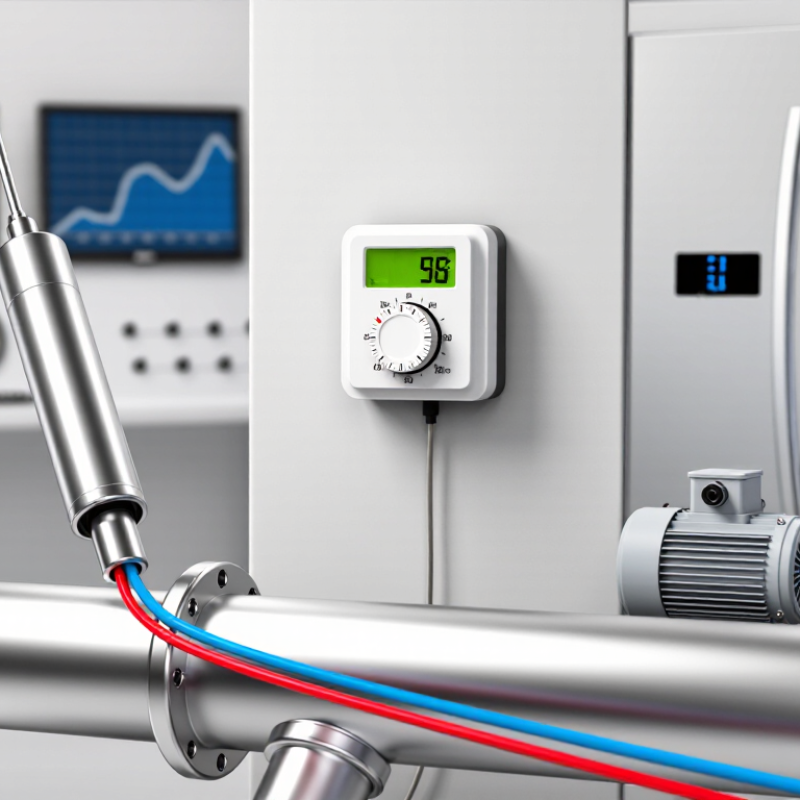
The signal may be tiny or nonlinear, so equipment often needs amplification, conversion, and calibration before displaying a useful temperature. For example, a probe attached to a warm pipe might send a changing resistance to a circuit, which converts it into a digital reading. Even a small air gap or loose contact can distort that reading. A precise sensor can still give a poor result when installed badly. Datasheet accuracy is reassuring, but real setups can be messier. Calibration helps, though it cannot fix every placement error. Temperature measurements depend on both the sensing element and how its signal is collected.

IEC 60751 Class A Pt100 Tolerance: ±(0.15 + 0.002|t|)°C

A Pt100 converts temperature into electrical resistance, but its reading is only as trustworthy as its tolerance and measurement setup. IEC 60751:2022 gives Class A the tolerance ±(0.15 + 0.002|t|)°C, where t is temperature in degrees Celsius. At 0°C, the allowed deviation is ±0.15°C; at 100°C, it is ±0.35°C. At 200°C, it reaches ±0.55°C. The tolerance grows with distance from zero. Small detail, real consequence.

Picture a sensor checking a heated pipe near 100°C. A Class A element may differ from the true temperature by 0.35°C before wiring, instrument accuracy, installation, or calibration effects are considered. IEC 60751’s figures describe the sensor’s permissible deviation, not the complete uncertainty of the installed measurement system. That distinction is easy to miss. A long cable, poor thermal contact, or a loose terminal can add error. For critical process control, engineers should check the full measurement chain and operating range, then calibrate the assembled system when needed. The standard gives a useful benchmark, though field conditions can still surprise you.

Functional Safety: IEC 61508 Defines Four Safety Integrity Levels (SIL 1–4)

Temperature hazards often begin as small changes. A bearing warms by a few degrees, or a vessel wall heats unevenly. A temperature sensor can detect these changes and feed a safety function that raises an alarm or stops equipment.

IEC 61508 defines four Safety Integrity Levels, from SIL 1 to SIL 4. Higher levels require greater risk reduction. The required level comes from hazard and risk assessment, not from choosing the most powerful sensor. SIL applies to the complete safety function, including its sensor, logic, and final control element.

In practice, sensor response time, diagnostic coverage, failure rates, and proof testing all matter. A sensor inside a thermowell may respond more slowly than one exposed directly to the process. Cable damage or gradual drift can also affect readings. That detail matters. A component’s certificate alone does not establish that an installed safety function meets its target. Regular testing and careful maintenance help reveal hidden faults, though real operating conditions can still complicate the picture. A stable display is reassuring, but it is not proof that the measurement is correct.

Vaccine Storage: WHO Guidance Keeps Many Vaccines at +2°C to +8°C

For many vaccines, the recommended refrigerator range is +2°C to +8°C. WHO guidance supports this range for many routine vaccines, but it is not universal. Storage requirements can differ by vaccine, so staff should check its official instructions and local procedures. A few degrees matter. Freezing can damage some vaccines, while excessive heat can reduce their potency.

A reliable temperature sensor helps staff see what a refrigerator is actually doing, not just what its display claims. Place the probe where vaccines are stored, away from walls, cooling plates, and the door. Use a calibrated device that records readings over time and signals when temperatures leave the approved range. A morning reading alone can miss an overnight problem. The small details matter.

When an alarm sounds, staff should record the time and temperature, keep affected stock separate, and seek guidance before using or discarding it. A sensor cannot correct a loose door seal or a refrigerator packed too tightly. Nor can it replace routine checks. This is where real practice gets messy: alarms may be overlooked, and records may be incomplete. Regular review of temperature logs can reveal patterns, such as repeated warming after deliveries, before more doses are affected.

Why Are Temperature Sensors Important?

Vaccine storage: WHO guidance commonly recommends keeping many vaccines between +2°C and +8°C. Temperature sensors help staff monitor conditions and identify readings outside this range.

The chart shows the recommended range boundaries. The 5°C midpoint is calculated for illustration; it is not a separate WHO storage requirement. Always follow the specific vaccine’s product information and applicable guidance.

Food Safety: FDA Food Code Sets Cold Holding at 5°C (41°F) or Below

Cold holding is a quiet but essential part of food safety. The FDA Food Code calls for time/temperature control for safety foods to be held at 5°C (41°F) or below. Local requirements can vary, since jurisdictions adopt and enforce food codes. Small shifts matter. A cooler display may read 4°C while a pan near the door has warmed during repeated opening.

Temperature sensors help staff spot those differences before food spends too long outside safe limits. Place a probe between packages or into the food, rather than relying only on the air reading. For a quick check, a clean, calibrated probe thermometer can reveal whether the center of a container is still cold. Record readings at consistent times, and check again after restocking or a power interruption.

A sensor is only as useful as its placement and upkeep. Dust, damaged cables, or a probe pressed against a cold wall can produce misleading readings. Logs can look reassuring even when checks are rushed; that’s an imperfect reality worth reviewing. If a reading is above 5°C, follow your food-safety procedure, assess how long the food has been warm, and document the action taken. Calibration checks and clear records make small problems easier to catch.