Top 10 Types of Robo Safety Fence for Global Buyers?
Industrial robots are no longer confined to large automotive plants. The International Federation of Robotics reported 541,302 industrial robot installations worldwide in 2023, with more than 4.28 million robots operating globally. As automation expands, physical safeguarding becomes a practical purchasing decision, not a decorative upgrade.
This guide examines the Top 10 Types of Robo Safety Fence for Global Buyers. It compares welded mesh panels, wire partitions, polycarbonate screens, aluminum-profile systems, modular barriers, retractable fences, sliding-door enclosures, hinged-door systems, light-curtain integrations, and collaborative-robot guarding. Each option affects visibility, access control, installation time, cleaning, maintenance, and future cell expansion. A two-meter mesh panel may protect a stamping cell, while a clear polycarbonate section can help operators observe a robot arm without entering the hazard zone.
The Association for Advancing Automation has repeatedly highlighted how robotics changes human work. Its president, Jeff Burnstein, said, “Robots are not replacing people; they are changing the way people work.” That idea matters here, although it is incomplete without discussing separation distances, interlocked access, and risk assessment. ISO 10218 and ISO 14120 provide important reference points, while regional requirements may differ. Buyers should verify every design with a competent safety professional.
Small details matter. A poorly positioned gate can create a tempting shortcut. A weak anchor can undermine an otherwise strong enclosure. Price alone is not enough. This comparison offers a useful starting point, but no fence is automatically safe for every robot cell.
What Is a Robo Safety Fence and How Does It Protect Industrial Robots?
A robo safety fence is a physical barrier around an industrial robot and its operating zone. It separates moving equipment from workers, visitors, and nearby production areas. The fence usually includes welded mesh panels, solid polycarbonate screens, modular aluminum sections, or reinforced steel frames. Each type supports different needs, such as visibility, impact resistance, space efficiency, and maintenance access.
Protection begins with controlled access. Interlocked gates can stop robot motion when opened, while monitored doors help prevent unexpected entry. Some systems also combine fences with light curtains, safety scanners, and emergency stop controls. The barrier does not make a robot harmless. It creates distance and supports a carefully designed safety system. A poorly positioned panel may leave a reachable opening. A small gap can matter.
In practical installations, I check the robot’s full reach, tooling movement, transfer points, and maintenance routes before selecting a fence type. The enclosure should resist foreseeable impact without blocking essential visibility. Anchoring, gate alignment, and inspection access also deserve attention. These details are often underestimated. A fence can look strong yet fail to control access during servicing. Risk assessments, manufacturer instructions, worker training, and applicable local safety requirements should guide the final design. Requirements may vary between countries and applications.
Top 10 Types of Robo Safety Fence for Global Buyers
What Is a Robo Safety Fence and How Does It Protect Industrial Robots?
A robo safety fence is a physical safeguarding system that separates industrial robots from people, tools, and surrounding equipment. The chart compares ten commonly used fence configurations by representative panel height used in industrial robot cells. Actual dimensions depend on robot reach, hazardous motion, access requirements, visibility needs, and the site risk assessment. Fence design should be validated against applicable machinery-safety requirements, including ISO 14120 and ISO 13857.
Top 10 Robo Safety Fence Types by Structure, Material, and Application
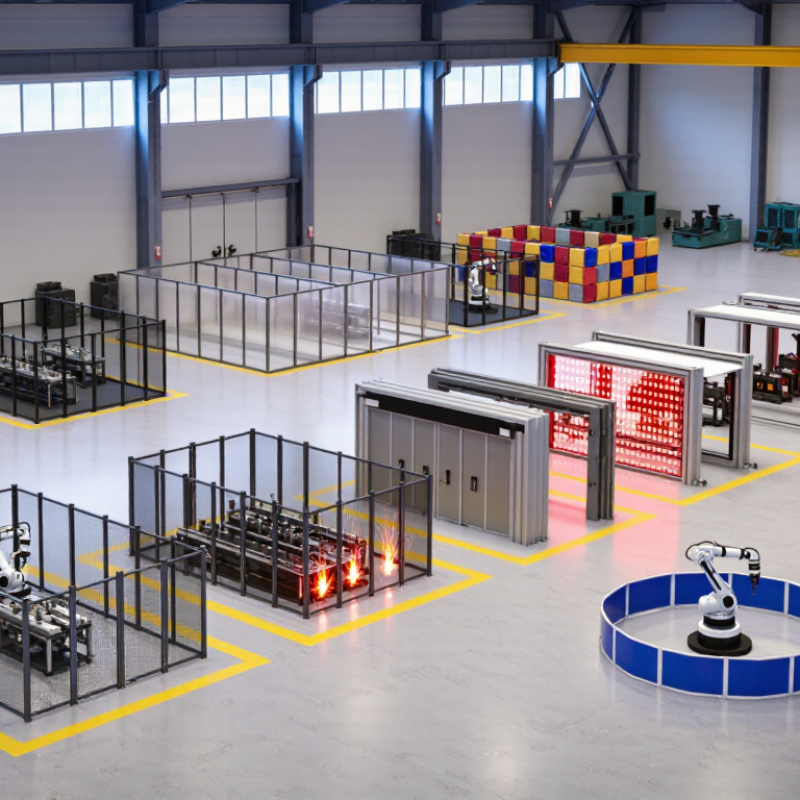
Robo safety fences vary by structure, material, and application. Welded mesh panels suit fixed robot cells because they resist impact and provide clear visibility. Wire mesh fencing is lighter and easier to reposition around changing production lines. Modular panel systems support fast installation, though their joints need careful inspection. Sliding gates save floor space, while hinged gates work well where access is occasional. Telescopic barriers can protect temporary work zones.
Visibility matters.
Material selection changes long-term performance. Powder-coated steel handles demanding factory environments and frequent cleaning. Stainless steel fits wet or corrosive areas, such as food or chemical processing zones. Aluminum offers lower weight for mobile guarding, but it may need stronger framing near high-energy robots. Polycarbonate panels provide a solid visual barrier and contain small fragments. Mixed mesh-and-panel designs balance airflow, visibility, and containment.
Space is limited.
Application should guide the final choice. Palletizing cells often need tall, impact-resistant fencing and controlled loading gates. Welding areas may require opaque or screened sections to reduce harmful light exposure. Collaborative robot zones still need defined boundaries for tools, materials, and unexpected movement. I have seen teams focus on the fence panel and overlook gate alignment. That mistake creates practical risk. Check weak points, including gaps, hinges, anchors, and access controls. A competent installer should verify reach distances, emergency access, visibility, and maintenance needs against applicable local requirements. No fence choice is perfect; production changes can make a once-suitable design inadequate.
How to Compare Fence Height, Mesh, Access, and Visibility Features
For global buyers, a robotic safety fence should be compared as a working system, not a steel rectangle. Ten common designs include welded mesh panels, woven mesh, solid screens, modular frames, sliding-door enclosures, swing-gate cells, perimeter barriers, ceiling-height cages, compact machine guards, and guarded transfer openings. Each type changes installation effort, inspection access, and operator awareness. Start with the robot’s maximum reach, tooling, payload, and movement envelope. Add space for maintenance, not just production. A fence that fits today may become restrictive after one upgrade. That mistake is common.
Fence height should exceed reachable hazards, including an arm lifted through an opening. Use the risk assessment and safety distances as the baseline, rather than a convenient standard size. Mesh spacing matters too. Small openings can stop fingers, while larger openings may allow hands or tools to enter. Measure from the nearest hazard, not from the panel edge. Fine mesh improves containment, but it can collect dust and reduce airflow. Check cleaning access and lighting. Visibility should let operators see the robot, status lights, and trapped-person areas without leaning into the cell. Transparent panels offer clearer viewing, but scratches and glare can weaken that advantage.
Access design deserves equal attention. A hinged gate may suit frequent loading; a sliding gate can save aisle space. Doors should be interlocked and monitored, with emergency release from inside where the risk assessment requires it. Transfer openings need guarded geometry, not a gap that invites reaching. In practice, buyers often compare price before access cycles. That is backwards. Record door frequency, cleaning routines, and maintenance tasks before choosing. I would also test visibility under real factory lighting. A design can look excellent in a drawing and fail beside reflective floors. Leave room for doubt, then verify the finished installation against the approved risk assessment and applicable local requirements.
How Can Buyers Select, Install, and Maintain the Right Fence?
When selecting a robot safety fence, match the barrier to the cell, not just the robot. Common options include welded mesh, modular panels, polycarbonate screens, aluminum frames, and steel partitions. Mesh improves visibility, while solid panels control sparks, dust, or flying fragments. Measure the robot’s full reach, including tools and payloads. Leave no reachable gap near conveyors, corners, or transfer points. A qualified safety engineer should verify stopping distances and access controls against local requirements.
Installation quality matters as much as fence strength. Anchor posts to a level, durable floor, then check every joint for movement. Gates should open outward when practical and include monitored safety switches. Keep switches protected from accidental impact. The fence must not create new trip hazards. I have seen well-designed barriers weakened by loose floor anchors and poorly aligned doors. Small errors become serious during repeated production cycles.
Maintenance needs a written inspection routine. Check mesh, fasteners, hinges, switches, warning labels, and floor anchors at defined intervals. Test each gate with the machine stopped, not running. Remove temporary openings immediately after maintenance work. Record defects with photographs and repair dates. A perfect fence rarely exists. Dust, vibration, and layout changes can expose weaknesses later. Buyers should reserve space for future equipment, but avoid oversized barriers that obstruct visibility and emergency access. Good selection is practical, documented, and willing to be revised.