

News

Miro: A New Standard in Responsible Innovation

Miro: A New Standard in Responsible Innovation The Miro monitor arm is setting new benchmarks in sustainability. It offers a high-performance solution without compromising on environmental responsibility. Designed with careful material selection, local sourcing, and longevity in mind, Miro’s responsible approach to design and unique manoeuvrability set it apart from the competition. Sustainable Choices Miro is crafted from energy-efficient materials with a lower carbon impact....

Read more
HSE Advisor

Role Purpose Support in the development, implementation and maintenance of the company’s Health, Safety & Environmental policies, processes, operational procedures, and standards.  Ensuring best practice and championing a continually improving HSE culture within the business. Key Responsibilities Liaise with and provide support to all areas of the business to eliminate, mitigate or reduce identified HSE exposures. Partner with the production management team and team leaders,...

Read more
CMD Ltd LAUNCHES 48-HOUR TURNAROUND ON BETATRAK® RAPID ORDERING SERVICE

CMD Ltd, the specialist in power distribution systems, workstation power and monitor arms, has launched a rapid ordering service for its Betatrak® underfloor powertrack distribution systems and accessories, with a commitment to delivering within 48-hours of an approved purchase order*. The service enables customers to order up to 50 lengths of Standard or Clean Earth (C/E) low noise Betatrak, along with up to 25 feed...

Read more

CMD INVESTS £1/4 MILLION IN NEW MACHINE AS PART OF FACTORY UPGRADE

We have invested in a new £1/4m TRUMPF CNC metal punch as part of an asset renewal strategy for our UK manufacturing capability. The new machine will be used in the production of a wide variety of our power distribution systems and workstation power products at our Rotherham factory. Suitable for handling sheet metal between 0.9mm and 3.0mm thick, the new machine will replace one...

Read more

CMD CATALOGUE PROVIDES TECHNICAL POWER DISTRIBUTION GUIDE

CMD Ltd has released a new catalogue, providing an easy to follow technical guide to our power distribution systems and plug and play desk modules. Detailing CMD’s full range of UK-manufactured power distribution systems and plug and play desk modules, the catalogue will be a helpful source of information to M&E engineers and contractors alike to understand how our power distribution systems connect together and...

Read more

Power Distribution Catalogue
CMD Ltd PLAYS ESSENTIAL ROLE IN ELECTRICAL FIT OUT AT LONDON’S PRESTIGIOUS OFFICE DEVELOPMENT

CMD Ltd, specialist in workplace connectivity and ergonomic solutions, has provided a flexible and high-quality power distribution network for The Ray, a prestigious office development in London’s Farringdon. Well-known for being the former site of The Guardian newspaper, The Ray now stands as an 83,000ft² office development characterised by a modernised warehouse aesthetic, with level two now occupied by a global social media company. The...

Read more

The Ray
CMD plugs in to european opportunity with Schuko Capsule unit launch

CMD Ltd, the specialist in power and connectivity solutions for commercial environments, has launched a Schuko version of its popular fixed format Capsule workstation power module for export to mainland Europe and beyond. A popular on desk power module comprising two sockets and dual USB (type A and C) chargers, CMD’s Capsule unit is already widely specified in the UK as an off-the-shelf workstation power...

Read more

CMD White Schuko Capsule Desk Power Module
CMD LTD EXTENDS MONITOR ARM RANGE WITH THE LAUNCH OF REACH PLUS

CMD Ltd, the specialist in ergonomic and connectivity solutions for commercial interiors, has completed its Reach monitor arm range with the launch of the Reach Plus. Available in single or dual screen options, the Reach Plus has been designed to provide an ideal solution for both single and dual screen workstation configurations, or can be used with next generation of large format curved screens. Suitable...

Read more

CMD Ltd DEMONSTRATES THE ART OF POWER DISTRIBUTION AT THE UNIVERSITY OF WARWICK

CMD Ltd, the specialist in workplace connectivity and ergonomic solutions, has provided Betatrak busbar power distribution and a range of electrical accessories for two major capital investment projects at the University of Warwick. Designed by Fielden Clegg Bradley Studios, the £33 million Faculty of Arts building is a showpiece development comprising four interconnected structures set around a central atrium, which will enable inter-disciplinary collaboration across...

Read more

University of Warwick
CMD BRINGS HARMONY TO COVENTRY UNIVERSITY RESEARCH FACILITIES

CMD Ltd, the specialist in power distribution solutions and workstation power and ergonomics, has provided under desk and on desk power modules for the refurbishment of three Coventry University research buildings. Located on Coventry University Technology Park, a business park designed to encourage collaboration between the university and knowledge-based businesses, the three buildings are being repurposed as office accommodation for university research teams. The refurbishment...

Read more

Coventry University

Top Industrial Mixing Machine Manufacturers in China?

China’s industrial mixing sector includes manufacturers serving chemicals, food, pharmaceuticals, coatings, and construction materials. Their catalogs may look similar, but the machines can behave very differently under real production conditions. A tank holding 1,000 liters of thin liquid is not the same challenge as a vessel handling thick paste, abrasive powder, or heat-sensitive ingredients. Small details matter.

Mixing researcher David S. Dickey has published extensively on mixing and processing. A practical takeaway from his work is: “Choose the mixer around the material and process, not the catalog photograph.” This is a paraphrase, not a verbatim quotation. It captures a point buyers can easily miss. A machine’s performance depends on viscosity, batch size, vessel geometry, required shear, and cleaning needs. A polished brochure cannot answer all of those questions.

This guide examines leading Industrial Mixing Machine manufacturers in China through practical selection criteria. It considers product range, customization, materials of construction, testing, documentation, and after-sales support. Buyers should ask for comparable test data and clarify what the quoted configuration includes. For example, does it cover the motor, control system, seals, and installation guidance? Those questions sound basic. They often prevent costly surprises. Manufacturer rankings also have limits: capabilities change, and a strong supplier for one process may be a poor fit for another. Verify claims directly, request references where possible, and judge each machine against your own production conditions. A little skepticism helps.

Top Industrial Mixing Machine Manufacturers in China?

Industrial Mixing Machines: Types, Functions, and Key Components

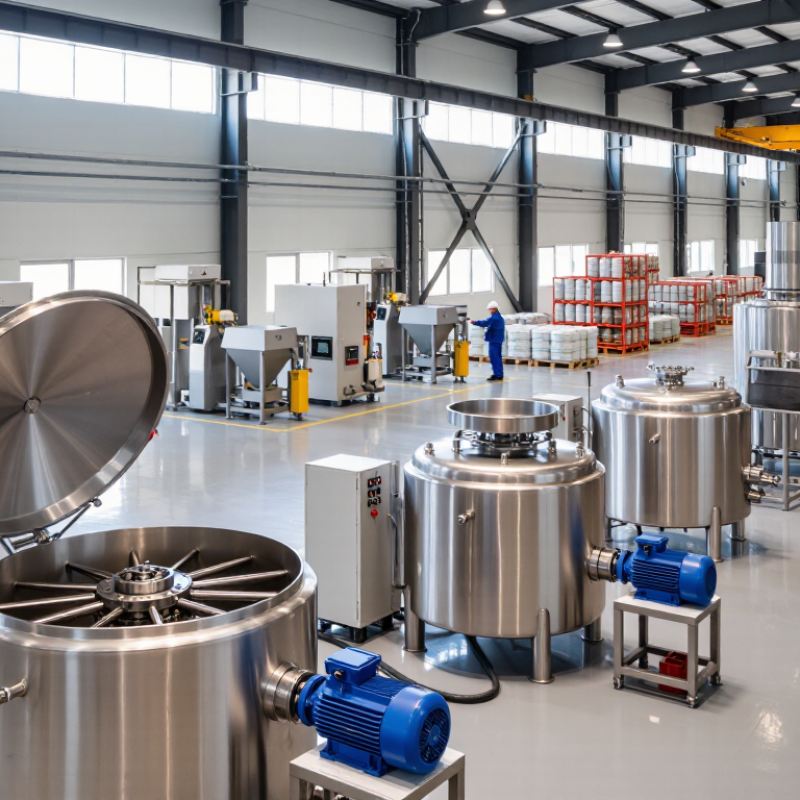
Industrial mixing machines combine liquids, powders, pastes, or suspended solids into a consistent batch. Common types include ribbon blenders for dry powders, paddle mixers for gentle blending, and high-shear mixers for dispersions and emulsions. Planetary mixers handle thick materials, such as sealants and dough, where ordinary impellers may struggle. Static mixers use fixed elements inside a pipe, so they suit continuous flow rather than batch processing. It sounds simple. In practice, viscosity, particle size, and batch volume can change the result.

Key components include a vessel, shaft, impeller, motor, gearbox, seals, and control system. Baffles help limit swirling in liquid tanks; seal condition matters when cleaning or product containment is important. Impeller shape affects circulation and shear, while variable-speed drives let operators adjust mixing intensity. The U.S. Department of Energy’s 2019 U.S. Industrial and Commercial Motor System Market Assessment reports that motor-driven systems account for about 69% of electricity use in U.S. manufacturing. That makes motor and drive selection relevant to operating costs, not just mixing speed. Yet a larger motor does not guarantee a better batch. Selection is rarely tidy: a design that works for one formulation may leave dead zones in another. Real-world trials still matter.

How to Assess Industrial Mixing Machine Manufacturers in China

When assessing industrial mixing machine manufacturers in China, begin with your process, not a catalogue. Specify batch size, viscosity, target mixing time, temperature range, and required uniformity. Ask whether the proposed machine has been tested with a material similar to yours. Request the test conditions and measured results, not only a video of a running mixer. Small details matter.

Energy use deserves attention. The U.S. Department of Energy’s 2014 report, Improving Motor and Drive System Performance, estimates that motor-driven systems account for about 68% of electricity use in U.S. manufacturing. The IEA’s Energy Efficiency 2023 report puts industry’s share at roughly 37% of global final energy consumption. These figures make motor efficiency, speed control, and power measurements practical assessment points. Still, a high-efficiency motor alone does not prove the whole mixing process is efficient. Paper specs can mislead.

During factory evaluation, inspect welds, shaft seals, vessel access, and the finish of product-contact surfaces. Ask for material certificates, inspection records, and a written factory acceptance test covering speed, temperature, power, and batch uniformity. For sticky or abrasive products, discuss cleaning time and wear parts using a real process sample. I would not trust a polished brochure alone. Compare the same test criteria across suppliers, and record any assumptions about product properties, output, and operating hours. Some details may only become clear during production, so leave room to verify them before final acceptance.

Top Industrial Mixing Machine Manufacturers in China? - How to Assess Industrial Mixing Machine Manufacturers in China
Assessment Dimension Recommended Weight What to Evaluate Evidence to Request or Verify
Process and Application Fit 20% Whether the proposed mixer suits the materials, batch size, viscosity, solids content, operating conditions, and required mixing result. Documented application review; written assumptions; references or test results using comparable materials, where available.
Engineering and Design Capability 15% Equipment configuration, mixing mechanism, vessel design, drive selection, controls, and ability to accommodate specified process requirements. Technical proposal, equipment drawings, key component specifications, and a clear list of included and excluded scope.
Materials and Fabrication Quality 15% Wetted-part material suitability, surface finish requirements, weld quality, corrosion considerations, and fabrication inspection practices. Material certificates where specified, inspection records, weld documentation where applicable, and agreed surface-finish details.
Testing and Acceptance 15% Whether inspection and factory acceptance testing (FAT) procedures are defined against the buyer’s agreed technical requirements. Written inspection and test plan, acceptance criteria, test records, and a list of checks to be completed before shipment.
Quality Management and Traceability 10% Consistency of quality controls, document management, nonconformance handling, and traceability of critical components. Quality-management-system certificate and its scope, if claimed; sample inspection documents; component and serial-number records.
Safety and Regulatory Documentation 10% Machine guarding, emergency-stop provisions, electrical documentation, and conformity requirements for the intended destination market. Risk assessment and safety documentation; applicable declarations and technical files. Verify that any claimed certification or marking applies to the supplied equipment and destination.
Service, Spare Parts, and Warranty 10% Availability of technical support, replacement parts, maintenance instructions, warranty terms, and response arrangements. Written warranty, spare-parts list, recommended maintenance schedule, support channels, and service response terms.
Commercial and Delivery Reliability 5% Clarity of price and scope, payment milestones, lead-time assumptions, packaging, shipping responsibilities, and change-control procedures. Itemized quotation, delivery schedule, Incoterms® rule and named place, packaging details, and written change-order process.
Total Recommended Weight 100% — Adjust the weighting to reflect project priorities and process risk.

Leading Chinese Manufacturers and Their Equipment Specialties

Chinese industrial mixing machine manufacturers often focus on distinct process needs rather than one universal design. High-shear mixers are suited to dispersing powders into liquids, where rotor speed and batch size affect consistency. Ribbon and paddle mixers handle dry blends, such as powders or granules, with attention to fill level and mixing time. Details matter.

For thicker materials, planetary mixers use rotating blades to reach more of the vessel, while vacuum models can help reduce trapped air. Liquid-processing manufacturers may offer tank-mounted agitators with different impeller shapes for gentle circulation or stronger blending. Buyers should compare the material’s viscosity, temperature, and cleaning requirements with the equipment’s seals, contact surfaces, and drive capacity. A machine that works well for a thin solution may struggle with a dense paste.

Equipment specialties can vary even among factories serving similar industries. Ask for material-specific test results, drawings, and clear details about batch capacity; a brief demonstration is useful, but not always conclusive. Catalog descriptions can leave gaps. Confirm how the machine handles residue, discharge, and routine maintenance before comparing prices. One weakness in many evaluations is treating advertised capacity as a guaranteed production rate. Real output also depends on loading, formulation, and operator practice.

Industries Served by China’s Industrial Mixing Machine Makers

China’s industrial mixing machine makers serve a wide range of processing industries. Food producers use mixers for sauces, dough, powders, and beverage ingredients. A bakery may need gentle blending for dry flour, while a sauce plant needs consistent circulation in a heated tank. These details affect blade design, vessel shape, and cleaning access. Small choices matter.

Chemical and coatings facilities often mix liquids, pigments, or viscous compounds. Their equipment may require controlled speed, sealed construction, and materials suited to the product. Pharmaceutical and personal-care manufacturers also use mixing systems for creams, gels, and powders, where repeatable batches and cleanable surfaces are important. These are practical requirements, not automatic guarantees; buyers should verify them against their own process.

Other customers include construction-material producers, water-treatment operators, and agricultural processors. They may blend cement additives, treatment chemicals, or feed ingredients, each with different flow and abrasion demands. A useful supplier discussion starts with the actual material, batch size, temperature, and target consistency. Ask how the machine performs during cleaning and changeovers, too. Specifications can look convincing on paper. Real product trials may reveal gaps, and sometimes the first assumption is wrong.

Market Trends and Selection Factors for Buyers of Mixing Equipment

Industrial mixing equipment is changing as buyers seek repeatable batches, lower energy use, and easier cleaning. Manufacturers in China are responding with variable-speed drives, recipe controls, and modular vessel designs. These features can help, but a touch screen cannot fix a poor mixing pattern.

Buyers should match the machine to the material, not just its advertised capacity. Note viscosity, solids content, batch size, and whether ingredients settle or form lumps. A 500-liter tank may suit one process and fail another. Ask for a trial using a representative sample, then check how long it takes to achieve a consistent result. Watch the discharge, too; residue around the outlet can waste product and slow cleaning. Small details matter.

Construction and service deserve equal attention. Compare wetted-part materials, shaft seals, motor ratings, guarding, and maintenance access. Request clear drawings, operating limits, spare-part details, and a written acceptance test. Good documentation signals process discipline, not decoration. Energy figures should describe a defined batch, since comparisons without test conditions can mislead. Cheap can become expensive. Yet premium specifications may be unnecessary for a simple blend. Buyers should question both assumptions and leave room for uncertainty during commissioning. Machines rarely behave exactly like a brochure suggests.