

News

Miro: A New Standard in Responsible Innovation

Miro: A New Standard in Responsible Innovation The Miro monitor arm is setting new benchmarks in sustainability. It offers a high-performance solution without compromising on environmental responsibility. Designed with careful material selection, local sourcing, and longevity in mind, Miro’s responsible approach to design and unique manoeuvrability set it apart from the competition. Sustainable Choices Miro is crafted from energy-efficient materials with a lower carbon impact....

Read more
HSE Advisor

Role Purpose Support in the development, implementation and maintenance of the company’s Health, Safety & Environmental policies, processes, operational procedures, and standards.  Ensuring best practice and championing a continually improving HSE culture within the business. Key Responsibilities Liaise with and provide support to all areas of the business to eliminate, mitigate or reduce identified HSE exposures. Partner with the production management team and team leaders,...

Read more
CMD Ltd LAUNCHES 48-HOUR TURNAROUND ON BETATRAK® RAPID ORDERING SERVICE

CMD Ltd, the specialist in power distribution systems, workstation power and monitor arms, has launched a rapid ordering service for its Betatrak® underfloor powertrack distribution systems and accessories, with a commitment to delivering within 48-hours of an approved purchase order*. The service enables customers to order up to 50 lengths of Standard or Clean Earth (C/E) low noise Betatrak, along with up to 25 feed...

Read more

CMD INVESTS £1/4 MILLION IN NEW MACHINE AS PART OF FACTORY UPGRADE

We have invested in a new £1/4m TRUMPF CNC metal punch as part of an asset renewal strategy for our UK manufacturing capability. The new machine will be used in the production of a wide variety of our power distribution systems and workstation power products at our Rotherham factory. Suitable for handling sheet metal between 0.9mm and 3.0mm thick, the new machine will replace one...

Read more

CMD CATALOGUE PROVIDES TECHNICAL POWER DISTRIBUTION GUIDE

CMD Ltd has released a new catalogue, providing an easy to follow technical guide to our power distribution systems and plug and play desk modules. Detailing CMD’s full range of UK-manufactured power distribution systems and plug and play desk modules, the catalogue will be a helpful source of information to M&E engineers and contractors alike to understand how our power distribution systems connect together and...

Read more

Power Distribution Catalogue
CMD Ltd PLAYS ESSENTIAL ROLE IN ELECTRICAL FIT OUT AT LONDON’S PRESTIGIOUS OFFICE DEVELOPMENT

CMD Ltd, specialist in workplace connectivity and ergonomic solutions, has provided a flexible and high-quality power distribution network for The Ray, a prestigious office development in London’s Farringdon. Well-known for being the former site of The Guardian newspaper, The Ray now stands as an 83,000ft² office development characterised by a modernised warehouse aesthetic, with level two now occupied by a global social media company. The...

Read more

The Ray
CMD plugs in to european opportunity with Schuko Capsule unit launch

CMD Ltd, the specialist in power and connectivity solutions for commercial environments, has launched a Schuko version of its popular fixed format Capsule workstation power module for export to mainland Europe and beyond. A popular on desk power module comprising two sockets and dual USB (type A and C) chargers, CMD’s Capsule unit is already widely specified in the UK as an off-the-shelf workstation power...

Read more

CMD White Schuko Capsule Desk Power Module
CMD LTD EXTENDS MONITOR ARM RANGE WITH THE LAUNCH OF REACH PLUS

CMD Ltd, the specialist in ergonomic and connectivity solutions for commercial interiors, has completed its Reach monitor arm range with the launch of the Reach Plus. Available in single or dual screen options, the Reach Plus has been designed to provide an ideal solution for both single and dual screen workstation configurations, or can be used with next generation of large format curved screens. Suitable...

Read more

CMD Ltd DEMONSTRATES THE ART OF POWER DISTRIBUTION AT THE UNIVERSITY OF WARWICK

CMD Ltd, the specialist in workplace connectivity and ergonomic solutions, has provided Betatrak busbar power distribution and a range of electrical accessories for two major capital investment projects at the University of Warwick. Designed by Fielden Clegg Bradley Studios, the £33 million Faculty of Arts building is a showpiece development comprising four interconnected structures set around a central atrium, which will enable inter-disciplinary collaboration across...

Read more

University of Warwick
CMD BRINGS HARMONY TO COVENTRY UNIVERSITY RESEARCH FACILITIES

CMD Ltd, the specialist in power distribution solutions and workstation power and ergonomics, has provided under desk and on desk power modules for the refurbishment of three Coventry University research buildings. Located on Coventry University Technology Park, a business park designed to encourage collaboration between the university and knowledge-based businesses, the three buildings are being repurposed as office accommodation for university research teams. The refurbishment...

Read more

Coventry University

Top 10Gb SFP Cable Types for Global Buyers

Choosing the right 10gb Sfp Cable is not just a matter of matching a connector to a port. Buyers must weigh link distance, switch compatibility, rack layout, heat, and the cost of future changes. A short passive DAC can connect two servers across a rack with little fuss. A longer run may call for an active DAC or optical transceivers with fiber, depending on equipment support. The details matter. A cable that looks right can still fail if its coding, length, or interface is incompatible.

Ethernet standards leader John D’Ambrosia is a relevant voice on network evolution. No source was provided to verify a direct quotation from him, so the line below is an editorial paraphrase, not a verbatim quote: “Match the connection to the distance, equipment, and operating conditions.” That is a useful buying principle, but it is not a substitute for checking manufacturer compatibility lists or testing the actual link. Small oversights happen. A tight bend, crowded airflow, or incorrect cable length can complicate an otherwise straightforward installation. This guide compares the leading 10Gb SFP cable types for global buyers, including passive and active DAC options, AOC assemblies, and fiber-based configurations. It highlights practical trade-offs in reach, flexibility, power use, and deployment cost, while noting where product specifications differ. No single type fits every rack. Verify the port and distance before ordering.

Top 10Gb SFP Cable Types for Global Buyers

Understanding 10Gb SFP Cables and Their Main Applications

Understanding 10Gb SFP Cables and Their Main Applications

10Gb SFP+ connections commonly use direct attach copper (DAC), active optical cables (AOC), or separate optical transceivers with fiber. DAC combines copper wiring and SFP+ connectors in one assembly. It is often practical for short links between neighboring switches or a switch and server inside a rack. AOC uses optical transmission but keeps transceivers attached, making it useful for longer equipment-room connections. For still longer links, separate transceivers and fiber can suit applications such as building-to-building connections. The IEEE 802.3ae standard defines 10 Gigabit Ethernet; actual reach depends on the optics, fiber type, and installation.

These links matter as networks carry more traffic. Cisco’s Annual Internet Report (2018–2023) forecast global IP traffic would reach 4.8 zettabytes annually by 2022. That forecast is not a measure of 10GbE cable sales, but it illustrates the pressure on network capacity. Short copper runs can simplify rack wiring. Optical links help avoid some copper-distance limits, though they require compatible optics and careful fiber handling. Small details matter: connector type, link distance, and switch compatibility. Even a tidy network diagram may miss a tight cable bend or crowded airflow.

Tips: Measure the route, not just the gap between devices. Check port compatibility and the cable’s stated reach before ordering. A little extra slack helps; too much can clutter the rack.

The Ten Main 10Gb SFP Cable Types Explained

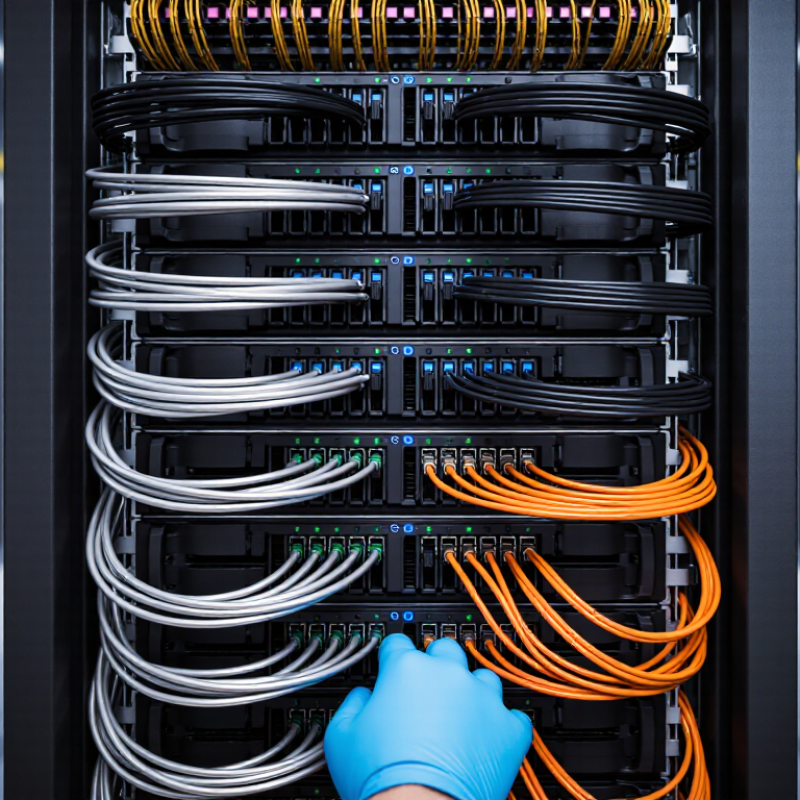
Ten main 10Gb SFP cable types cover copper and fiber links. Passive twinax DAC connects nearby switches or servers with low power use. Active DAC adds signal conditioning for longer rack connections. AOC uses fiber strands with fixed optical ends, making it light and flexible. Check connector fit and device support before ordering.

For fiber, OM1 and OM2 multimode patch cables suit only short 10GBASE-SR links; their reach is limited. OM3 and OM4 duplex cables are common choices for SR connections across equipment rooms. OM5 can also carry 10Gb traffic, though its extra wavelength capacity may go unused. OS2 duplex single-mode cable pairs with optics such as LR for longer links. Armored OS2 adds a protective layer where cables may face bumps or tight routing. Simplex OS2 supports BiDi optics, which send and receive on different wavelengths over one strand. Details matter.

Cable labels can be confusing. A cable’s reach depends on the installed optics, link design, and fiber quality, not its name alone. Keep the two ends matched, verify connector polarity, and inspect the fiber faces before installation. Even experienced teams sometimes overlook a small connector mismatch.

Top 10Gb SFP Cable Types for Global Buyers — The Ten Main 10Gb SFP Cable Types Explained

Typical maximum link reach varies by cable, fiber grade, and deployment. The figures below are reference distances, not a guarantee for every product or installation.

Direct-attach copper and active optical cables are commonly used for short links, while fiber-optic options can span much longer distances. Check the relevant cabling standard and equipment specifications before choosing a link.

Comparing Cable Reach, Media, and Performance

At 10Gb/s, the right SFP cable depends on distance, port layout, and airflow. Direct-attach copper (DAC) combines cable and transceiver ends, making it practical for short rack links. Passive DACs suit very short runs; active versions may reach farther, but limits vary by model. Check equipment compatibility carefully.

An active optical cable (AOC) carries data over fiber in a fixed assembly, often across tens of meters. It is lighter than copper on longer paths and resists electromagnetic interference.

Less bulk. Cleaner routes.

However, its ends are not detachable, reducing flexibility when equipment changes. Separate optical modules and fiber cords offer more reach options. Multimode SR commonly spans hundreds of meters; single-mode LR can reach several kilometers. Actual distance depends on the optic, fiber grade, and installation.

For a crowded rack, DAC may reduce cost and setup time. For a warehouse-to-control-room run, fiber can simplify routing and isolate electrical noise. Measure the path, not just the gap between devices. Leave room for bends and service loops; tight routing can undermine a sound specification.

Even experienced buyers can over-focus on reach. Port compatibility and module temperature deserve equal attention, though product tables can make those details easy to overlook.

Checking Transceiver Compatibility and Regional Standards

A 10Gb SFP link can use direct-attach copper (DAC), active copper, active optical cable (AOC), or separate optical transceivers and fiber. The right choice depends on distance, port support, and the installed cabling—not just the connector. IEEE 802.3 specifies 10GBASE-SR reach of up to 300 meters over OM3 and 400 meters over OM4 multimode fiber. For 10GBASE-LR, the specified reach is 10 kilometers over single-mode fiber (IEEE 802.3). Short rack links often suit DAC; longer paths may call for AOC or optics. Check the host port’s supported module type and power limits. Small detail. Easy to miss.

Regional cabling rules matter too. In North America, structured copper installations commonly follow TIA-568; European projects may specify EN 50173, while fiber performance references include IEC 60793. For copper Ethernet, IEEE 802.3an specifies 10GBASE-T over up to 100 meters of Category 6A channel. That does not mean every SFP+ port accepts a copper transceiver or every cable meets local fire-rating requirements. Check connector type, fiber mode, wavelength, and the required regional cable classification before ordering. One awkward gap: product listings often state reach but omit test conditions. Verify the datasheet and, where possible, test the exact cable and port combination before deployment.

Choosing a 10Gb SFP Cable for Global Networks

Choosing a 10Gb SFP cable for global networks starts with distance, port support, and the route between devices. Passive DAC cables suit short links inside a rack, while active DAC can extend reach within equipment specifications. AOC cables use fiber and can help connect racks over longer distances. For greater flexibility, separate optical modules and fiber may be suitable, but confirm connector and fiber compatibility. Distance matters.

Check device documentation before ordering. SFP+ ports do not guarantee support for every cable type or length. Confirm the required cable coding, operating temperature, connector type, and fiber grade. A low-cost cable that fails compatibility checks can delay deployment.

Tips: Measure the actual route, including bends and rack movement. Leave a little service slack, but avoid tight coils or sharp bends. Label both ends with port and destination details. Check the details. Global installations also need consistent testing records across sites. A common planning mistake is focusing only on purchase price; support, replacement availability, and clear specifications matter too. Even careful planning can miss a site-specific constraint, so verify one sample in the intended equipment before wider rollout.