

News

Miro: A New Standard in Responsible Innovation

Miro: A New Standard in Responsible Innovation The Miro monitor arm is setting new benchmarks in sustainability. It offers a high-performance solution without compromising on environmental responsibility. Designed with careful material selection, local sourcing, and longevity in mind, Miro’s responsible approach to design and unique manoeuvrability set it apart from the competition. Sustainable Choices Miro is crafted from energy-efficient materials with a lower carbon impact....

Read more
HSE Advisor

Role Purpose Support in the development, implementation and maintenance of the company’s Health, Safety & Environmental policies, processes, operational procedures, and standards.  Ensuring best practice and championing a continually improving HSE culture within the business. Key Responsibilities Liaise with and provide support to all areas of the business to eliminate, mitigate or reduce identified HSE exposures. Partner with the production management team and team leaders,...

Read more
CMD Ltd LAUNCHES 48-HOUR TURNAROUND ON BETATRAK® RAPID ORDERING SERVICE

CMD Ltd, the specialist in power distribution systems, workstation power and monitor arms, has launched a rapid ordering service for its Betatrak® underfloor powertrack distribution systems and accessories, with a commitment to delivering within 48-hours of an approved purchase order*. The service enables customers to order up to 50 lengths of Standard or Clean Earth (C/E) low noise Betatrak, along with up to 25 feed...

Read more

CMD INVESTS £1/4 MILLION IN NEW MACHINE AS PART OF FACTORY UPGRADE

We have invested in a new £1/4m TRUMPF CNC metal punch as part of an asset renewal strategy for our UK manufacturing capability. The new machine will be used in the production of a wide variety of our power distribution systems and workstation power products at our Rotherham factory. Suitable for handling sheet metal between 0.9mm and 3.0mm thick, the new machine will replace one...

Read more

CMD CATALOGUE PROVIDES TECHNICAL POWER DISTRIBUTION GUIDE

CMD Ltd has released a new catalogue, providing an easy to follow technical guide to our power distribution systems and plug and play desk modules. Detailing CMD’s full range of UK-manufactured power distribution systems and plug and play desk modules, the catalogue will be a helpful source of information to M&E engineers and contractors alike to understand how our power distribution systems connect together and...

Read more

Power Distribution Catalogue
CMD Ltd PLAYS ESSENTIAL ROLE IN ELECTRICAL FIT OUT AT LONDON’S PRESTIGIOUS OFFICE DEVELOPMENT

CMD Ltd, specialist in workplace connectivity and ergonomic solutions, has provided a flexible and high-quality power distribution network for The Ray, a prestigious office development in London’s Farringdon. Well-known for being the former site of The Guardian newspaper, The Ray now stands as an 83,000ft² office development characterised by a modernised warehouse aesthetic, with level two now occupied by a global social media company. The...

Read more

The Ray
CMD plugs in to european opportunity with Schuko Capsule unit launch

CMD Ltd, the specialist in power and connectivity solutions for commercial environments, has launched a Schuko version of its popular fixed format Capsule workstation power module for export to mainland Europe and beyond. A popular on desk power module comprising two sockets and dual USB (type A and C) chargers, CMD’s Capsule unit is already widely specified in the UK as an off-the-shelf workstation power...

Read more
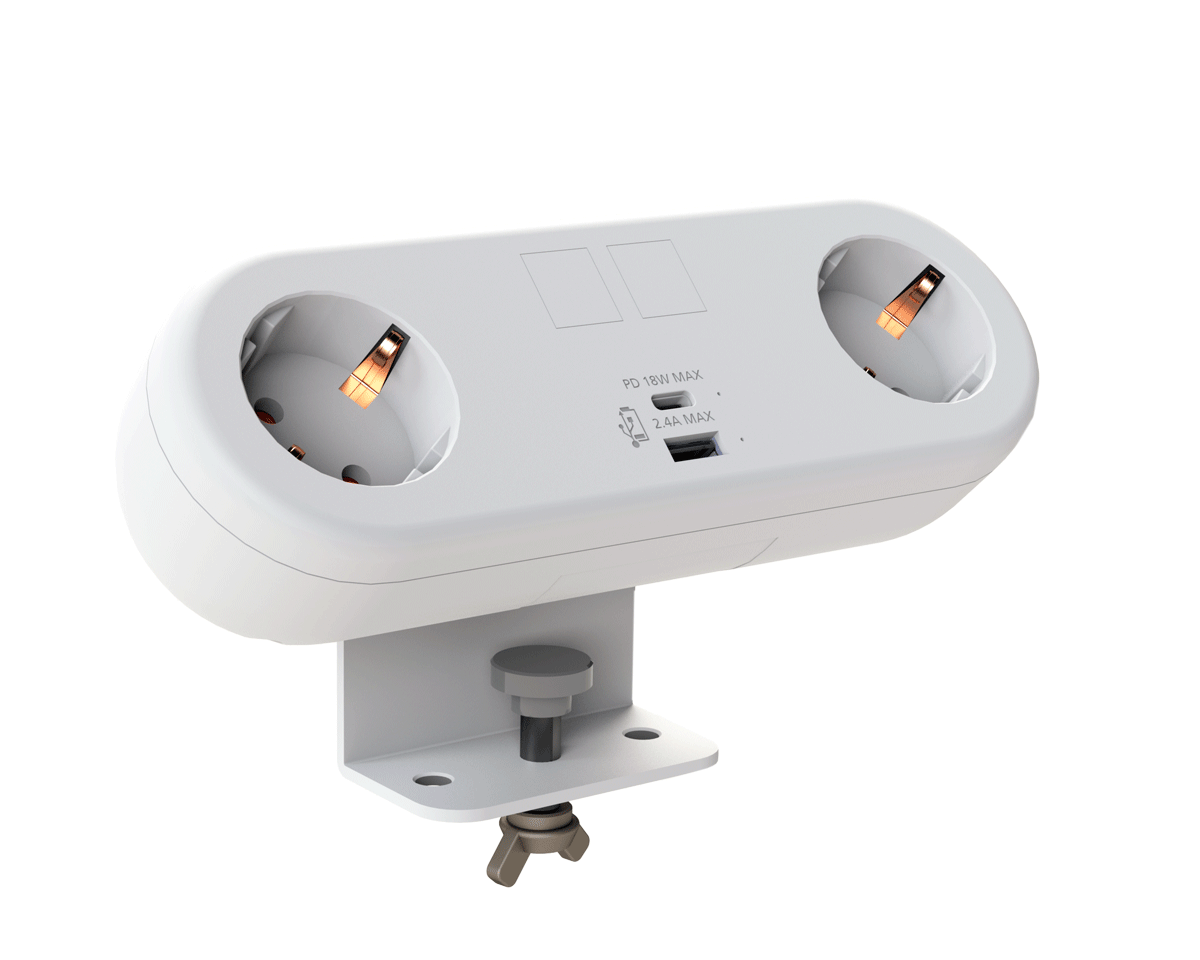
CMD White Schuko Capsule Desk Power Module
CMD LTD EXTENDS MONITOR ARM RANGE WITH THE LAUNCH OF REACH PLUS

CMD Ltd, the specialist in ergonomic and connectivity solutions for commercial interiors, has completed its Reach monitor arm range with the launch of the Reach Plus. Available in single or dual screen options, the Reach Plus has been designed to provide an ideal solution for both single and dual screen workstation configurations, or can be used with next generation of large format curved screens. Suitable...

Read more

CMD Ltd DEMONSTRATES THE ART OF POWER DISTRIBUTION AT THE UNIVERSITY OF WARWICK

CMD Ltd, the specialist in workplace connectivity and ergonomic solutions, has provided Betatrak busbar power distribution and a range of electrical accessories for two major capital investment projects at the University of Warwick. Designed by Fielden Clegg Bradley Studios, the £33 million Faculty of Arts building is a showpiece development comprising four interconnected structures set around a central atrium, which will enable inter-disciplinary collaboration across...

Read more

University of Warwick
CMD BRINGS HARMONY TO COVENTRY UNIVERSITY RESEARCH FACILITIES

CMD Ltd, the specialist in power distribution solutions and workstation power and ergonomics, has provided under desk and on desk power modules for the refurbishment of three Coventry University research buildings. Located on Coventry University Technology Park, a business park designed to encourage collaboration between the university and knowledge-based businesses, the three buildings are being repurposed as office accommodation for university research teams. The refurbishment...

Read more


Coventry University

Essential Tips for Using a Single High Performance API?

In today’s digital landscape, the demand for efficient data handling is crucial. Businesses are increasingly relying on a Single High-Performance API to streamline operations. According to a recent report by the International Data Corporation, 75% of enterprises view API management as vital for their digital transformation. This statistic underscores the significance of leveraging a well-designed API architecture.

Organizations that can maximize the potential of a Single High-Performance API often experience a notable increase in speed and flexibility. However, challenges persist. Many industry leaders report difficulties in integration and scalability. A balanced approach to API design is essential. While aiming for high performance, companies must also prioritize security and usability, areas where oversight can lead to vulnerabilities.

As we explore essential tips for effective usage, it’s important to remember that not every solution is perfect. Mistakes in implementation often lead to wasted resources and missed opportunities. By focusing on practical strategies, businesses can better navigate the complexities of leveraging a Single High-Performance API, ensuring that they not only meet their current demands but also adapt to future challenges.

Essential Tips for Using a Single High Performance API?

Understanding High Performance APIs and Their Importance

High-performance APIs play a crucial role in modern software development. They allow seamless communication between applications, enhancing speed and efficiency. According to a recent industry report, high-performance APIs can increase processing speed by up to 70%. This can significantly impact user experience and overall productivity.

Understanding their importance is essential. High-performance APIs help businesses handle large amounts of data. They reduce latency and improve response times. A notable study indicated that 85% of developers face challenges with slow APIs. This issue can lead to frustrated users and decreased engagement.

While high-performance APIs offer many advantages, they come with challenges. Not every application needs extreme performance. Over-optimizing can lead to unnecessary complexity. Organizations must evaluate their specific needs to avoid wasting resources. Finding a balance between performance and maintainability is key.

Evaluating Your Needs: Choosing the Right High Performance API

When evaluating your needs for a high-performance API, consider the specific requirements of your project. A 2022 report from the API Performance Association highlights that 80% of developers prioritize speed and reliability. This statistic underscores the importance of choosing an API that aligns with your performance benchmarks. Moreover, a poorly chosen API can lead to significant bottlenecks. Every millisecond counts when users expect instant responses.

Understanding your data volume is crucial. If you anticipate handling over a million requests per day, scalability is essential. The same report reveals that APIs with flexible scaling options can handle 60% more traffic without compromising performance. Furthermore, assess your team's expertise. A complex API may offer powerful features, but a steep learning curve can slow down development. Aim for a balance between advanced capabilities and ease of use.

Lastly, consider the cost implications. Some APIs might appear affordable upfront but can accumulate hidden costs over time. A financial analysis could reveal that 70% of organizations underestimate these expenses. Reflect on your long-term budget and operational needs. Finding the right API connects various aspects of your project, including user experience and operational efficiency.

Best Practices for Integrating a Single High Performance API

Integrating a single high-performance API can streamline your application's functionality. However, it's crucial to take the right steps to ensure smooth operations. Start by thoroughly understanding the API documentation. This will help you avoid common pitfalls. Missing small details can lead to significant issues down the line. Each endpoint should be carefully tested for performance and reliability.

Monitoring API performance is essential. Set up alerts for response times or error rates. Sometimes, unexpected downtimes can occur. Regularly check the API’s status and handle errors gracefully in your application. Building a fallback mechanism is wise. It can save users from frustrating experiences if the primary API fails.

Performance optimization should not be an afterthought. Analyze your application's usage patterns. This helps you identify bottlenecks. Remember, API usage limits can impact performance. Rethink how often data is requested. Sometimes, a bulk request strategy works better than multiple individual calls. Balancing efficiency with user experience is a constant challenge. Aim for improvements but be prepared to adapt.

Performance Metrics of API Usage

This chart illustrates the performance metrics of a single high-performance API. It displays the number of requests per second, the average response time in milliseconds, and the error rate as a percentage, providing a quick overview of the API's operational efficiency.

Monitoring and Optimizing Performance with a Single API

When working with a single high-performance API, monitoring is crucial. Collecting metrics like response times and error rates helps identify bottlenecks. Real-time analytics can reveal how the API behaves under different loads. It's essential to tune your settings based on this data. Regularly check for any unusual spikes or patterns in performance.

Optimization begins with understanding usage patterns. Identify the most common requests and focus on them. Caching can dramatically reduce response times for frequently accessed data. However, implementing caching isn't without its challenges. Stale data may lead to confusion.

Testing should never be overlooked. Conduct load tests to see how well the API performs under pressure. During these tests, you might uncover gradual declines in performance. Continuous evaluation is key. Regularly revisit and adjust your strategy based on the insights you gather. Even a small change can lead to significant improvements.

Troubleshooting Common Issues with High Performance APIs

When using high performance APIs, it's common to encounter issues that can affect your application's functionality. One frequent problem is latency during requests. This can slow down your application significantly. To troubleshoot this, monitor your network speed and server response times. Utilize tools that help measure these metrics, allowing you to pinpoint bottlenecks.

Another common issue is errors related to authentication. It can be frustrating when valid requests return unauthorized responses. Double-check your API keys and access tokens. Ensure they are correctly implemented and have not expired. Debugging tools can also highlight the specifics of the error messages, aiding in resolving these issues efficiently.

Sometimes, API documentation lacks clarity. This can lead to misinterpretation of how to implement certain features. Try experimenting with different endpoints and parameters. Document your findings for future reference. Engaging with community forums might also provide insights that are not found in official resources. Ultimately, reflecting on your troubleshooting approach can lead to improved problem-solving skills with high performance APIs.