









News

Miro: A New Standard in Responsible Innovation

Miro: A New Standard in Responsible Innovation The Miro monitor arm is setting new benchmarks in sustainability. It offers a high-performance solution without compromising on environmental responsibility. Designed with careful material selection, local sourcing, and longevity in mind, Miro’s responsible approach to design and unique manoeuvrability set it apart from the competition. Sustainable Choices Miro is crafted from energy-efficient materials with a lower carbon impact....

Read more
HSE Advisor

Role Purpose Support in the development, implementation and maintenance of the company’s Health, Safety & Environmental policies, processes, operational procedures, and standards.  Ensuring best practice and championing a continually improving HSE culture within the business. Key Responsibilities Liaise with and provide support to all areas of the business to eliminate, mitigate or reduce identified HSE exposures. Partner with the production management team and team leaders,...

Read more
CMD Ltd LAUNCHES 48-HOUR TURNAROUND ON BETATRAK® RAPID ORDERING SERVICE

CMD Ltd, the specialist in power distribution systems, workstation power and monitor arms, has launched a rapid ordering service for its Betatrak® underfloor powertrack distribution systems and accessories, with a commitment to delivering within 48-hours of an approved purchase order*. The service enables customers to order up to 50 lengths of Standard or Clean Earth (C/E) low noise Betatrak, along with up to 25 feed...

Read more
CMD INVESTS £1/4 MILLION IN NEW MACHINE AS PART OF FACTORY UPGRADE

We have invested in a new £1/4m TRUMPF CNC metal punch as part of an asset renewal strategy for our UK manufacturing capability. The new machine will be used in the production of a wide variety of our power distribution systems and workstation power products at our Rotherham factory. Suitable for handling sheet metal between 0.9mm and 3.0mm thick, the new machine will replace one...

Read more
CMD CATALOGUE PROVIDES TECHNICAL POWER DISTRIBUTION GUIDE

CMD Ltd has released a new catalogue, providing an easy to follow technical guide to our power distribution systems and plug and play desk modules. Detailing CMD’s full range of UK-manufactured power distribution systems and plug and play desk modules, the catalogue will be a helpful source of information to M&E engineers and contractors alike to understand how our power distribution systems connect together and...

Read more
Power Distribution Catalogue
CMD Ltd PLAYS ESSENTIAL ROLE IN ELECTRICAL FIT OUT AT LONDON’S PRESTIGIOUS OFFICE DEVELOPMENT

CMD Ltd, specialist in workplace connectivity and ergonomic solutions, has provided a flexible and high-quality power distribution network for The Ray, a prestigious office development in London’s Farringdon. Well-known for being the former site of The Guardian newspaper, The Ray now stands as an 83,000ft² office development characterised by a modernised warehouse aesthetic, with level two now occupied by a global social media company. The...

Read more
The Ray
CMD plugs in to european opportunity with Schuko Capsule unit launch

CMD Ltd, the specialist in power and connectivity solutions for commercial environments, has launched a Schuko version of its popular fixed format Capsule workstation power module for export to mainland Europe and beyond. A popular on desk power module comprising two sockets and dual USB (type A and C) chargers, CMD’s Capsule unit is already widely specified in the UK as an off-the-shelf workstation power...

Read more
CMD White Schuko Capsule Desk Power Module
CMD LTD EXTENDS MONITOR ARM RANGE WITH THE LAUNCH OF REACH PLUS

CMD Ltd, the specialist in ergonomic and connectivity solutions for commercial interiors, has completed its Reach monitor arm range with the launch of the Reach Plus. Available in single or dual screen options, the Reach Plus has been designed to provide an ideal solution for both single and dual screen workstation configurations, or can be used with next generation of large format curved screens. Suitable...

Read more
CMD Ltd DEMONSTRATES THE ART OF POWER DISTRIBUTION AT THE UNIVERSITY OF WARWICK

CMD Ltd, the specialist in workplace connectivity and ergonomic solutions, has provided Betatrak busbar power distribution and a range of electrical accessories for two major capital investment projects at the University of Warwick. Designed by Fielden Clegg Bradley Studios, the £33 million Faculty of Arts building is a showpiece development comprising four interconnected structures set around a central atrium, which will enable inter-disciplinary collaboration across...

Read more
University of Warwick
CMD BRINGS HARMONY TO COVENTRY UNIVERSITY RESEARCH FACILITIES

CMD Ltd, the specialist in power distribution solutions and workstation power and ergonomics, has provided under desk and on desk power modules for the refurbishment of three Coventry University research buildings. Located on Coventry University Technology Park, a business park designed to encourage collaboration between the university and knowledge-based businesses, the three buildings are being repurposed as office accommodation for university research teams. The refurbishment...

Read more
Coventry University

7 Tips for Choosing the Best Aluminum Frying Pan?

Choosing an Aluminum Frying Pan can feel simple until heat, coating, weight, and safety compete for attention. The market is expanding quickly. Grand View Research valued the global cookware market at approximately $19.56 billion in 2022 and forecast a 6.5% compound annual growth rate through 2030. That growth reflects demand, not guaranteed quality. A crowded shelf still requires careful judgment.

Harold McGee, author of On Food and Cooking, describes aluminum as “a good conductor of heat, and light and inexpensive.” His observation explains the pan’s popularity. Aluminum heats quickly, feels manageable, and suits everyday eggs, vegetables, and delicate fish. Yet rapid heating can also create hot spots when the base is thin. I have found that a pan’s weight often reveals more than its glossy finish.

This guide presents seven practical tips for choosing the best Aluminum Frying Pan. We will examine construction, thickness, coating durability, handle design, stovetop compatibility, cleaning demands, and verified safety information. The U.S. Food and Drug Administration evaluates food-contact materials, but consumers should still inspect manufacturer documentation. Look for clear specifications, not vague promises.

Small details matter. A flat base should remain stable on the cooktop. A comfortable handle should stay secure during lifting. The interior should resist scratches under normal use. No pan is perfect. Even premium cookware can disappoint when overheated or poorly maintained. These tips aim to make the decision more measurable, realistic, and suitable for your kitchen.

7 Tips for Choosing the Best Aluminum Frying Pan?

Understand Aluminum Pan Types and Construction

When choosing an aluminum frying pan, study its construction before its appearance.

Spun aluminum is lightweight and heats quickly, but thin walls may warp over high heat.

Cast aluminum usually feels heavier and offers better rigidity.

Hard-anodized aluminum has a treated surface that improves scratch resistance, although coating quality still varies.

Look at the cooking base.

A thicker base spreads heat more consistently. Multilayer or clad designs may add stainless steel for durability and induction compatibility. However, extra layers can make the pan slower to respond. Your burner size still matters.

ASM Handbook data places pure aluminum’s thermal conductivity near 237 W/m·K, far above common stainless steel.

That explains aluminum’s fast heating, not perfect cooking control.

Check the handle attachment and interior finish closely. Riveted handles often feel secure, but exposed rivets collect residue. A coated interior should appear even, without bubbles or thin patches.

The International Aluminium Institute reports that recycling aluminum uses about 5% of the energy required for primary production.

A durable pan can therefore support a lower-impact purchase, especially when its body remains usable after surface wear.

I once preferred the lightest pan, but it heated unevenly on a wide burner. Weight alone misled me. Choose the thickest practical base, then match the pan to your stove and cooking habits.

Check Heat Distribution and Cooking Performance

When choosing an aluminum frying pan, heat distribution deserves close attention. A pan should warm steadily across the base, not only beneath the burner. I test this with a few drops of water. They should spread and evaporate at a similar pace. Uneven movement can reveal cold areas or excessive hot spots.

Base thickness matters. A very thin pan heats quickly, but it may also lose heat when food enters. That weakness becomes obvious with chilled vegetables or thick fish fillets. A heavier aluminum base usually holds temperature more reliably. However, extra weight does not guarantee better cooking. The construction still matters.

Watch the edges.

During everyday cooking, eggs should set gently without burning near the center. Vegetables should brown gradually, rather than release water and steam. I also check whether the pan remains flat after repeated heating. Some pans perform well at first, then develop slight warping. I once judged a pan too quickly because its first meal cooked evenly. Later, its temperature recovery disappointed me. That experience changed my testing habits. I now repeat the same test with different burner settings and food quantities. A useful pan should respond predictably, even when cooking conditions are less than perfect.

7 Tips for Choosing the Best Aluminum Frying Pan

Use these practical evaluation weights to compare aluminum frying pans, with heat distribution and cooking performance receiving the greatest emphasis.

A thicker, evenly constructed aluminum body generally improves heat stability, while a durable cooking surface, comfortable handle, and suitable oven temperature range support everyday performance.

Choose the Right Size, Shape, and Weight

7 Tips for Choosing the Best Aluminum Frying Pan?

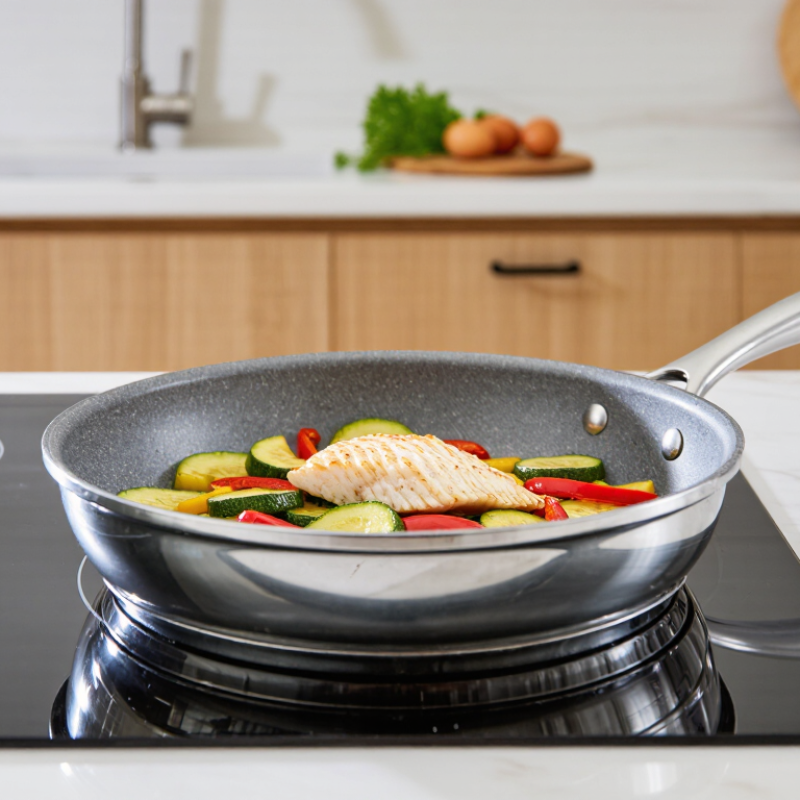
Choose a pan size that matches your usual meals. A 20-centimeter pan suits one person or two eggs. A 28-centimeter pan handles vegetables, fish, or family portions. Measure the cooking surface, not only the outer rim. A wide pan may not heat evenly on a small burner. Check your stovetop first. This small step prevents wasted space and uneven browning.

Shape affects daily comfort. Look for a flat base that sits firmly on the cooking surface. Slightly sloped sides make flipping pancakes or turning vegetables easier. Higher sides help contain sauces and reduce splashes. A rounded edge also makes stirring smoother. I once bought a very wide pan with shallow sides. It looked useful, but food slipped out during tossing. The design taught me to value control over appearance.

Weight deserves careful attention. A very light pan heats quickly, but it may develop hot spots. A heavier aluminum body often feels steadier and distributes heat more consistently. Hold the pan before buying it. Can you lift it with one hand? Does the handle pull your wrist downward? Test the balance while the pan is empty. Too much weight becomes tiring, especially when cooking several dishes. Still, heavier is not always better. Your cooking style, hand strength, and storage space should guide the choice.

Evaluate Coatings, Handles, and Safety Features

When choosing an aluminum frying pan, inspect the coating under bright kitchen light. A smooth, even surface should have no bubbles, thin patches, or exposed metal. Nonstick coatings vary in durability, so follow the stated temperature guidance and use utensils that will not scratch them. I prefer a moderately thick base because it heats more evenly on my stove. That preference is practical, not universal.

Check the handle before buying. Hold the pan with one hand and gently move the handle from side to side. It should feel firm, balanced, and comfortable, even when the pan is empty. Riveted handles are often secure, but they can collect grease around the joints. Removable handles save storage space, yet their locking systems need regular inspection. It matters.

Safety details deserve close attention. Confirm the oven-safe temperature, especially if the handle contains plastic or silicone. A heat-resistant grip may still become hot near the pan body, so keep a dry cloth nearby. For uncoated aluminum, avoid prolonged contact with strongly acidic foods, which may affect flavor and the pan’s surface. If the coating peels, flakes, or exposes the base, stop using the pan. I once ignored a loose handle because the pan still cooked well. That was careless. Washing by hand usually protects the coating, although I admit I sometimes use the dishwasher when time is short. Inspect the pan afterward.

7 Tips for Choosing the Best Aluminum Frying Pan: Evaluate Coatings, Handles, and Safety Features

Tip Evaluation Area What to Check Practical Benchmark Safety and Use Implication
1 Pan Construction Compare the aluminum body thickness, weight, and flatness of the cooking surface. A heavier, rigid body—often about 2.5–4 mm for everyday pans—typically distributes heat more evenly than very thin aluminum. A flat base reduces hot spots and helps prevent oil or batter from pooling on one side.
2 Nonstick Coating Identify whether the surface uses PTFE, ceramic, or another coating, and inspect it for scratches, bubbles, or uneven areas. Choose a smooth, uniform coating with clear care instructions and no visible damage. Coating thickness is not directly comparable unless measured to the same standard. Use low to medium heat for coated pans, avoid preheating an empty pan for long periods, and replace the pan if the coating is peeling or severely damaged.
3 Cooking Surface Compatibility Check the cookware symbol or instructions for gas, electric, glass-ceramic, and induction use. Bare aluminum is generally not induction-compatible. Induction requires a magnetic stainless-steel or iron layer built into the base. Using a pan on an incompatible cooktop can result in no heating, unstable contact, or poor temperature control.
4 Handle Design Look for a firmly attached handle with a comfortable grip, enough clearance from the pan wall, and a hanging hole if desired. The handle should remain stable when the pan is tilted and should not wobble, rotate, or become excessively hot during normal stovetop use. A secure, heat-resistant handle lowers the risk of spills and burns. Use a dry oven mitt because heat can travel through metal handles.
5 Oven and Broiler Rating Confirm the maximum oven temperature for the pan, coating, lid, and handle as separate components. Do not assume that an oven-safe pan is broiler-safe. The lowest temperature rating among the components controls safe use. Plastic, silicone, painted parts, and some nonstick coatings may have lower temperature limits than the aluminum body.
6 Rim, Base, and Stability Inspect the rolled rim, underside, and contact area for sharp edges, dents, rocking, or warping. The pan should sit flat without rocking and should have a smooth rim that pours cleanly without creating sharp exposed edges. A stable base improves control when stirring or flipping food and reduces the chance of spills on the cooktop.
7 Care, Cleaning, and Food Safety Review cleaning instructions, utensil recommendations, dishwasher guidance, and the pan’s food-contact compliance information. Hand washing with mild detergent and a soft sponge generally helps preserve nonstick finishes. Avoid metal utensils unless the instructions specifically allow them. Do not use a damaged coating, abrasive cleaners, or sudden cold-water rinsing on a very hot pan. Follow the manufacturer’s stated care and temperature limits.

Compare Maintenance Needs, Durability, and Price

Choosing the best aluminum frying pan means comparing maintenance, durability, and price together. Tip one: check base thickness, not total weight. A thin pan heats fast but may lose heat when cold food lands. Tip two: inspect the coating warranty and care instructions. Nonstick surfaces usually last longer with low heat, soft utensils, and hand washing. Tip three: test the handle. It should stay firm without twisting. I once ignored this detail. The loose handle became irritating within weeks.

Tip four: decide between untreated, coated, and hard-anodized aluminum. Hard-anodized surfaces usually resist scratches better, but they still need gentle cleaning. Tip five: press the base on a flat counter. Any rocking suggests future uneven cooking. Tip six: calculate maintenance effort. A cheaper pan is not economical if it needs frequent replacement. The International Aluminium Institute reports that recycled aluminum requires about 95% less energy than primary aluminum production. That supports choosing a pan designed for longer use, although recycling does not fix poor construction.

Tip seven: compare price per expected year, not the shelf price. Divide the cost by a realistic service period, then add replacement risks. Industry pricing changes with aluminum and energy markets, as documented in U.S. Geological Survey Mineral Commodity Summaries reports. Prices can mislead. A heavier pan may cost more, yet deliver steadier heat and fewer cooking frustrations. Still, I would not assume weight guarantees quality. Check the base, rivets, coating, and care requirements before paying extra.