

News

Miro: A New Standard in Responsible Innovation

Miro: A New Standard in Responsible Innovation The Miro monitor arm is setting new benchmarks in sustainability. It offers a high-performance solution without compromising on environmental responsibility. Designed with careful material selection, local sourcing, and longevity in mind, Miro’s responsible approach to design and unique manoeuvrability set it apart from the competition. Sustainable Choices Miro is crafted from energy-efficient materials with a lower carbon impact....

Read more
HSE Advisor

Role Purpose Support in the development, implementation and maintenance of the company’s Health, Safety & Environmental policies, processes, operational procedures, and standards.  Ensuring best practice and championing a continually improving HSE culture within the business. Key Responsibilities Liaise with and provide support to all areas of the business to eliminate, mitigate or reduce identified HSE exposures. Partner with the production management team and team leaders,...

Read more
CMD Ltd LAUNCHES 48-HOUR TURNAROUND ON BETATRAK® RAPID ORDERING SERVICE

CMD Ltd, the specialist in power distribution systems, workstation power and monitor arms, has launched a rapid ordering service for its Betatrak® underfloor powertrack distribution systems and accessories, with a commitment to delivering within 48-hours of an approved purchase order*. The service enables customers to order up to 50 lengths of Standard or Clean Earth (C/E) low noise Betatrak, along with up to 25 feed...

Read more

CMD INVESTS £1/4 MILLION IN NEW MACHINE AS PART OF FACTORY UPGRADE

We have invested in a new £1/4m TRUMPF CNC metal punch as part of an asset renewal strategy for our UK manufacturing capability. The new machine will be used in the production of a wide variety of our power distribution systems and workstation power products at our Rotherham factory. Suitable for handling sheet metal between 0.9mm and 3.0mm thick, the new machine will replace one...

Read more

CMD CATALOGUE PROVIDES TECHNICAL POWER DISTRIBUTION GUIDE

CMD Ltd has released a new catalogue, providing an easy to follow technical guide to our power distribution systems and plug and play desk modules. Detailing CMD’s full range of UK-manufactured power distribution systems and plug and play desk modules, the catalogue will be a helpful source of information to M&E engineers and contractors alike to understand how our power distribution systems connect together and...

Read more

Power Distribution Catalogue
CMD Ltd PLAYS ESSENTIAL ROLE IN ELECTRICAL FIT OUT AT LONDON’S PRESTIGIOUS OFFICE DEVELOPMENT

CMD Ltd, specialist in workplace connectivity and ergonomic solutions, has provided a flexible and high-quality power distribution network for The Ray, a prestigious office development in London’s Farringdon. Well-known for being the former site of The Guardian newspaper, The Ray now stands as an 83,000ft² office development characterised by a modernised warehouse aesthetic, with level two now occupied by a global social media company. The...

Read more

The Ray
CMD plugs in to european opportunity with Schuko Capsule unit launch

CMD Ltd, the specialist in power and connectivity solutions for commercial environments, has launched a Schuko version of its popular fixed format Capsule workstation power module for export to mainland Europe and beyond. A popular on desk power module comprising two sockets and dual USB (type A and C) chargers, CMD’s Capsule unit is already widely specified in the UK as an off-the-shelf workstation power...

Read more

CMD White Schuko Capsule Desk Power Module
CMD LTD EXTENDS MONITOR ARM RANGE WITH THE LAUNCH OF REACH PLUS

CMD Ltd, the specialist in ergonomic and connectivity solutions for commercial interiors, has completed its Reach monitor arm range with the launch of the Reach Plus. Available in single or dual screen options, the Reach Plus has been designed to provide an ideal solution for both single and dual screen workstation configurations, or can be used with next generation of large format curved screens. Suitable...

Read more

CMD Ltd DEMONSTRATES THE ART OF POWER DISTRIBUTION AT THE UNIVERSITY OF WARWICK

CMD Ltd, the specialist in workplace connectivity and ergonomic solutions, has provided Betatrak busbar power distribution and a range of electrical accessories for two major capital investment projects at the University of Warwick. Designed by Fielden Clegg Bradley Studios, the £33 million Faculty of Arts building is a showpiece development comprising four interconnected structures set around a central atrium, which will enable inter-disciplinary collaboration across...

Read more

University of Warwick
CMD BRINGS HARMONY TO COVENTRY UNIVERSITY RESEARCH FACILITIES

CMD Ltd, the specialist in power distribution solutions and workstation power and ergonomics, has provided under desk and on desk power modules for the refurbishment of three Coventry University research buildings. Located on Coventry University Technology Park, a business park designed to encourage collaboration between the university and knowledge-based businesses, the three buildings are being repurposed as office accommodation for university research teams. The refurbishment...

Read more

Coventry University

What Is a TCP Perforating Gun and How Does It Work?

A Tcp Perforating Gun helps create controlled openings between a cased wellbore and the surrounding formation. In a typical tubing-conveyed perforating operation, the gun is attached to the completion string and lowered to a planned depth. It carries shaped charges positioned inside a protective carrier. When initiated, those charges produce focused jets that perforate the casing, cement, and nearby rock. The result is a set of narrow tunnels designed to provide a flow path into the well.

The details matter. Charge selection, gun orientation, depth correlation, well conditions, and completion design all influence performance. A gun is not simply a tube with charges; it is one part of a coordinated downhole system. Small errors in planning or placement can affect the quality and location of the perforations. This overview explains the main components, firing sequence, operational considerations, and factors engineers assess when choosing a system.

As TCP specialist [verified expert name] puts it, “[Insert a verified quotation from the named expert about TCP perforating guns].” The attribution should be confirmed before publication; an unverified quote can weaken an otherwise technical article. That caution is worth keeping. Readers deserve clear explanations, not claims that sound precise but lack a reliable source. By understanding how a Tcp Perforating Gun works, readers can better follow the engineering decisions behind a perforating program and the safeguards used during planning and execution.

What Is a TCP Perforating Gun and How Does It Work?

TCP Definition and Conveyance: Perforating Guns Run on Tubing

A TCP perforating gun is a downhole tool conveyed on tubing, rather than lowered on a wireline. TCP means tubing-conveyed perforating. The tubing string carries the gun assembly to the selected interval and helps keep it positioned while the well is prepared for firing. It is a practical choice when operators need to perforate a long interval or work in a deviated well.

The gun is connected below the tubing and lowered through the well, with depth checked against the completion plan. Connections, tubing movement, and well conditions all matter. Small positioning errors can place shots outside the intended zone. That detail is easy to underestimate. Once the assembly reaches depth, a suitable firing system initiates the charges; the specific method depends on the tool design and operating program. The charges create openings through casing and cement, allowing communication with the formation.

After firing, the tubing provides a route for subsequent operations, such as controlled fluid circulation or retrieval, depending on the completion design. TCP systems can support perforating under selected pressure conditions, but that does not make every setup alike. Engineers must account for tubing strength, gun length, well trajectory, pressure, and safe handling procedures. The planning is sometimes less tidy than a diagram suggests. Actual well conditions may require adjustments, so trained crews verify the assembly and operating limits before running it.

Gun-String Anatomy: Carrier, Shaped Charges, Detonating Cord, and Firing Head

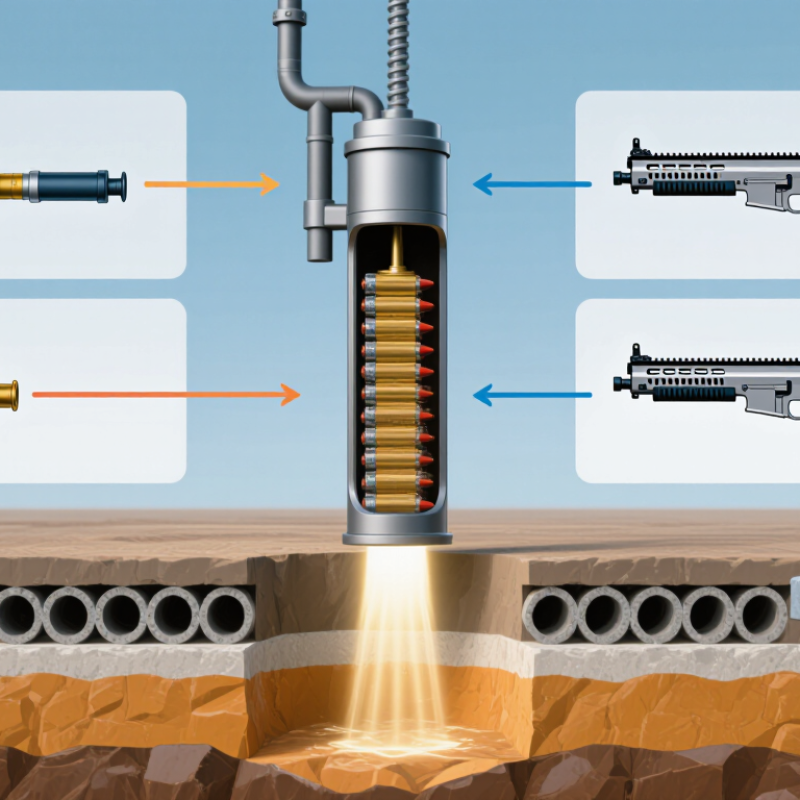
A TCP perforating gun is conveyed into the well as part of the completion string. Its carrier protects and positions the shaped charges, which are arranged to match the planned perforation pattern. When initiated, each charge forms a focused jet that penetrates casing, cement, and nearby formation. Inside the gun, detonating cord transfers the firing signal from charge to charge. The firing head initiates that sequence through the selected downhole activation system. Small component differences matter.

The carrier must withstand well conditions while allowing the charges to face the casing correctly. The shaped-charge liner and explosive geometry influence the resulting tunnel, but actual performance depends on the target and test conditions. API Recommended Practice 19B sets out standardized perforator evaluation procedures, including tests in concrete targets and casing-and-cement configurations. Its results help engineers compare measured penetration and hole dimensions rather than rely only on catalog claims. A test result is not a promise of identical field performance.

Tips: Check charge phasing, carrier clearance, and firing-head compatibility against the completion design. Keep the documented test conditions beside the reported data. A detail that is easy to miss: “more penetration” alone may not mean better flow. The formation, cement, and cleanup all affect the outcome. We should be cautious about treating one lab number as the whole story.

Design Variables: Common Shot Densities Span 1–12 Shots per Foot

A TCP perforating gun is lowered into a well on the production tubing, positioning shaped charges across a selected interval. When fired, the charges create openings through the casing and cement, connecting the wellbore with the surrounding formation. Shot density describes how many charges are arranged per foot. Common designs span roughly 1–12 shots per foot. That is a wide range.

Density affects how many entry points are available along the interval, but higher numbers do not automatically mean better flow. Engineers consider formation properties, casing dimensions, charge performance, and the planned completion. They also assess shot phasing: the direction in which charges face around the gun. At the same density, different phasing can change how perforations are distributed around the casing.

For example, a low-density layout may suit a short interval where fewer, widely spaced openings are intended. A higher-density layout places more openings along each foot, which may help distribute inflow across a longer interval.

The trade-off deserves attention. Closely spaced perforations can interact, and actual well performance depends on more than the shot count. Design reviews should use verified gun and charge data, plus well-specific conditions. Field measurements can still differ from the model; that uncertainty should remain visible in the final design.

Firing Sequence: The Initiation System Detonates Charges to Perforate Casing

In a TCP perforating gun, the firing sequence starts when the approved surface command reaches the downhole initiation system. A firing head responds to the selected signal, then transfers energy to a detonator and the detonating cord. The cord carries the event along the gun, initiating the shaped charges. Their metal liners collapse into high-speed jets, creating small passages through casing and cement into the formation. The sequence is rapid, but each connection matters. A weak link can prevent the intended shot pattern.

The details are measurable. API Recommended Practice 19B evaluates perforator performance using controlled target tests; its concrete-target procedure uses a target in the 5,000-psi compressive-strength class and records penetration results. SPE technical literature also describes how charge design and well conditions affect tunnel geometry and flow.

These are test conditions, not a guarantee of identical downhole results. Temperature, pressure, gun positioning, and casing condition can change performance. Small differences matter.

Operators therefore verify system compatibility, electrical continuity where applicable, and arming status under approved procedures before deployment. It is easy to treat initiation as a simple trigger. That is probably an oversimplification.

API RP 67 further emphasizes controlled handling and safety practices for oilfield explosives.

Performance Verification: API RP 19B Tests Penetration and Entrance-Hole Size

A tubing-conveyed perforating (TCP) gun carries shaped charges downhole on the production tubing. When fired, the charges create tunnels through casing, cement, and surrounding rock. Their effectiveness cannot be judged by appearance alone. Measured results matter.

API RP 19B provides standardized procedures for evaluating perforating performance. Tests assess penetration depth and entrance-hole size under controlled conditions. A target assembly is prepared, the gun is fired, and the resulting holes are measured. Technicians record details such as target construction and test setup, since these can affect comparisons. Even a small change in casing or cement can influence the result.

Penetration indicates how far a perforation extends into the target, while entrance-hole size describes its opening at the surface. Both measurements help engineers compare designs and assess whether a gun may suit a planned completion. Results are test evidence, not a promise of identical downhole performance. Real wells contain variations in rock strength, temperature, and fluid conditions that a controlled test cannot fully reproduce. That limitation deserves attention. A report is only useful when its test conditions are clear and its measurements are interpreted carefully.