

News

Miro: A New Standard in Responsible Innovation

Miro: A New Standard in Responsible Innovation The Miro monitor arm is setting new benchmarks in sustainability. It offers a high-performance solution without compromising on environmental responsibility. Designed with careful material selection, local sourcing, and longevity in mind, Miro’s responsible approach to design and unique manoeuvrability set it apart from the competition. Sustainable Choices Miro is crafted from energy-efficient materials with a lower carbon impact....

Read more
HSE Advisor

Role Purpose Support in the development, implementation and maintenance of the company’s Health, Safety & Environmental policies, processes, operational procedures, and standards.  Ensuring best practice and championing a continually improving HSE culture within the business. Key Responsibilities Liaise with and provide support to all areas of the business to eliminate, mitigate or reduce identified HSE exposures. Partner with the production management team and team leaders,...

Read more
CMD Ltd LAUNCHES 48-HOUR TURNAROUND ON BETATRAK® RAPID ORDERING SERVICE

CMD Ltd, the specialist in power distribution systems, workstation power and monitor arms, has launched a rapid ordering service for its Betatrak® underfloor powertrack distribution systems and accessories, with a commitment to delivering within 48-hours of an approved purchase order*. The service enables customers to order up to 50 lengths of Standard or Clean Earth (C/E) low noise Betatrak, along with up to 25 feed...

Read more

CMD INVESTS £1/4 MILLION IN NEW MACHINE AS PART OF FACTORY UPGRADE

We have invested in a new £1/4m TRUMPF CNC metal punch as part of an asset renewal strategy for our UK manufacturing capability. The new machine will be used in the production of a wide variety of our power distribution systems and workstation power products at our Rotherham factory. Suitable for handling sheet metal between 0.9mm and 3.0mm thick, the new machine will replace one...

Read more

CMD CATALOGUE PROVIDES TECHNICAL POWER DISTRIBUTION GUIDE

CMD Ltd has released a new catalogue, providing an easy to follow technical guide to our power distribution systems and plug and play desk modules. Detailing CMD’s full range of UK-manufactured power distribution systems and plug and play desk modules, the catalogue will be a helpful source of information to M&E engineers and contractors alike to understand how our power distribution systems connect together and...

Read more

Power Distribution Catalogue
CMD Ltd PLAYS ESSENTIAL ROLE IN ELECTRICAL FIT OUT AT LONDON’S PRESTIGIOUS OFFICE DEVELOPMENT

CMD Ltd, specialist in workplace connectivity and ergonomic solutions, has provided a flexible and high-quality power distribution network for The Ray, a prestigious office development in London’s Farringdon. Well-known for being the former site of The Guardian newspaper, The Ray now stands as an 83,000ft² office development characterised by a modernised warehouse aesthetic, with level two now occupied by a global social media company. The...

Read more

The Ray
CMD plugs in to european opportunity with Schuko Capsule unit launch

CMD Ltd, the specialist in power and connectivity solutions for commercial environments, has launched a Schuko version of its popular fixed format Capsule workstation power module for export to mainland Europe and beyond. A popular on desk power module comprising two sockets and dual USB (type A and C) chargers, CMD’s Capsule unit is already widely specified in the UK as an off-the-shelf workstation power...

Read more

CMD White Schuko Capsule Desk Power Module
CMD LTD EXTENDS MONITOR ARM RANGE WITH THE LAUNCH OF REACH PLUS

CMD Ltd, the specialist in ergonomic and connectivity solutions for commercial interiors, has completed its Reach monitor arm range with the launch of the Reach Plus. Available in single or dual screen options, the Reach Plus has been designed to provide an ideal solution for both single and dual screen workstation configurations, or can be used with next generation of large format curved screens. Suitable...

Read more

CMD Ltd DEMONSTRATES THE ART OF POWER DISTRIBUTION AT THE UNIVERSITY OF WARWICK

CMD Ltd, the specialist in workplace connectivity and ergonomic solutions, has provided Betatrak busbar power distribution and a range of electrical accessories for two major capital investment projects at the University of Warwick. Designed by Fielden Clegg Bradley Studios, the £33 million Faculty of Arts building is a showpiece development comprising four interconnected structures set around a central atrium, which will enable inter-disciplinary collaboration across...

Read more

University of Warwick
CMD BRINGS HARMONY TO COVENTRY UNIVERSITY RESEARCH FACILITIES

CMD Ltd, the specialist in power distribution solutions and workstation power and ergonomics, has provided under desk and on desk power modules for the refurbishment of three Coventry University research buildings. Located on Coventry University Technology Park, a business park designed to encourage collaboration between the university and knowledge-based businesses, the three buildings are being repurposed as office accommodation for university research teams. The refurbishment...

Read more

Coventry University

What Is a Portable Milk Frother and How Does It Work?

A Portable Milk Frother is a compact, handheld tool that adds air to milk to create a light foam. It can make a home coffee feel more café-like without taking up much counter space. The device usually has a small motor and a whisk-shaped wire coil at the end of a metal stem. When switched on, the coil spins rapidly and pulls air into the milk. That is the basic idea. Some models use replaceable batteries, while others recharge by USB.

Using one is simple, but the result depends on more than the frother. Milk type, temperature, container shape, and whisk position all affect the texture. A narrow cup can help limit splashes, and keeping the whisk just below the surface at first can build foam more evenly. Cold milk may froth well, while warm milk can suit drinks such as lattes; check the product instructions before heating milk with the device. Not quite magic. A handheld frother generally makes airy foam, not the dense, finely textured microfoam produced by many espresso steam wands.

This guide explains what a Portable Milk Frother is, how its parts work, and what to expect when using one. It also considers practical details, including cleaning the whisk promptly and avoiding water near the motor housing. Small tools still have limits. Knowing them can help you choose a suitable model and make better foam, though results may take a little practice.

What Is a Portable Milk Frother and How Does It Work?

What a Portable Milk Frother Is

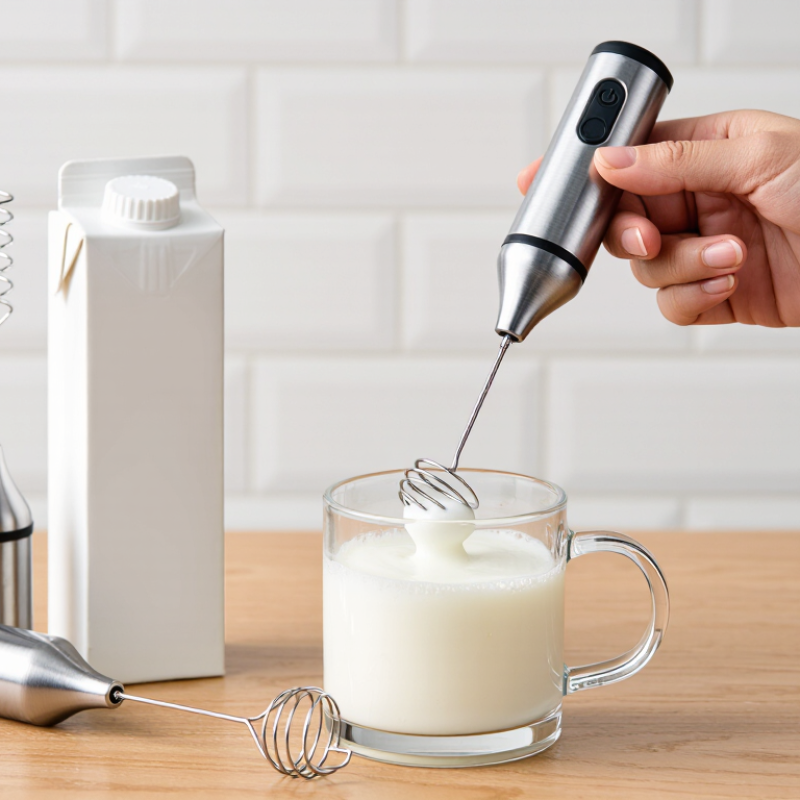
A portable milk frother is a small handheld tool that whips air into milk to create foam. It usually has a narrow handle, a battery-powered motor, and a tiny whisk at the end. Unlike a countertop frother, it fits in a drawer or travel bag. Many handheld models do not heat milk, so warm it separately if you want a hot drink. The spinning whisk breaks the milk’s surface and draws in air, making bubbles that give drinks a lighter texture.

The result depends on the milk, its temperature, and how long you froth. Cold milk can work well for iced drinks, while warm milk suits coffee or cocoa. Plant-based options vary: some foam readily, while others stay thin. A portable frother is convenient, but it does not always create the dense, lasting foam of larger machines. I used to assume longer frothing meant better foam; it can instead make large, loose bubbles.

Tips: Keep the whisk just below the milk’s surface at first, then lower it as foam forms. Use a deep cup to reduce splashes. Rinse the whisk promptly, and avoid submerging the motor handle. Start with short bursts. Check your milk’s texture before adding it to a drink.

The Main Parts and Their Functions

A portable milk frother is a small, handheld tool that whips air into milk. Its main parts are the handle, motor, shaft, and whisk head. The handle contains the power button and usually holds batteries or a rechargeable cell. Inside, a compact motor turns the shaft at high speed. The shaft connects the motor to a small wire coil or loop at the tip. That whisk head creates tiny bubbles as it moves through the milk. Simple parts, quick action.

The frother works best when the whisk head sits just below the milk’s surface. A little movement helps distribute the bubbles and build a light foam. If it stays too deep, it may warm or swirl the milk without adding much air. The design looks effortless, but controlling the depth takes a little practice. Milk type and temperature also affect the result.

Tips: Use a narrow cup with enough room to prevent splashes. Start with the whisk head submerged, then raise it slightly as the milk begins to foam. Rinse the whisk promptly; dried milk can cling between the wires. Avoid immersing the handle, since it houses the motor and power components.

What Is a Portable Milk Frother and How Does It Work?

A portable milk frother is a handheld, battery-powered tool that spins a whisk to add air to milk. The chart shows the typical order in which its main parts transfer power and motion during operation.

The numbers indicate sequence, not component size or performance: the battery supplies electrical energy, the switch controls the circuit, and the motor turns the shaft and whisk head to froth the milk.

How the Motor Spins the Whisk

A portable milk frother uses a small motor to turn a narrow whisk at high speed. The motor’s shaft connects to the whisk, directly or through a simple coupling. When switched on, the spinning wire loop pulls air into the milk and breaks it into tiny bubbles. You can see the effect at the surface: a thin foam gathers, then thickens as the whisk moves through the liquid. It is a small mechanism, but speed and whisk shape both matter.

The motor needs enough torque to keep spinning when the whisk meets thicker milk or a crowded patch of bubbles. Too little power can make the whisk slow down; excessive speed may splash milk up the sides of the cup. The International Energy Agency’s 2011 assessment estimated that motor-driven systems used about 40% of global electricity. That figure covers many kinds of motors, not handheld frothers, but it shows why efficient motor design matters across everyday equipment. A frother’s tiny motor is a different scale. Still, its battery, shaft alignment, and load affect how reliably it runs. In practice, foam can look uneven even when the motor works properly. Milk temperature, cup depth, and whisk angle also change the result. The mechanism is simple; the outcome isn’t always.

How to Froth Milk Step by Step

A portable milk frother is a small, battery-powered whisk that spins air into milk. For a smooth drink, start with a clean, dry cup and pour in cold milk. Leave plenty of room at the top; milk expands as it foams. Warm milk works too, but heat it gently before frothing. It should feel warm, not scalding.

Place the whisk just below the milk’s surface, then switch it on. Keep the cup steady and move the frother slowly in small circles. After a few seconds, lower the whisk slightly to blend larger bubbles into the foam. Stop when the milk looks glossy and has roughly doubled in volume. Small bubbles matter. Tap the cup lightly on the counter to settle the foam, then swirl the milk before pouring. If the foam is thin, try a deeper cup or fresh milk; results vary with milk type and temperature.

Tips: Don’t fill the cup to the brim. Keep the whisk submerged while it runs to avoid splashes, and rinse it soon after use. For a warm drink, froth first or heat carefully afterward; overheated milk can taste flat. I sometimes stop too early, so check the texture before pouring.

Factors That Affect Froth Quality

A portable milk frother uses a small spinning whisk to pull air into milk. The result depends on more than the device. Milk temperature, fat and protein content, freshness, and the whisk’s condition all affect the bubbles.

Start with cold, fresh milk if your frother is designed for cold frothing. For warm foam, heat the milk separately, then froth it while it is warm but not scalding. Very hot milk can lose its ability to hold a stable foam. Whole milk often makes a creamy texture, while lower-fat milk may produce lighter, larger bubbles. Plant-based milks vary; choose one labeled for frothing, but expect differences between recipes. Small changes matter.

The whisk needs room to move. Use a cup that lets the liquid circulate without splashing, and keep the whisk just below the surface at first. A clogged or bent whisk can make foam uneven, so rinse it soon after use. In practice, the same milk can behave differently after opening or chilling. There is no perfect setting. Adjust one factor at a time, and note what changes; even then, foam can be a little unpredictable.