How to Choose the Right Refrigeration Chiller?
Choosing the right Refrigeration Chiller is a practical engineering decision, not a simple comparison of prices. The selected unit must match the building’s cooling demand, operating schedule, climate, and available space. A chiller serving a food-processing room faces different conditions from one cooling an office tower. That difference matters.
Dr. Pega Hrnjak, a respected refrigeration researcher, emphasizes this principle: “Energy efficiency must be considered together with safety, reliability, and environmental impact.” His view provides a useful foundation for this guide. A high-efficiency rating can look impressive, yet it may hide poor performance during part-load operation. Check the real conditions. Review entering and leaving water temperatures, peak load, seasonal demand, compressor type, refrigerant choice, and control strategy. These details often decide whether a system performs well after installation.
Noise, maintenance access, and water quality also deserve attention. A compact Refrigeration Chiller may fit neatly beside a production line, but restricted service space can create expensive problems later. Likewise, an oversized unit may cycle too often and waste energy. That is easy to overlook. I have seen equipment decisions focus heavily on purchase cost, while ignoring pumps, filters, controls, and future servicing. That approach can be misleading. A reliable selection process compares lifecycle cost, documented test data, installation requirements, and supplier support. This article will examine each factor carefully, helping readers make a defensible choice rather than accepting the first attractive specification.
What Is a Refrigeration Chiller and How Does It Work?
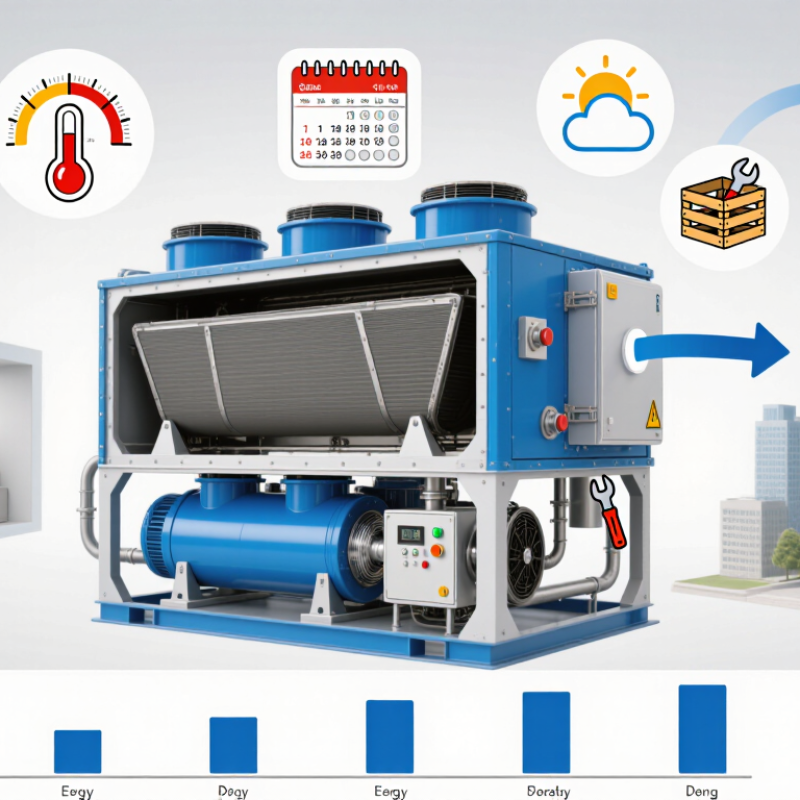
A refrigeration chiller removes heat from a process or secondary fluid, usually water or glycol. It does not create cold. It moves heat.
In a typical vapor-compression cycle, the compressor raises refrigerant pressure and temperature. The condenser rejects that heat to air or water. The expansion device lowers pressure sharply. The evaporator then absorbs heat from the circulating fluid. That cooled fluid travels through pipes, coils, or production equipment. The cycle repeats continuously. Simple in theory.
The International Institute of Refrigeration reports that refrigeration uses about 17% of global electricity consumption. The International Energy Agency also projects global space-cooling demand could triple by 2050. These figures make efficiency more than a purchasing detail. When choosing a chiller, match the actual cooling load, leaving-fluid temperature, outdoor conditions, and operating schedule. Compare full-load and part-load efficiency under recognized testing procedures, such as AHRI 550/590. Check refrigerant requirements, water quality, sound levels, service access, and control compatibility. A unit that looks efficient at one rating point may perform differently in a dusty plant during partial load. Field conditions often disagree with catalog numbers. I may overvalue rated efficiency if maintenance access is poor. Ask for measured performance data, commissioning records, and a realistic load profile before approving the selection.
How to Choose the Right Refrigeration Chiller?
A refrigeration chiller removes heat from a process or building by circulating chilled water or another secondary fluid through an evaporator. The compressor raises the refrigerant pressure and temperature, the condenser rejects heat, and the expansion device reduces the refrigerant pressure before the cycle repeats.
How to read the chart: The bars show typical full-load COP ranges, calculated as cooling output divided by electrical input. Water-cooled chillers generally achieve higher efficiency because water rejects heat more effectively than outdoor air. Actual performance varies with entering and leaving water temperatures, condenser conditions, part-load operation, fouling, and system design.
How to Calculate Cooling Capacity and Operating Requirements
How to Choose the Right Refrigeration Chiller?
Start with the real heat load, not the equipment size you prefer. Measure product input temperature, desired outlet temperature, flow rate, and operating hours. For liquid cooling, use this practical formula:
cooling capacity (kW) = mass flow (kg/s) × specific heat (kJ/kg·K) × temperature difference (K).
For example, cooling 2 kg/s of water by 8°C requires about 67 kW. Add heat from pumps, motors, pipelines, and nearby equipment. These sources are often underestimated.
A 10–15% design allowance can cover normal variation, but avoid excessive oversizing. Large chillers may cycle frequently, waste energy, and control temperature poorly. Check the required supply temperature, return temperature, ambient conditions, and available electrical power. Condenser performance changes sharply in a hot plant room. Water flow also matters. A restricted flow can trigger alarms or create uneven cooling. Confirm the pump head and pipe diameter with measured pressure data.
Field experience shows that clean calculations still need verification. A spreadsheet can look precise and remain wrong. Record temperatures during the busiest production period, preferably at several points. Then compare those readings with the calculated load.
Review refrigerant regulations, ventilation needs, noise limits, and maintenance access before selecting the chiller. I would also test the system at partial load. Full-load performance alone can mislead operators. Perfect assumptions are rare. Reliable sizing comes from measured conditions, documented operating requirements, and review by a qualified refrigeration engineer.
Which Chiller Type Fits Your Application?
Choosing the right refrigeration chiller starts with the application, not the equipment room. A small office may need an air-cooled chiller with simple maintenance and limited water use. However, a large factory running continuously may benefit from a water-cooled system. Cooling towers can improve efficiency, but they require water treatment, regular cleaning, and careful hygiene control.
Load behavior also matters. Scroll chillers suit smaller systems and offer practical redundancy through modular operation. Screw chillers often handle medium or large process loads with strong part-load performance. Centrifugal chillers can be efficient for high-capacity facilities with stable demand. They may perform poorly when the load changes sharply. That detail is often overlooked.
Temperature requirements can change the decision. A food process, cold storage area, and comfort-cooling system rarely need identical leaving-water temperatures. Glycol may protect low-temperature circuits, but it also increases pumping resistance. Field experience shows that oversized chillers cycle too often, wasting energy and shortening compressor life. It sounds simple. It is not. Reviewing hourly load data, ambient conditions, water quality, service access, and future expansion usually produces a safer selection. Engineers should also verify performance under local design conditions, rather than trusting a single catalog rating. One imperfect assumption can affect years of operating cost.
How to Compare Energy Efficiency, Controls, and Maintenance
How to Choose the Right Refrigeration Chiller?
Compare energy efficiency under real operating conditions, not only the rated coefficient of performance. The International Energy Agency reports that cooling demand could more than triple globally by 2050. Small efficiency losses will matter. Review seasonal efficiency, part-load performance, leaving-water temperature, and ambient operating limits. A chiller running at 40% load should remain stable, not hunt between starts. Ask for test conditions based on recognized standards, such as AHRI 550/590. ENERGY STAR guidance also encourages measuring whole-system performance, including pumps, fans, and heat rejection equipment. The lowest purchase price may hide higher electrical costs.
Controls deserve a hands-on review. Trend compressor speed, suction pressure, water temperature, alarms, and runtime through the building management system. Good controls expose drift early. They should also support remote alerts and clear fault histories. Maintenance access is equally important. Check filter locations, condenser cleaning space, refrigerant leak detection, and service clearances before installation. The U.S. Department of Energy’s 2024 Better Buildings resources emphasize commissioning and ongoing monitoring as practical energy-saving measures. In my field experience, a clean condenser can protect capacity during hot afternoons, but actual savings vary with climate, load, and operator habits. That uncertainty should be documented, not ignored. Request maintenance intervals, replacement-part lead times, and verified service procedures. Cheap sensors can mislead. Test them.
How to Evaluate Installation Costs, Safety, and Long-Term Value
Choosing the right refrigeration chiller starts with installation costs, not the equipment price alone. A site survey should check pipe routes, electrical capacity, ventilation, drainage, lifting access, and shutdown time. These details can add thousands to a project budget. The U.S. Department of Energy reports that HVAC systems may represent around 40% of energy use in commercial buildings. An efficient chiller can therefore reduce operating costs for years, although predicted savings are not guaranteed.
Safety deserves equal attention. Specify refrigerant classification, leak detection, pressure relief, emergency ventilation, and technician access. ASHRAE Standard 34 provides recognized guidance for refrigerant safety classification and concentration limits. The installer should also document testing, commissioning, and operator training. A polished handover matters. It is often neglected.
Tips: Request itemized quotations with labor, controls, commissioning, permits, and future maintenance. Compare seasonal efficiency, not only rated capacity. The IEA’s Future of Cooling report projects global cooling demand could more than triple by 2050, making energy performance increasingly important. Ask for measured performance after commissioning. Estimates can be optimistic. Review them carefully. A lifecycle-cost model, following U.S. DOE Federal Energy Management Program guidance, should include electricity, refrigerant management, repairs, downtime, and replacement value. I would not choose the lowest bid without checking these assumptions.









