

News

Miro: A New Standard in Responsible Innovation

Miro: A New Standard in Responsible Innovation The Miro monitor arm is setting new benchmarks in sustainability. It offers a high-performance solution without compromising on environmental responsibility. Designed with careful material selection, local sourcing, and longevity in mind, Miro’s responsible approach to design and unique manoeuvrability set it apart from the competition. Sustainable Choices Miro is crafted from energy-efficient materials with a lower carbon impact....

Read more
HSE Advisor

Role Purpose Support in the development, implementation and maintenance of the company’s Health, Safety & Environmental policies, processes, operational procedures, and standards.  Ensuring best practice and championing a continually improving HSE culture within the business. Key Responsibilities Liaise with and provide support to all areas of the business to eliminate, mitigate or reduce identified HSE exposures. Partner with the production management team and team leaders,...

Read more
CMD Ltd LAUNCHES 48-HOUR TURNAROUND ON BETATRAK® RAPID ORDERING SERVICE

CMD Ltd, the specialist in power distribution systems, workstation power and monitor arms, has launched a rapid ordering service for its Betatrak® underfloor powertrack distribution systems and accessories, with a commitment to delivering within 48-hours of an approved purchase order*. The service enables customers to order up to 50 lengths of Standard or Clean Earth (C/E) low noise Betatrak, along with up to 25 feed...

Read more

CMD INVESTS £1/4 MILLION IN NEW MACHINE AS PART OF FACTORY UPGRADE

We have invested in a new £1/4m TRUMPF CNC metal punch as part of an asset renewal strategy for our UK manufacturing capability. The new machine will be used in the production of a wide variety of our power distribution systems and workstation power products at our Rotherham factory. Suitable for handling sheet metal between 0.9mm and 3.0mm thick, the new machine will replace one...

Read more

CMD CATALOGUE PROVIDES TECHNICAL POWER DISTRIBUTION GUIDE

CMD Ltd has released a new catalogue, providing an easy to follow technical guide to our power distribution systems and plug and play desk modules. Detailing CMD’s full range of UK-manufactured power distribution systems and plug and play desk modules, the catalogue will be a helpful source of information to M&E engineers and contractors alike to understand how our power distribution systems connect together and...

Read more

Power Distribution Catalogue
CMD Ltd PLAYS ESSENTIAL ROLE IN ELECTRICAL FIT OUT AT LONDON’S PRESTIGIOUS OFFICE DEVELOPMENT

CMD Ltd, specialist in workplace connectivity and ergonomic solutions, has provided a flexible and high-quality power distribution network for The Ray, a prestigious office development in London’s Farringdon. Well-known for being the former site of The Guardian newspaper, The Ray now stands as an 83,000ft² office development characterised by a modernised warehouse aesthetic, with level two now occupied by a global social media company. The...

Read more

The Ray
CMD plugs in to european opportunity with Schuko Capsule unit launch

CMD Ltd, the specialist in power and connectivity solutions for commercial environments, has launched a Schuko version of its popular fixed format Capsule workstation power module for export to mainland Europe and beyond. A popular on desk power module comprising two sockets and dual USB (type A and C) chargers, CMD’s Capsule unit is already widely specified in the UK as an off-the-shelf workstation power...

Read more

CMD White Schuko Capsule Desk Power Module
CMD LTD EXTENDS MONITOR ARM RANGE WITH THE LAUNCH OF REACH PLUS

CMD Ltd, the specialist in ergonomic and connectivity solutions for commercial interiors, has completed its Reach monitor arm range with the launch of the Reach Plus. Available in single or dual screen options, the Reach Plus has been designed to provide an ideal solution for both single and dual screen workstation configurations, or can be used with next generation of large format curved screens. Suitable...

Read more

CMD Ltd DEMONSTRATES THE ART OF POWER DISTRIBUTION AT THE UNIVERSITY OF WARWICK

CMD Ltd, the specialist in workplace connectivity and ergonomic solutions, has provided Betatrak busbar power distribution and a range of electrical accessories for two major capital investment projects at the University of Warwick. Designed by Fielden Clegg Bradley Studios, the £33 million Faculty of Arts building is a showpiece development comprising four interconnected structures set around a central atrium, which will enable inter-disciplinary collaboration across...

Read more

University of Warwick
CMD BRINGS HARMONY TO COVENTRY UNIVERSITY RESEARCH FACILITIES

CMD Ltd, the specialist in power distribution solutions and workstation power and ergonomics, has provided under desk and on desk power modules for the refurbishment of three Coventry University research buildings. Located on Coventry University Technology Park, a business park designed to encourage collaboration between the university and knowledge-based businesses, the three buildings are being repurposed as office accommodation for university research teams. The refurbishment...

Read more

Coventry University

How to Choose the Right Cement Mixer for Your Needs?

Choosing the right Cement Mixer can shape the speed, quality, and cost of a project. A small patio repair needs different equipment from a foundation pour. The wrong mixer may leave dry pockets, overload its motor, or waste valuable material. Size matters. So does the drum design.

This guide examines practical choices from a jobsite perspective. It considers batch capacity, power source, mixing speed, portability, and cleaning requirements. A 3.5-cubic-foot mixer may suit home repairs, while larger work often demands higher output. Electric models usually work well near reliable power. Gas-powered units offer more freedom outdoors, but they can be louder and require careful maintenance. Read the manufacturer’s specifications closely. Marketing claims do not replace verified capacity.

Safety deserves equal attention. Stable frames, guarded moving parts, emergency controls, and suitable electrical protection can reduce avoidable risks. Operators should also follow the equipment manual and applicable workplace requirements. Experience teaches a simple lesson: a mixer that looks affordable may cost more after repeated repairs. Still, no single recommendation fits every buyer. Budget, transport limits, batch size, and working conditions can change the answer.

Expect a few compromises. Perfect equipment rarely exists. Before purchasing, compare realistic output rather than maximum advertised capacity. Check whether replacement parts are available and whether the drum can be washed easily after use. A reliable decision comes from matching the machine to actual tasks, not from choosing the biggest model.

How to Choose the Right Cement Mixer for Your Needs?

Define Your Concrete Mixing Requirements

Before choosing a cement mixer, define exactly what your concrete work demands. Estimate each batch by volume, not by the mixer’s advertised capacity. A practical load should leave space for cement, sand, stone, and water to turn freely. Overfilling often creates dry pockets and uneven strength.

Consider the worksite carefully. A small backyard path may need a portable electric mixer, while repeated foundation pours require greater output and stronger construction. Measure the distance from the mixer to the pouring area. Check doorway widths, ground conditions, available power, and cleanup access. These details can matter more than raw mixing speed. Also identify your aggregate size and preferred concrete consistency. Heavy stone can strain a light-duty drum.

I once chose equipment based only on batch size, and my estimate was wrong. The mixer struggled on sloped ground, and moving wet concrete became the real problem. Now I record the expected daily volume, mixing frequency, crew size, and maximum lifting distance. I also allow extra capacity for delays and small mistakes. Do not ignore noise, water access, or drum height. Ask whether the mixer can maintain a consistent blend for the entire job, because convenience should never replace reliable concrete quality.

Compare Cement Mixer Types and Their Working Methods

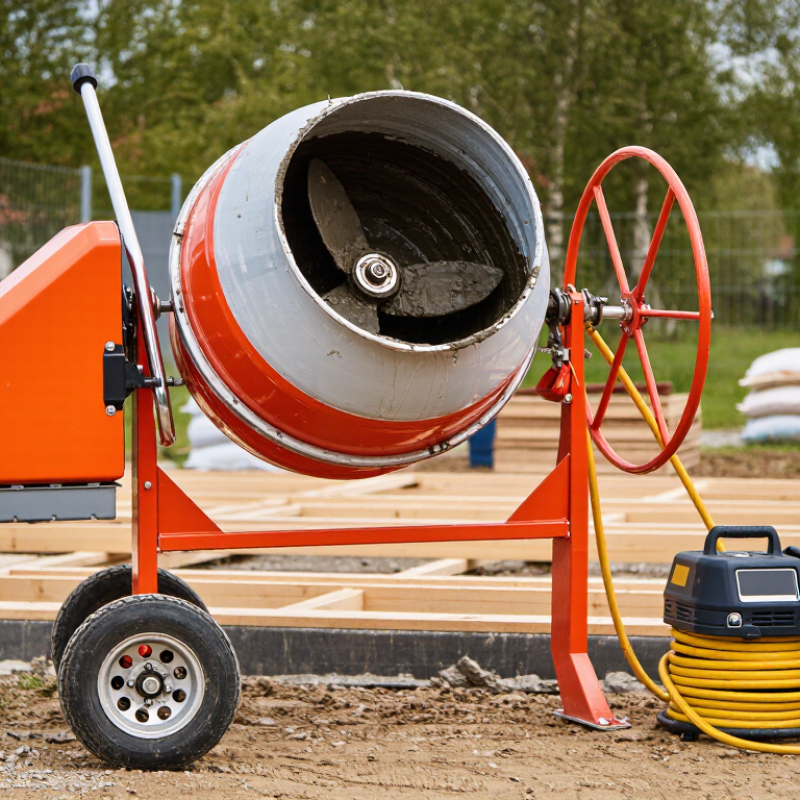
Choosing a cement mixer starts with its working method, not its appearance. A rotating drum tumbles materials through gravity, making it practical for small construction jobs and repair work. It handles concrete, mortar, and general mixtures with moderate consistency. I have found that drum mixers are forgiving, but they may leave dry material near the walls when overloaded.

A pan mixer uses a shallow vessel and rotating blades to scrape and fold the mixture. Its action is more controlled, which suits mortar, plaster, and stiff concrete. Twin-shaft mixers apply strong horizontal agitation from two interlocking shafts. They blend dense batches quickly and evenly, but they require careful cleaning around the blades. Continuous mixers feed ingredients steadily and produce material without stopping between batches. This method can save time on long projects, although accurate feed control becomes essential.

Match the mixer to batch size, material stiffness, and available power. A small electric unit may suit indoor renovation work where ventilation and noise matter. Larger diesel-powered equipment can serve remote sites, but fuel handling adds responsibility. Check the drum capacity against the actual batch, not the advertised maximum. Leave room for movement.

Measure moisture carefully.

From practical use, operator technique often matters as much as mixer design. Adding water too quickly can create weak, uneven concrete. I have made that mistake. A timed mixing cycle, regular inspection, and proper cleaning usually produce more reliable results than rushing for higher output.

Choose the Right Drum Capacity for Your Project

Choosing the right drum capacity starts with your project’s batch size. A mixer that is too small may require constant refilling, while an oversized drum can waste power and space. For small repairs, garden paths, or a few fence posts, a 2- to 3-cubic-foot drum is often practical. Keep empty space inside the drum. Concrete needs room to tumble.

Do not fill the drum to its maximum volume. A workable batch usually uses about two-thirds of the stated capacity, depending on the mix and moisture level. One cubic foot of fresh concrete weighs roughly 140 to 150 pounds, so capacity also affects handling and transport. I once underestimated this detail. The mixer could hold the volume, but moving the loaded unit became difficult. That was an avoidable mistake.

For slabs, footings, or repeated pours, a 5- to 9-cubic-foot drum may reduce loading time. Check the actual batch capacity, not only the drum’s total volume. Also consider access through gates, storage space, and the power supply available at the site. A larger mixer is not automatically better. It may be inefficient for short jobs and harder to control on uneven ground. Before buying, estimate the concrete needed per batch and compare it with the mixer’s recommended working load. Build in a little margin, but not too much.

Match Power and Mobility to Your Worksite

How to Choose the Right Cement Mixer for Your Needs?

Match Power and Mobility to Your Worksite

A cement mixer should match the worksite, not merely the project size. Check the required batch volume, mixing time, and available power before comparing machines. A small residential repair may need a compact electric mixer, while repeated foundation work demands a stronger motor and larger drum. Confirm the site’s electrical supply first. An overloaded circuit can interrupt work and damage equipment.

Mobility matters just as much. On a level slab, solid wheels and a short handle may be enough. On gravel, soft soil, or a sloped driveway, choose wider wheels, balanced weight, and a secure towing point. I have found that a mixer can appear portable in a yard but become awkward near a narrow gate. Measure access routes. Do not trust estimates.

Power must support the material, not just turn an empty drum. Heavy, stiff mixes place more resistance on the motor. A higher-capacity motor may improve consistency, but it can also increase weight and energy use. That trade-off is easy to overlook. Look for guarded moving parts, stable supports, accessible controls, and clear maintenance instructions. Clean the drum after each use, because hardened residue reduces capacity and strains the drive system. A few minutes of washing helps. Even experienced crews sometimes skip it when weather changes or deadlines tighten.

How to Choose the Right Cement Mixer for Your Needs? - Match Power and Mobility to Your Worksite

Mixer Type Typical Batch Capacity Typical Motor or Engine Power Mobility Best Worksite Conditions Recommended Use Key Selection Consideration
Compact Electric Drum Mixer 60–120 L 0.5–1.0 kW Two wheels; manually moved Small residential sites with access to a suitable electrical supply Repair work, posts, paths, small slabs, and occasional concrete batches Choose compact size and low power demand when space and portability matter most
Medium Portable Drum Mixer 120–250 L 0.75–1.5 kW electric motor Wheels; pushed or towed short distances Residential and light commercial sites with relatively level access Footings, driveways, walkways, retaining walls, and general renovation work Balance batch size against available power, transport distance, and unloading space
Towable Drum Mixer 250–500 L 4–13 hp petrol engine or equivalent electric drive Trailer-mounted; towed by a suitable vehicle Large, remote, uneven, or temporary worksites where grid power is limited Foundations, agricultural construction, road repairs, and repeated medium-volume batches Verify towing capacity, access width, ground conditions, and fuel or generator availability
Pan Mixer 100–500 L 2.2–11 kW electric motor Usually stationary or forklift-positioned Prepared production areas with stable ground and reliable electrical service Mortar, concrete products, paving units, stiff mixes, and frequent controlled batches Prioritize mixing action and discharge design when working with low-slump or dense materials
Stationary Large-Batch Mixer 500–1,500 L 15–45 kW electric motor Fixed installation; moved only with lifting equipment Commercial yards, batching areas, and high-volume construction operations Continuous production, large foundations, precast work, and major infrastructure projects Confirm three-phase power, foundation requirements, material flow, and required output per hour
Selection note: Actual power requirements vary with drum design, material moisture, aggregate size, batch load, and local electrical standards. Do not exceed the mixer’s rated capacity, and allow practical space for loading, discharge, cleaning, and safe operator access.

Evaluate Durability, Safety, Maintenance, and Cost

Choosing a cement mixer starts with the worksite, not the price tag. A durable drum should resist abrasion from coarse aggregate and repeated loading. Check drum thickness, frame welds, wheel bearings, and motor protection. A mixer that feels heavy and stable usually handles uneven ground better. Usually, but not always. Capacity also matters. Filling beyond the manufacturer’s working limit can strain the drive system and shorten service life.

Safety requires more than a guarded motor. OSHA’s respirable crystalline silica standard sets a permissible exposure limit of 50 micrograms per cubic meter over an eight-hour shift. Choose a mixer that supports controlled charging, wet mixing, and easy cleaning. Keep hands away from the drum opening and isolate power before maintenance. The U.S. Bureau of Labor Statistics continues to identify construction as a high-risk employment sector, so emergency stops, stable footing, and clear operator training deserve serious attention. Small details matter.

Maintenance affects the real cost. Inspect belts, gears, cables, and fasteners on a scheduled basis. Clean hardened cement after every shift; neglected residue can reduce drum capacity and increase load resistance. The U.S. Department of Energy notes that properly maintained motors can preserve efficiency and reduce operating waste. Record repair time, electricity use, labor, and replacement parts. These figures reveal total ownership cost more honestly than the purchase invoice. A cheaper mixer may become expensive after repeated downtime. I would also allow a repair budget, because even careful operators miss something occasionally. That assumption is less comfortable, but more realistic.

How to Choose the Right Cement Mixer for Your Needs?

Recommended evaluation weights for comparing cement mixers across durability, safety, maintenance, and cost.

How to use this chart: Give each mixer a score from 1 to 5 for every factor, then multiply the score by the recommended weight. Durability and safety receive higher priority because equipment reliability and operator protection directly affect long-term project performance.