

News

Miro: A New Standard in Responsible Innovation

Miro: A New Standard in Responsible Innovation The Miro monitor arm is setting new benchmarks in sustainability. It offers a high-performance solution without compromising on environmental responsibility. Designed with careful material selection, local sourcing, and longevity in mind, Miro’s responsible approach to design and unique manoeuvrability set it apart from the competition. Sustainable Choices Miro is crafted from energy-efficient materials with a lower carbon impact....

Read more
HSE Advisor

Role Purpose Support in the development, implementation and maintenance of the company’s Health, Safety & Environmental policies, processes, operational procedures, and standards.  Ensuring best practice and championing a continually improving HSE culture within the business. Key Responsibilities Liaise with and provide support to all areas of the business to eliminate, mitigate or reduce identified HSE exposures. Partner with the production management team and team leaders,...

Read more
CMD Ltd LAUNCHES 48-HOUR TURNAROUND ON BETATRAK® RAPID ORDERING SERVICE

CMD Ltd, the specialist in power distribution systems, workstation power and monitor arms, has launched a rapid ordering service for its Betatrak® underfloor powertrack distribution systems and accessories, with a commitment to delivering within 48-hours of an approved purchase order*. The service enables customers to order up to 50 lengths of Standard or Clean Earth (C/E) low noise Betatrak, along with up to 25 feed...

Read more

CMD INVESTS £1/4 MILLION IN NEW MACHINE AS PART OF FACTORY UPGRADE

We have invested in a new £1/4m TRUMPF CNC metal punch as part of an asset renewal strategy for our UK manufacturing capability. The new machine will be used in the production of a wide variety of our power distribution systems and workstation power products at our Rotherham factory. Suitable for handling sheet metal between 0.9mm and 3.0mm thick, the new machine will replace one...

Read more

CMD CATALOGUE PROVIDES TECHNICAL POWER DISTRIBUTION GUIDE

CMD Ltd has released a new catalogue, providing an easy to follow technical guide to our power distribution systems and plug and play desk modules. Detailing CMD’s full range of UK-manufactured power distribution systems and plug and play desk modules, the catalogue will be a helpful source of information to M&E engineers and contractors alike to understand how our power distribution systems connect together and...

Read more

Power Distribution Catalogue
CMD Ltd PLAYS ESSENTIAL ROLE IN ELECTRICAL FIT OUT AT LONDON’S PRESTIGIOUS OFFICE DEVELOPMENT

CMD Ltd, specialist in workplace connectivity and ergonomic solutions, has provided a flexible and high-quality power distribution network for The Ray, a prestigious office development in London’s Farringdon. Well-known for being the former site of The Guardian newspaper, The Ray now stands as an 83,000ft² office development characterised by a modernised warehouse aesthetic, with level two now occupied by a global social media company. The...

Read more

The Ray
CMD plugs in to european opportunity with Schuko Capsule unit launch

CMD Ltd, the specialist in power and connectivity solutions for commercial environments, has launched a Schuko version of its popular fixed format Capsule workstation power module for export to mainland Europe and beyond. A popular on desk power module comprising two sockets and dual USB (type A and C) chargers, CMD’s Capsule unit is already widely specified in the UK as an off-the-shelf workstation power...

Read more

CMD White Schuko Capsule Desk Power Module
CMD LTD EXTENDS MONITOR ARM RANGE WITH THE LAUNCH OF REACH PLUS

CMD Ltd, the specialist in ergonomic and connectivity solutions for commercial interiors, has completed its Reach monitor arm range with the launch of the Reach Plus. Available in single or dual screen options, the Reach Plus has been designed to provide an ideal solution for both single and dual screen workstation configurations, or can be used with next generation of large format curved screens. Suitable...

Read more

CMD Ltd DEMONSTRATES THE ART OF POWER DISTRIBUTION AT THE UNIVERSITY OF WARWICK

CMD Ltd, the specialist in workplace connectivity and ergonomic solutions, has provided Betatrak busbar power distribution and a range of electrical accessories for two major capital investment projects at the University of Warwick. Designed by Fielden Clegg Bradley Studios, the £33 million Faculty of Arts building is a showpiece development comprising four interconnected structures set around a central atrium, which will enable inter-disciplinary collaboration across...

Read more

University of Warwick
CMD BRINGS HARMONY TO COVENTRY UNIVERSITY RESEARCH FACILITIES

CMD Ltd, the specialist in power distribution solutions and workstation power and ergonomics, has provided under desk and on desk power modules for the refurbishment of three Coventry University research buildings. Located on Coventry University Technology Park, a business park designed to encourage collaboration between the university and knowledge-based businesses, the three buildings are being repurposed as office accommodation for university research teams. The refurbishment...

Read more

Coventry University

How to Choose a Rotary Pouch Packing Machine?

Choosing a rotary pouch packing machine is not simply a matter of comparing speeds. It is a production decision involving product behavior, pouch material, filling accuracy, labor, maintenance, and future demand. A machine may look impressive in a showroom, yet struggle with sticky powder or irregular granules on a busy factory floor.

PMMI market-development expert Jorge Izquierdo has emphasized, “The most important thing is to understand the process and the product.” That principle remains practical. Before reviewing machine models, manufacturers should test the product’s flow, density, moisture, and particle size. They should also examine pouch width, seal structure, filling range, and target output. Small details matter. A weak seal can waste an entire production shift.

A reliable rotary pouch packing machine should offer stable indexing, accurate dosing, accessible changeover parts, and clear operator controls. Hygienic design also deserves close attention, especially around product-contact areas and dust collection points. Experienced teams should request sample runs using their own materials, not only factory demonstrations. Ask for measured results, including seal strength, giveaway, downtime, and rejected pouch rates.

No checklist is perfect. A machine that suits one plant may disappoint another. Budget pressure can also hide long-term costs. Energy use, spare parts, training, and service response should be considered honestly. This guide explains how to compare these factors, identify avoidable risks, and select equipment that supports dependable production rather than impressive promises.

How to Choose a Rotary Pouch Packing Machine?

Define Your Product and Packaging Requirements

How to Choose a Rotary Pouch Packing Machine?

Define Your Product and Packaging Requirements

Your product should determine the machine, not the other way around. Start with its shape, density, moisture, temperature, and flow behavior. Powdered ingredients may bridge inside the hopper, while oily snacks can contaminate sealing jaws. Granules may require a multihead weigher for stable dosing.

Measure the target fill weight and acceptable variation. Then define pouch width, height, zipper needs, seal style, and film structure. A 2024 report from the Flexible Packaging Association valued the U.S. flexible packaging market at approximately $40 billion in 2023. This scale reflects strong demand, but every product still needs individual testing. Flexible film is not automatically suitable for every barrier requirement.

Consider oxygen, moisture, light, and aroma protection. A food product may need high-barrier laminate, while a dry household product may need a simpler structure. Review the sealing temperature range and friction of the film. Small differences can create wrinkles, weak seals, or leaking corners.

Ask for trials using your actual product and film. Watch the feed path closely. Does powder settle on the seal? Do irregular pieces damage the pouch? These observations matter more than a brochure’s maximum speed. PMMI’s 2024 State of the Industry report recorded U.S. packaging machinery shipments of about $10.2 billion in 2023, showing a mature equipment market. Yet advertised speed can mislead. Real output falls during film changes, cleaning, and adjustments. Build your specification around dependable production, not perfect test conditions.

Compare Rotary Pouch Machine Types and Operating Features

Choosing a rotary pouch packing machine requires more than comparing speed figures. The pouch material, product texture, and required seal quality matter equally. A practical evaluation should begin with daily production volume and pouch dimensions.

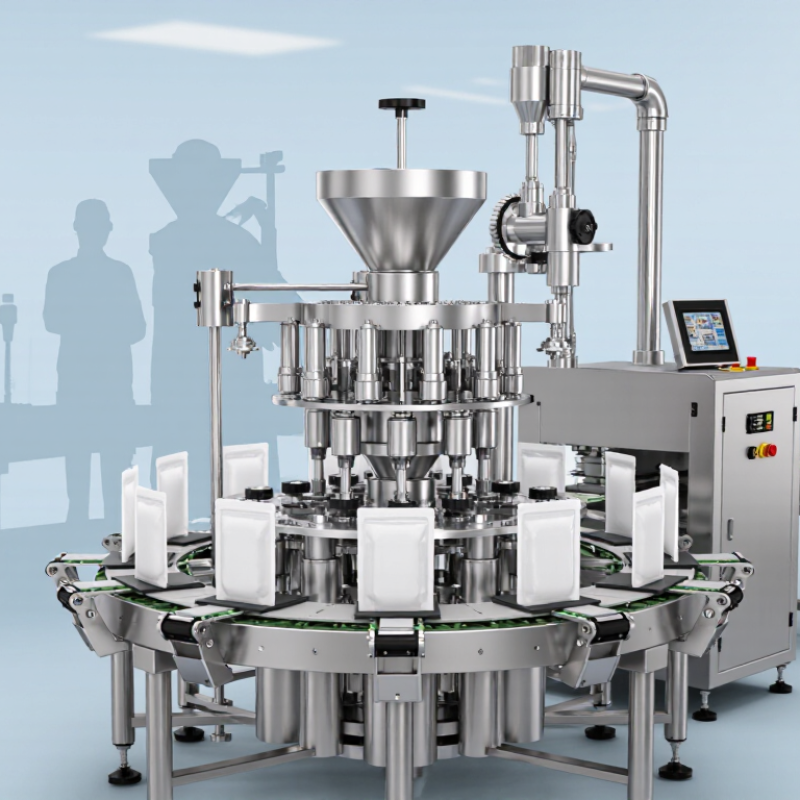
Intermittent-motion rotary machines suit products needing accurate dosing and careful sealing. They pause during filling and sealing, which can improve control for powders, granules, and irregular pieces. Continuous-motion models run faster and reduce stopping time. However, they may require more precise product flow and timing. Check whether the machine supports premade pouches, zipper pouches, spouted pouches, or flat sachets. Flexibility sounds useful, but unused options can increase maintenance work.

Operating features deserve close attention. Servo-driven dosing improves repeatability, while load cells can verify fill weight during production. Adjustable sealing temperature and pressure help protect delicate films. A clear touchscreen, recipe storage, and fault history can shorten operator training. Automatic film tracking is valuable when film edges shift slightly. It still needs regular inspection. Sensors should detect empty pouches, open seals, and product trapped in the sealing area. Washdown design, tool-free access, and stainless-steel contact parts support cleaner changeovers. In production reviews, changeover time is often underestimated. Measure the full process, including cleaning, adjustment, and test packs. A faster machine may become less productive when operators struggle with access or frequent adjustments. Reliability also depends on spare-part availability, service response, and documented operating procedures.

How to Choose a Rotary Pouch Packing Machine?

Compare typical throughput and operating features of common rotary pouch machine configurations.

Intermittent-Motion Rotary

A flexible choice for standard premade pouches, powders, granules, and irregular products. It generally offers easier changeovers and moderate speed.

Continuous-Motion Rotary

Designed for higher output with reduced stopping between stations. It is suitable for stable products and production lines that prioritize speed.

Vacuum Rotary

Removes air before sealing and is commonly selected for meat, seafood, cheese, and other products where reduced oxygen exposure is important.

MAP / Gas-Flushing Rotary

Replaces pouch air with a controlled gas mixture before sealing. It supports products that require a modified atmosphere and careful seal integrity.

The chart shows representative midpoints of common industry operating ranges: approximately 30–60, 60–100, 20–50, and 20–40 pouches per minute respectively. Actual output depends on pouch size, filling volume, product characteristics, sealing time, and the number of machine stations.

Evaluate Capacity, Accuracy, and Pouch Size Compatibility

How to Choose a Rotary Pouch Packing Machine?

Capacity, accuracy, and pouch size compatibility should guide your machine selection. A machine rated for 60 pouches per minute may slow down with heavy products, wide pouches, or delicate materials. Check the practical output, not only the advertised speed. Ask for trial data using your actual product, pouch film, and target weight.

Accuracy depends on the filling system, product flow, and weighing method. Granules may require a different filler from powders or irregular pieces. During testing, record ten or more consecutive weights. Small variations can become expensive over a long production shift.

I have seen teams focus on speed and overlook seal consistency. That mistake is easy to make. Inspect the seal width, temperature stability, and rejected pouch rate.

Pouch compatibility also needs careful checking. Confirm the minimum and maximum pouch width, height, thickness, zipper position, and spout location. A machine may handle several formats, but frequent size changes can reduce output. Changeover time matters.

Tips: Bring real pouches to the factory trial. Test the smallest and largest sizes. Leave room for future products, but do not pay for unused capacity. Write down every setting, result, and adjustment. My own preference is to repeat difficult tests, because one successful run can create false confidence.

Check Materials, Automation, Sanitation, and Safety Standards

Choosing a rotary pouch packing machine begins with the material, not the advertised speed. Film thickness, sealability, pouch size, powder flow, and product moisture all affect performance. A machine that handles dry granules may struggle with sticky products. Test your actual material before purchase. Small trials reveal problems that brochures often hide.

Automation should match your operators and production volume. Servo-driven filling, automatic film tracking, weight feedback, and recipe storage can improve consistency. Sensors should detect empty pockets, sealing faults, and film misalignment. I once underestimated changeover time; cleaning and format adjustments reduced daily output more than expected. Simple controls may be better than excessive automation.

Sanitation requires practical access. Choose smooth stainless-steel surfaces, removable contact parts, protected wiring, and designs that prevent product buildup. Check whether tools are needed for routine cleaning. Shorter cleaning routes matter. Safety cannot be treated as an optional feature. Confirm guarding, door interlocks, emergency stops, overload protection, and clear lockout procedures. Ask for risk-assessment documents and evidence of conformity with applicable local and industry standards. Do not accept vague claims. Review manuals, inspection records, and operator training requirements. A machine may meet a standard on paper, yet still create awkward cleaning or maintenance risks on the factory floor.

Assess Installation, Maintenance, Cost, and Supplier Support

How to Choose a Rotary Pouch Packing Machine?

Installation deserves more attention than catalog speed. Measure ceiling height, floor loading, electrical capacity, compressed-air quality, and feeding distances before purchase. A machine that fits the room may still obstruct maintenance access. Request a documented commissioning plan, operator training, and format-change tests using your actual pouch film. PMMI’s State of the Industry reporting placed U.S. packaging machinery shipments at about $10.2 billion in 2022, showing a mature market where integration quality strongly affects investment value.

Maintenance should be judged through evidence, not promises. Ask for lubrication charts, fault-history exports, accessible sensors, and a critical-spares list. The U.S. Department of Energy’s Operations & Maintenance Best Practices guide reports that predictive maintenance can reduce maintenance costs by 25–30% and downtime by 35–45%. Those figures are useful, but not automatic. Poor data collection can make predictive maintenance expensive theater. Check whether technicians can diagnose sealing temperature drift before rejected pouches accumulate.

Cost includes labor, utilities, film waste, training, and lost production. Build a three-year total-cost model, then challenge every assumption. Supplier support matters here. Confirm response times, remote-access procedures, local service coverage, software-update policies, and spare-part availability. Ask for references from facilities with similar pouch sizes and changeover frequency. A low purchase price can become costly after one unavailable servo drive. I would also test the supplier’s honesty: request known limitations, not only performance claims. That conversation often reveals more than a polished demonstration.