Miro: A New Standard in Responsible Innovation The Miro monitor arm is setting new benchmarks in sustainability. It offers a high-performance solution without compromising on environmental responsibility. Designed with careful material selection, local sourcing, and longevity in mind, Miro’s responsible approach to design and unique manoeuvrability set it apart from the competition. Sustainable Choices Miro is crafted from energy-efficient materials with a lower carbon impact....
Role Purpose Support in the development, implementation and maintenance of the company’s Health, Safety & Environmental policies, processes, operational procedures, and standards. Ensuring best practice and championing a continually improving HSE culture within the business. Key Responsibilities Liaise with and provide support to all areas of the business to eliminate, mitigate or reduce identified HSE exposures. Partner with the production management team and team leaders,...
CMD Ltd LAUNCHES 48-HOUR TURNAROUND ON BETATRAK® RAPID ORDERING SERVICE
March 3, 2022
CMD Ltd, the specialist in power distribution systems, workstation power and monitor arms, has launched a rapid ordering service for its Betatrak® underfloor powertrack distribution systems and accessories, with a commitment to delivering within 48-hours of an approved purchase order*. The service enables customers to order up to 50 lengths of Standard or Clean Earth (C/E) low noise Betatrak, along with up to 25 feed...
CMD INVESTS £1/4 MILLION IN NEW MACHINE AS PART OF FACTORY UPGRADE
September 29, 2021
We have invested in a new £1/4m TRUMPF CNC metal punch as part of an asset renewal strategy for our UK manufacturing capability. The new machine will be used in the production of a wide variety of our power distribution systems and workstation power products at our Rotherham factory. Suitable for handling sheet metal between 0.9mm and 3.0mm thick, the new machine will replace one...
CMD CATALOGUE PROVIDES TECHNICAL POWER DISTRIBUTION GUIDE
August 18, 2021
CMD Ltd has released a new catalogue, providing an easy to follow technical guide to our power distribution systems and plug and play desk modules. Detailing CMD’s full range of UK-manufactured power distribution systems and plug and play desk modules, the catalogue will be a helpful source of information to M&E engineers and contractors alike to understand how our power distribution systems connect together and...
CMD Ltd PLAYS ESSENTIAL ROLE IN ELECTRICAL FIT OUT AT LONDON’S PRESTIGIOUS OFFICE DEVELOPMENT
July 22, 2021
CMD Ltd, specialist in workplace connectivity and ergonomic solutions, has provided a flexible and high-quality power distribution network for The Ray, a prestigious office development in London’s Farringdon. Well-known for being the former site of The Guardian newspaper, The Ray now stands as an 83,000ft² office development characterised by a modernised warehouse aesthetic, with level two now occupied by a global social media company. The...
CMD plugs in to european opportunity with Schuko Capsule unit launch
July 1, 2021
CMD Ltd, the specialist in power and connectivity solutions for commercial environments, has launched a Schuko version of its popular fixed format Capsule workstation power module for export to mainland Europe and beyond. A popular on desk power module comprising two sockets and dual USB (type A and C) chargers, CMD’s Capsule unit is already widely specified in the UK as an off-the-shelf workstation power...
CMD LTD EXTENDS MONITOR ARM RANGE WITH THE LAUNCH OF REACH PLUS
June 30, 2021
CMD Ltd, the specialist in ergonomic and connectivity solutions for commercial interiors, has completed its Reach monitor arm range with the launch of the Reach Plus. Available in single or dual screen options, the Reach Plus has been designed to provide an ideal solution for both single and dual screen workstation configurations, or can be used with next generation of large format curved screens. Suitable...
CMD Ltd DEMONSTRATES THE ART OF POWER DISTRIBUTION AT THE UNIVERSITY OF WARWICK
June 16, 2021
CMD Ltd, the specialist in workplace connectivity and ergonomic solutions, has provided Betatrak busbar power distribution and a range of electrical accessories for two major capital investment projects at the University of Warwick. Designed by Fielden Clegg Bradley Studios, the £33 million Faculty of Arts building is a showpiece development comprising four interconnected structures set around a central atrium, which will enable inter-disciplinary collaboration across...
CMD BRINGS HARMONY TO COVENTRY UNIVERSITY RESEARCH FACILITIES
May 18, 2021
CMD Ltd, the specialist in power distribution solutions and workstation power and ergonomics, has provided under desk and on desk power modules for the refurbishment of three Coventry University research buildings. Located on Coventry University Technology Park, a business park designed to encourage collaboration between the university and knowledge-based businesses, the three buildings are being repurposed as office accommodation for university research teams. The refurbishment...
Choosing the right Bridge Gantry crane begins with the worksite, not the catalogue. Every project has different lifting demands, travel paths, ground conditions, and safety risks. A crane that performs well in a steel warehouse may struggle on uneven outdoor rails.
According to lifting-equipment consultant Martin Keller, “The best crane is not the largest one; it is the one that matches the load, movement, and environment.” This principle deserves careful attention. Rated capacity matters, but it is only one part of the decision. Buyers must also examine span, lifting height, duty cycle, wheel loads, power supply, control systems, and maintenance access.
Picture the daily operation. A ten-ton load moves beneath a low roof. Wind pushes against a container. A trolley stops several times each hour. These details influence the correct Bridge Gantry design more than a simple capacity label. Operators also need clear visibility, responsive braking, reliable limit switches, and practical emergency controls.
Experience can expose weak assumptions. A calculated load may exclude lifting tools, impact forces, or future production changes. That mistake can become expensive. Sometimes, the cheaper crane is not the economical choice.
This guide explains how to compare crane structures, operating conditions, safety features, and supplier support. It also considers installation space and long-term service requirements. The final choice should reflect verified data, competent engineering review, and honest discussion with the manufacturer. A perfect selection is not always possible. A carefully questioned one is far safer.
Define the Load, Span, Lift Height, and Duty Requirements
How to Choose the Right Bridge Gantry Crane?
Define the Load, Span, Lift Height, and Duty Requirements
Start with the load, not the crane size. Record the heaviest item, load shape, lifting points, and any attachments used below the hook. A 10-ton machine may need more capacity when fixtures, slings, and impact forces are included. Do not rely on an average load. Occasional overloads can distort equipment choices and increase structural stress.
Measure the span between runway rails carefully. A small measurement error can affect wheel loads, beam deflection, and installation cost. Check the available lift height, including the hook’s highest and lowest positions. A low ceiling, roof truss, or nearby pipe may reduce usable clearance. Draw the lifting path on site. It often reveals obstacles that drawings miss.
Duty requirements are equally important. Estimate lifts per hour, operating hours per day, load distribution, travel distance, and expected service life. A crane moving light loads occasionally has different needs from one handling near-capacity loads continuously. Select suitable controls, brakes, wheels, and structural members with help from a qualified engineer. Applicable safety standards must guide the design and inspection plan. A conservative choice is not always the best choice. Excess capacity can increase dead weight, power demand, and building loads. Review the assumptions before ordering. Some details will still change after operators test the workflow.
Compare Bridge Gantry Crane Configurations and Operating Environments
How to Choose the Right Bridge Gantry Crane?
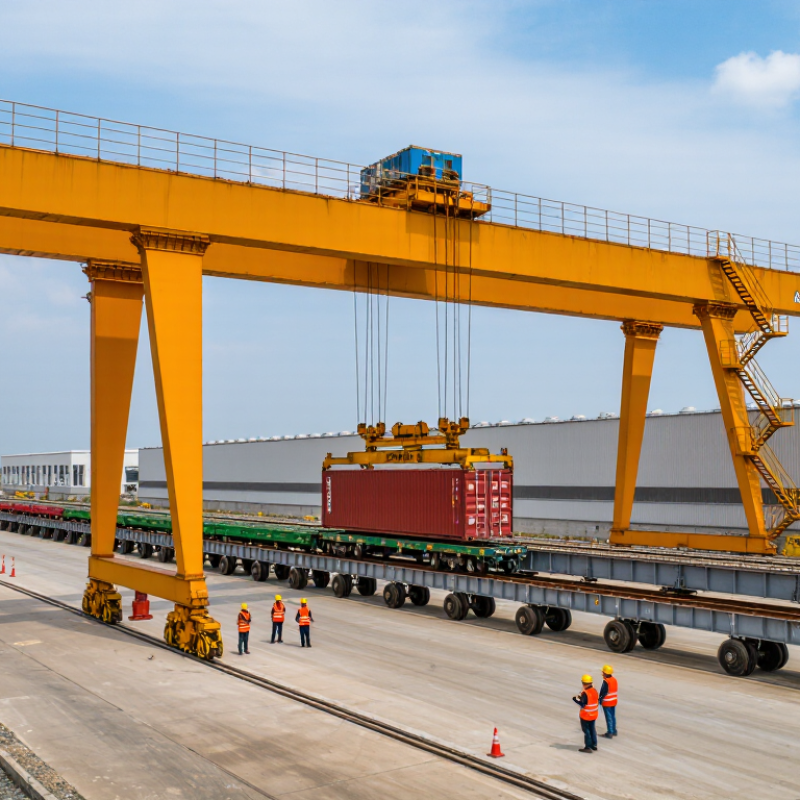
A bridge gantry crane should match the building, load path, and working climate. Compare the configuration before comparing price.
Single-girder systems suit moderate loads and shorter spans. Double-girder models provide greater lifting height and heavier-duty performance.
Fixed legs work well on permanent rails. Adjustable legs help when floor levels or bay widths change.
Operating conditions matter just as much.
Indoor workshops usually need compact wheels, low headroom, and precise controls.
The CMAA Specification No. 70 stresses proper duty classification and structural design. OSHA 1910.179 also requires rated-load markings and regular inspections. MHI’s 2024 Annual Industry Report found that 55% of supply-chain leaders planned to increase technology investment.
Remote diagnostics may reduce downtime, but they cannot replace physical inspections. I have seen teams overestimate automation and underestimate dust, rain, and poor visibility.
Tips:
Record the heaviest load, lifting frequency, span, hook height, and temperature range. Check power availability and emergency access. Ask an engineer to verify runway loads and wheel pressures. Select a higher duty class only when usage proves it necessary. Overspecification wastes capital. Underspecification creates risk. Document every assumption, because site measurements are sometimes wrong.
Evaluate Structural Design, Mobility, Power, and Control Features
Choosing the right bridge gantry crane starts with structural evidence, not catalogue capacity. Verify rated load, span, headroom, beam deflection, wheel loads, anchorage, and end stops. ISO 4301-1 classifies cranes by utilization and load spectrum, not lifting capacity alone. A five-ton crane used every hour may need a higher duty class than one used twice daily. That distinction is often missed. The U.S. Occupational Safety and Health Administration requires rated-load markings and regular inspections under 29 CFR 1910.179.
Mobility should match the work area. Rails suit repeated travel along a fixed path, while lockable casters support short repositioning on prepared floors. Measure floor flatness and confirm the surface can carry concentrated wheel loads. Power selection also depends on duty cycle, acceleration, ambient temperature, and voltage stability. The U.S. Department of Energy reports that motor-driven systems consume more than half of industrial electricity. Efficient drives and controlled acceleration can reduce waste, although savings depend on actual operating patterns. Do not assume a variable-frequency drive solves every power problem.
Control features should make load movement predictable. Specify overload protection, upper and lower limit switches, emergency stopping, brake monitoring, and clear status indicators. Radio controls can improve visibility, but poor signal planning creates new risks. OSHA recorded 72 crane-related construction fatalities from 2011 through 2017. That figure deserves attention. Before purchasing, record lift frequency, travel distance, floor conditions, and operator complaints for several weeks. I would not treat a modern control panel as proof of safety. Its value depends on inspection, training, and disciplined daily use.
How to Choose the Right Bridge Gantry Crane?
Evaluate structural design, mobility, power, and control features using typical industrial specification ranges.
How to interpret the chart
Rail-mounted gantry cranes generally provide the highest capacity and travel efficiency on fixed routes. Rubber-tyred gantry cranes offer greater mobility but usually require more power. Semi-gantry cranes suit facilities with limited floor space, while portable aluminum gantry cranes are intended for lighter loads and short spans.
When selecting a crane, also verify structural deflection, wheel and rail loading, duty classification, emergency stopping, variable-frequency drives, overload protection, limit switches, radio controls, and required positioning accuracy. The figures shown are representative upper-end values for common non-brand industrial configurations and must be confirmed against the final engineering design.
Verify Safety Standards, Installation Needs, and Maintenance Access
Choosing a bridge gantry crane starts with verifiable safety standards, not lifting capacity alone. OSHA’s construction analysis recorded 297 crane-related deaths between 2003 and 2008, averaging nearly 50 annually. That older dataset still exposes the risk of weak planning. Check compliance with applicable standards, such as ISO 12480-1, ISO 9927, ASME B30.2, or EN 15011. Confirm emergency stops, overload protection, limit switches, guarding, inspection records, and operator training.
Installation conditions deserve equal attention. Measure the runway span, headroom, floor strength, foundation loads, wind exposure, and nearby obstructions. Confirm that electrical power matches the crane’s starting and running requirements. Leave enough clearance for suspended loads and maintenance vehicles. A site drawing may look complete, yet overlook drainage or uneven rails. That mistake becomes expensive. The U.S. Bureau of Labor Statistics reported 1,008 fatal occupational injuries involving cranes between 2011 and 2017, showing why site details matter.
Maintenance access should be designed before delivery. Provide safe platforms, isolation points, lighting, and reachable lubrication locations. Technicians need clear access to brakes, ropes, wheels, controls, and electrical panels without standing beneath a suspended load. ISO 9927 recommends systematic inspections, while manufacturer instructions define service intervals. Keep inspection logs with dates, findings, repairs, and responsible personnel. Small omissions remain possible. Recheck the layout with operators and maintenance staff; they often identify blind spots that engineering drawings miss.
Assess Total Cost, Supplier Support, and Long-Term Performance
How to Choose the Right Bridge Gantry Crane?
Price is only the visible part of a bridge gantry crane’s cost. Include installation, power consumption, inspections, spare parts, operator training, and planned downtime. The U.S. Department of Energy notes that operations and maintenance can represent 60–70% of a facility’s lifecycle cost. A cheaper crane may therefore become expensive after several years. Request a five-year cost model, not only a purchase quotation. Include runway changes and foundation work.
Supplier support deserves equal attention. Ask for documented response times, technician coverage, spare-parts availability, and digital maintenance records. The U.S. Bureau of Labor Statistics reported 1,075 fatal construction workplace injuries in 2023. That figure does not describe crane accidents alone, but it reinforces the need for competent inspections and training. Check whether the supplier explains load testing, emergency procedures, and preventive maintenance clearly. Vague answers are warning signs.
Long-term performance depends on duty class, load spectrum, environment, and control quality. ISO 4301-1 evaluates crane classification through operating cycles and load conditions, so capacity alone is not enough. Compare rated loads with actual lifting frequency. A warehouse lifting two tonnes hourly needs a different design from a fabrication plant lifting eight tonnes repeatedly. I have seen buyers overestimate future capacity and pay for unused steel. That choice feels safe, but it can reduce efficiency. Ask for fatigue calculations, brake-life assumptions, warranty limits, and measured energy data. Get everything in writing.