

News

Miro: A New Standard in Responsible Innovation

Miro: A New Standard in Responsible Innovation The Miro monitor arm is setting new benchmarks in sustainability. It offers a high-performance solution without compromising on environmental responsibility. Designed with careful material selection, local sourcing, and longevity in mind, Miro’s responsible approach to design and unique manoeuvrability set it apart from the competition. Sustainable Choices Miro is crafted from energy-efficient materials with a lower carbon impact....

Read more
HSE Advisor

Role Purpose Support in the development, implementation and maintenance of the company’s Health, Safety & Environmental policies, processes, operational procedures, and standards.  Ensuring best practice and championing a continually improving HSE culture within the business. Key Responsibilities Liaise with and provide support to all areas of the business to eliminate, mitigate or reduce identified HSE exposures. Partner with the production management team and team leaders,...

Read more
CMD Ltd LAUNCHES 48-HOUR TURNAROUND ON BETATRAK® RAPID ORDERING SERVICE

CMD Ltd, the specialist in power distribution systems, workstation power and monitor arms, has launched a rapid ordering service for its Betatrak® underfloor powertrack distribution systems and accessories, with a commitment to delivering within 48-hours of an approved purchase order*. The service enables customers to order up to 50 lengths of Standard or Clean Earth (C/E) low noise Betatrak, along with up to 25 feed...

Read more

CMD INVESTS £1/4 MILLION IN NEW MACHINE AS PART OF FACTORY UPGRADE

We have invested in a new £1/4m TRUMPF CNC metal punch as part of an asset renewal strategy for our UK manufacturing capability. The new machine will be used in the production of a wide variety of our power distribution systems and workstation power products at our Rotherham factory. Suitable for handling sheet metal between 0.9mm and 3.0mm thick, the new machine will replace one...

Read more

CMD CATALOGUE PROVIDES TECHNICAL POWER DISTRIBUTION GUIDE

CMD Ltd has released a new catalogue, providing an easy to follow technical guide to our power distribution systems and plug and play desk modules. Detailing CMD’s full range of UK-manufactured power distribution systems and plug and play desk modules, the catalogue will be a helpful source of information to M&E engineers and contractors alike to understand how our power distribution systems connect together and...

Read more

Power Distribution Catalogue
CMD Ltd PLAYS ESSENTIAL ROLE IN ELECTRICAL FIT OUT AT LONDON’S PRESTIGIOUS OFFICE DEVELOPMENT

CMD Ltd, specialist in workplace connectivity and ergonomic solutions, has provided a flexible and high-quality power distribution network for The Ray, a prestigious office development in London’s Farringdon. Well-known for being the former site of The Guardian newspaper, The Ray now stands as an 83,000ft² office development characterised by a modernised warehouse aesthetic, with level two now occupied by a global social media company. The...

Read more

The Ray
CMD plugs in to european opportunity with Schuko Capsule unit launch

CMD Ltd, the specialist in power and connectivity solutions for commercial environments, has launched a Schuko version of its popular fixed format Capsule workstation power module for export to mainland Europe and beyond. A popular on desk power module comprising two sockets and dual USB (type A and C) chargers, CMD’s Capsule unit is already widely specified in the UK as an off-the-shelf workstation power...

Read more

CMD White Schuko Capsule Desk Power Module
CMD LTD EXTENDS MONITOR ARM RANGE WITH THE LAUNCH OF REACH PLUS

CMD Ltd, the specialist in ergonomic and connectivity solutions for commercial interiors, has completed its Reach monitor arm range with the launch of the Reach Plus. Available in single or dual screen options, the Reach Plus has been designed to provide an ideal solution for both single and dual screen workstation configurations, or can be used with next generation of large format curved screens. Suitable...

Read more

CMD Ltd DEMONSTRATES THE ART OF POWER DISTRIBUTION AT THE UNIVERSITY OF WARWICK

CMD Ltd, the specialist in workplace connectivity and ergonomic solutions, has provided Betatrak busbar power distribution and a range of electrical accessories for two major capital investment projects at the University of Warwick. Designed by Fielden Clegg Bradley Studios, the £33 million Faculty of Arts building is a showpiece development comprising four interconnected structures set around a central atrium, which will enable inter-disciplinary collaboration across...

Read more

University of Warwick
CMD BRINGS HARMONY TO COVENTRY UNIVERSITY RESEARCH FACILITIES

CMD Ltd, the specialist in power distribution solutions and workstation power and ergonomics, has provided under desk and on desk power modules for the refurbishment of three Coventry University research buildings. Located on Coventry University Technology Park, a business park designed to encourage collaboration between the university and knowledge-based businesses, the three buildings are being repurposed as office accommodation for university research teams. The refurbishment...

Read more

Coventry University

How to Choose a Pneumatic Punching Machine in 2026?

Choosing a Pneumatic Punching Machine in 2026 requires more than comparing pressure ratings and catalogue prices. The decision affects output, air consumption, worker safety, tooling life, and maintenance costs. Grand View Research valued the global pneumatic equipment market at approximately USD 27.5 billion in 2023. It also forecasts steady growth through 2030. MarketsandMarkets similarly identifies automation, manufacturing efficiency, and compact equipment as major market drivers. However, these reports cover broad pneumatic systems, not punching machines alone. That limitation matters.

“Pneumatics is not dead; it is changing.” — Dr. Peter Post, former Head of Research at Festo.

A suitable Pneumatic Punching Machine should match the material, hole diameter, stroke length, cycle speed, and required force. Imagine a production bench cutting stainless-steel blanks every six seconds. A small pressure drop can create incomplete holes, noisy impacts, or premature die wear. Moisture in the air line can make the problem worse. It is easy to focus on maximum punching force. That may be the wrong starting point.

This guide examines practical selection factors, including compressor capacity, air preparation, control systems, guarding, noise, and total ownership cost. ISO 12100 risk assessment and ISO 13849 safety principles should inform machine evaluation. Supplier claims still need verification. A brochure cannot reveal vibration after eight hours, nor maintenance difficulty beneath a crowded frame. My own caution is simple: market growth does not guarantee suitability. The best machine is the one that performs reliably under your real material, tooling, and production conditions.

How to Choose a Pneumatic Punching Machine in 2026?

What Is a Pneumatic Punching Machine?

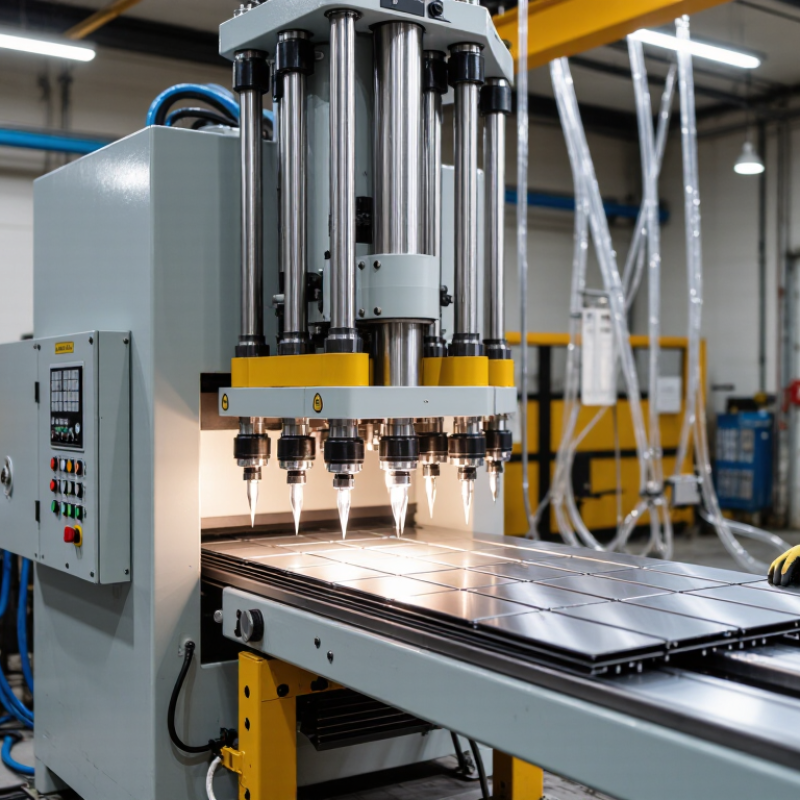
A pneumatic punching machine uses compressed air to drive a punch through sheet material. It creates holes, slots, or formed openings with controlled downward force. Unlike manual punching, it delivers repeatable movement and reduces operator effort. The machine usually includes an air cylinder, punch, die, frame, and foot or hand control. When the control activates, air pressure moves the cylinder, and the punch enters the die. The cut piece then falls away or remains attached, depending on the tool design.

In practical workshops, these machines process materials such as mild steel, aluminum, plastic, and gasket sheet. Their performance depends on material thickness, punch diameter, air pressure, and cycle speed. A larger punch does not always mean better production. It may require more force and cause rougher edges. I have found that alignment often matters more than advertised speed. Even a powerful machine can produce uneven holes when the die is worn or poorly centered. That detail is easy to overlook.

Tips: Check the rated punching force against your thickest material. Inspect the punch and die for chips before each shift. Use a stable work table and keep fingers away from the tooling area. Ask whether replacement tooling is easy to obtain. Also, measure actual noise and air consumption in your workshop. Catalog figures can be optimistic. Safety guards and emergency controls deserve a hands-on inspection, not just a checklist review.

How Does a Pneumatic Punching Machine Work?

How to Choose a Pneumatic Punching Machine in 2026?

A pneumatic punching machine converts compressed-air energy into controlled linear motion. Air enters a cylinder through a directional valve. The pressure pushes a piston, which drives the punch toward the die. When the valve changes position, exhaust air leaves the cylinder, and the ram returns. The punch cuts or forms material only when alignment, clearance, and timing work together. Force depends on air pressure and piston area, not pressure alone. The U.S. Department of Energy reports that compressed-air leaks can waste 20% to 30% of compressor output. That loss can make a correctly sized machine perform poorly. In practice, the clean diagram is not the whole story.

Look for adjustable stroke length, guarded tooling, a stable frame, and a pressure regulator. ISO 8573-1 classifies compressed-air cleanliness, moisture, and oil content, so air preparation should match the cylinder and production environment. A 2024 industrial energy-efficiency review from the International Energy Agency continues to identify compressed-air optimization as a practical efficiency measure. Check the machine at its real operating speed. A machine that punches well during a short demonstration may hesitate during continuous cycles. That assumption deserves checking. Record pressure drop, cycle time, noise, and rejected parts before purchase.

Tips: Use a filter-regulator-lubricator only when the cylinder manufacturer permits lubrication. Inspect hoses and fittings weekly. Keep punch-to-die clearance within the material supplier’s recommendation. Ask for measured force data, not only a catalog rating. Small leaks sound harmless. They are not.

How to Choose a Pneumatic Punching Machine in 2026?

A pneumatic punching machine converts compressed-air pressure into linear force. The chart shows the theoretical push force produced by different cylinder bores at a gauge pressure of 0.6 MPa.

How it works: Compressed air enters the cylinder and pushes the piston. The piston transfers force through the punch to the material. The theoretical force is calculated as F = P × A, where pressure is multiplied by the piston area. Actual punching capacity is lower because of friction, air losses, tooling design, material strength, and machine safety limits.

Which Machine Specifications Fit Your Production Needs?

How to Choose a Pneumatic Punching Machine in 2026?

Which Machine Specifications Fit Your Production Needs?

Start with the material, hole pattern, and hourly output. A thicker sheet needs higher punching force, but force alone can mislead. Calculate force from cut perimeter, material thickness, and shear strength. Then add a practical safety margin, often 20–30%. Check stroke length and throat depth against your largest workpiece. A short throat may limit production, even when the machine has enough force.

Speed must match the complete cycle, not the catalog headline. Compare strokes per minute, feeding time, die changes, and operator handling. For repeated holes, a stable 40–60 strokes per minute may outperform a faster machine with frequent pauses. Die size matters too. Confirm the available working area and maximum tool diameter before ordering. Measure the bottleneck.

Air consumption deserves equal attention. The U.S. Department of Energy’s Compressed Air System Best Practices guide reports that leaks can waste 20–30% of compressor output. Select a machine with stated air consumption per cycle, operating pressure, and receiver requirements. ISO 8573-1 also provides air-quality classes for particles, water, and oil. Poor air quality can damage valves and reduce repeatability.

I have seen specifications overlooked here. That mistake becomes expensive.

Include guarding, emergency stops, noise data, and maintenance access in the comparison. A machine that fits production but slows inspections is not truly efficient.

How Should You Compare Safety, Durability, and Maintenance?

Choosing a pneumatic punching machine in 2026 requires more than comparing pressure and price. Safety, durability, and maintenance should guide the decision. In a working shop, observe the machine under realistic conditions. Check the guard, foot pedal, emergency stop, and control response. The operator should not reach near the punch during normal use. Clear warning labels and accessible instructions also matter. Small details often prevent serious mistakes.

Durability depends on the frame, cylinder, tooling support, and air system. Look for rigid construction and clean welds around stressed areas. The machine should hold alignment after repeated cycles. Ask for load-test records, service history, and replacement-part availability. A powerful cylinder is not enough. Poor alignment can damage tools and create uneven holes. I have seen buyers focus on output speed and overlook vibration. That choice can become expensive.

Maintenance should be simple enough for daily use. Inspect hoses, fittings, guides, and fasteners on a written schedule. Moisture in compressed air can shorten component life, so filtration and drainage deserve attention. Choose a design with reachable lubrication points and removable wear parts. Ask how long common repairs normally take. No machine stays perfect. A realistic maintenance plan is better than optimistic promises. Keep inspection records, but review them critically when noise, leakage, or slower cycles appear.

How Can You Evaluate Cost, Installation, and Supplier Support?

How to Choose a Pneumatic Punching Machine in 2026?

Cost evaluation should begin with the complete operating picture, not the machine price alone. Request an itemized quotation covering tooling, delivery, installation, training, spare parts, and routine maintenance. A machine using excessive compressed air may raise monthly costs. Check its air consumption, cycle speed, working pressure, and expected service intervals. In practical factory evaluations, a cheaper machine can become expensive when replacement punches arrive slowly. The first quotation is rarely complete. Ask what is excluded.

Installation also deserves careful measurement. Confirm the machine’s footprint, floor loading, electrical supply, air quality, and ventilation requirements. Leave space for tool changes and safe operator movement. Ask whether the supplier provides commissioning and production testing. A short demonstration may hide vibration, noise, or inconsistent punching during longer runs. Record sample results using your actual material and thickness. Small details matter.

Tips: Compare at least three written quotations. Request a layout drawing before purchase. Check response times for technical questions. Ask how quickly common spare parts can ship. Supplier support should include clear manuals, operator training, troubleshooting guidance, and documented warranty terms. Verify who handles remote diagnosis and on-site service. A confident supplier will explain limitations, not promise perfection. No checklist is flawless, so let maintenance staff review the final decision.