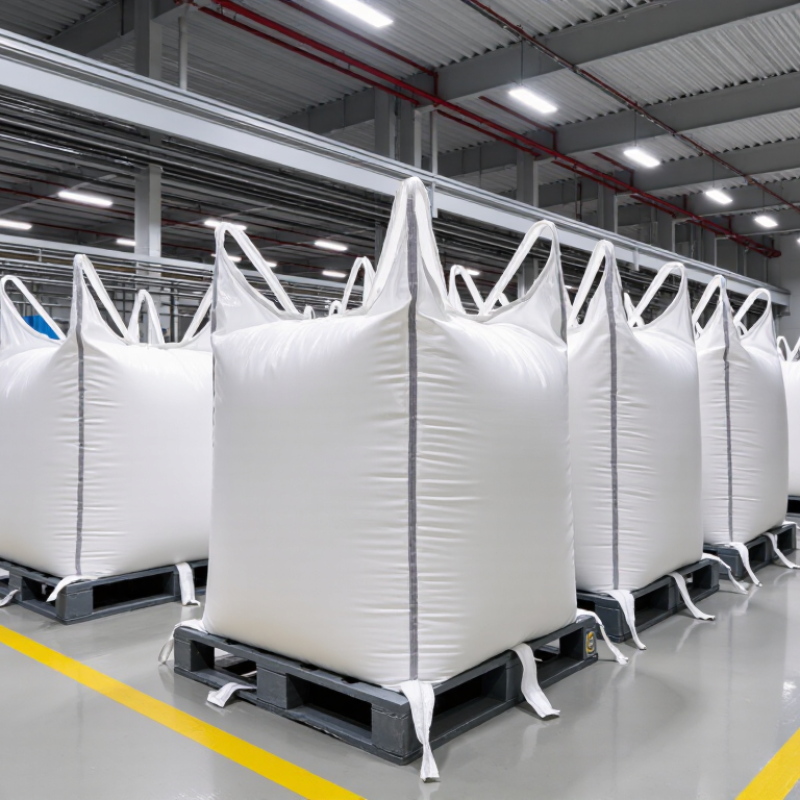
| FIBC Design and Load Capacity | 15% | Common commercial FIBC safe working loads are approximately 500–2,000 kg, depending on construction, dimensions, material, and filling conditions. | Approved drawings showing bag dimensions, square-bottom construction, lifting-loop configuration, discharge spout, liner option, safe working load, and safety factor. | Pass when the design is supported by calculations, drawings, and a documented load specification. |
| Applicable Product Standard | 12% | ISO 21898 specifies requirements and test methods for flexible intermediate bulk containers intended for non-dangerous goods. | Current conformity documentation, test reports, product specifications, and traceability to the applicable edition of ISO 21898. | Pass when the supplier clearly identifies the applicable standard and product scope. |
| Safety Factor and Top-Lift Performance | 12% | FIBC safety factors are commonly specified as 5:1 or 6:1, but the required rating depends on the intended reuse and handling cycle. | Independent or controlled internal top-lift test reports, test load, test duration, number of cycles, failure criteria, and sample identification. | Pass when test conditions match the intended working load and reuse category. |
| Fabric and Tape Quality | 10% | Woven polypropylene fabric and tapes should have consistent denier, tensile strength, elongation, coating quality, and UV-resistance requirements where exposure is expected. | Incoming inspection records, fabric technical data sheets, tensile-test results, coating checks, and batch-level raw-material traceability. | Pass when each production batch can be linked to defined material specifications. |
| Seam and Stitching Control | 10% | Critical seams should be designed and tested for the specified load; seam performance depends on stitch type, thread, stitch density, and construction. | Seam-strength test results, sewing specifications, stitch-density standards, operator instructions, and inspection records for body, corners, loops, and spouts. | Pass when seam testing covers all load-bearing components, not only the fabric. |
| Square-Bottom Stability and Discharge Function | 10% | A square-bottom FIBC should maintain its intended footprint during filling, storage, transport, and discharge without unacceptable leaning or deformation. | Prototype test records for filling height, pallet stability, stacking, forklift handling, discharge-spout operation, and residual-material performance. | Pass when the completed bag is tested in a configuration equivalent to the customer's process. |
| Dimensional and Weight Consistency | 8% | Dimensional tolerances should be defined on the approved specification rather than left to informal production judgment. | Control plans covering finished length, width, height, inlet and outlet dimensions, loop spacing, liner fit, and finished-bag weight. | Pass when inspection limits are measurable and recorded by production lot. |
| Contamination and Cleanliness Control | 8% | Food, pharmaceutical, chemical, and other sensitive applications require controls appropriate to the cargo and regulatory environment. | Production-area zoning, foreign-material control, compressed-air quality controls where applicable, cleaning procedures, packaging controls, and declarations of compliance. | Pass when hygiene controls are matched to the intended end use and supported by records. |
| Quality Management System | 7% | A documented quality management system should control purchasing, production, inspection, nonconformities, corrective action, and document revision. | Valid management-system certificate when applicable, internal-audit records, corrective-action reports, calibration records, and quality objectives. | Pass when the system is active in daily operations rather than limited to certification paperwork. |
| Traceability and Inspection Records | 4% | Traceability should connect raw materials, production dates, operators or lines, inspection results, and shipment records. | Lot-number format, retained samples, inspection forms, complaint records, and the ability to retrieve records for a shipped batch. | Pass when a finished bag can be traced back to its materials and inspection results. |
| Testing Laboratory Capability | 4% | Critical tests may include tensile strength, seam strength, top-lift performance, dimensional checks, and functional testing of closures and spouts. | Laboratory equipment list, calibration certificates, test methods, personnel competency records, and use of independent laboratories for validation when required. | Pass when test equipment is calibrated and test methods are documented. |