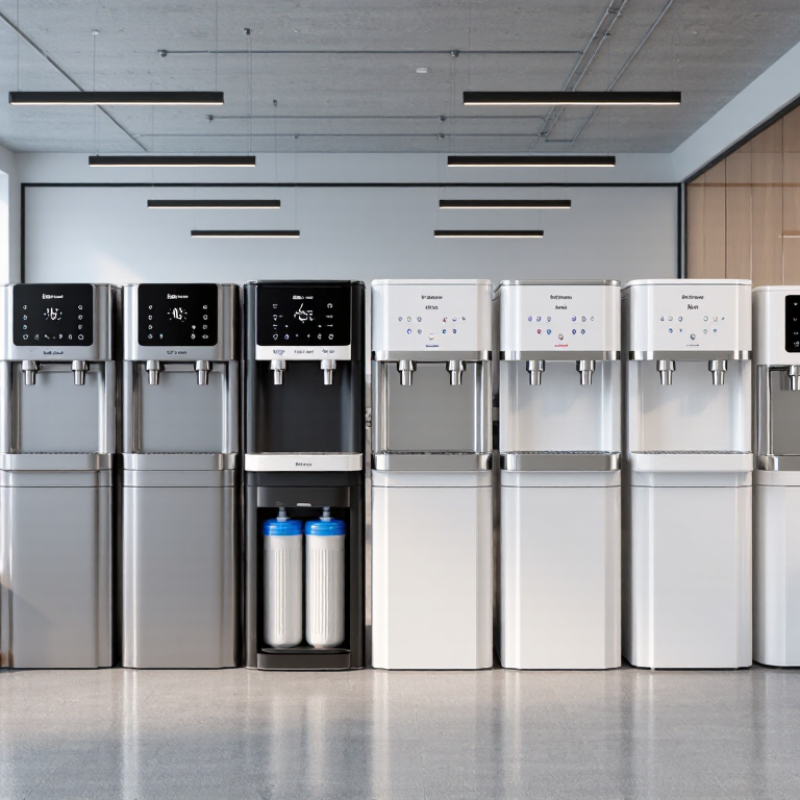
| Product Configuration | Floor-standing or countertop unit with room-temperature, cold, hot, or ambient dispensing options. | Technical datasheet showing water paths, dispensing modes, rated voltage, rated frequency, and intended installation method. | Product specification review; electrical safety assessment for the destination market. | Confirms that the proposed model matches office size, water source, electrical supply, and user requirements. |
| Rated Voltage and Frequency | Common export configurations include 100–120 V or 220–240 V; frequency is normally 50 Hz or 60 Hz depending on the destination. | Rating label, wiring diagram, power-cord specification, and sample inspection report. | IEC 60335-1 principles and applicable national electrical requirements. | Incorrect voltage or frequency can create overheating, poor cooling performance, or electrical safety risks. |
| Cooling Performance | Many compressor-cooled office units provide approximately 2–5 L/h of chilled-water output, depending on inlet temperature and ambient conditions. | Test report stating ambient temperature, inlet-water temperature, target outlet temperature, recovery time, and continuous output. | Supplier-defined performance test with clearly recorded test conditions. | Cooling capacity varies substantially when suppliers use different test conditions; comparable data is essential. |
| Heating Performance | Typical hot-water output is approximately 3–5 L/h, with a tank temperature commonly around 80–95°C. | Heating-capacity test, outlet-temperature records, thermal cut-off test, and child-safety lock verification where applicable. | IEC 60335-2-15 is relevant to appliances for heating liquids, subject to product construction and market scope. | Helps assess beverage service speed, scalding risk, energy use, and thermal reliability. |
| Water-Tank Materials | Common wetted materials include food-contact stainless steel, approved engineering plastics, silicone tubing, and elastomer seals. | Material declarations, food-contact compliance documents, migration-test reports, and a water-path bill of materials. | Applicable food-contact rules may include EU Framework Regulation (EC) No. 1935/2004, U.S. FDA requirements, or destination-country rules. | Water-contact materials can affect taste, odor, durability, and regulatory acceptance. |
| Filtration Compatibility | Configurations may support sediment, activated-carbon, ultrafiltration, or reverse-osmosis stages; each technology has different removal capabilities. | Filter specification, pore-size or performance claim, rated capacity, replacement interval, and installation instructions. | NSF/ANSI 42 for certain aesthetic effects; NSF/ANSI 53 for specific health-effect claims; NSF/ANSI 58 for reverse-osmosis systems. | Prevents unsupported purification claims and allows buyers to match filtration to local water quality. |
| Filtration Claims | Claims should identify the specific contaminant, reduction percentage, test method, influent concentration, and filter life. | Independent laboratory report or certification covering the exact filter model and claimed reduction performance. | NSF/ANSI 42, 53, or 58 as applicable; certification scope must match the complete claim. | A general “purification” statement is not equivalent to verified removal of bacteria, metals, chemicals, or particulates. |
| Electrical Safety | Protection should include grounding or double insulation, over-temperature protection, leakage-current control, and safe internal wiring. | Electrical safety test report, insulation and hipot results, grounding continuity results, and internal construction photographs. | IEC 60335-1 and applicable regional conformity requirements, such as CE-related EU legislation or market-specific certification. | Reduces the risk of electric shock, fire, field failures, and customs or compliance problems. |
| Energy Efficiency | Energy consumption depends on cooling technology, tank insulation, ambient temperature, standby behavior, and usage frequency. | Measured daily energy consumption, test conditions, standby consumption, compressor duty cycle, and insulation details. | Destination-market energy-labeling or minimum-efficiency rules where applicable. | Operating cost may exceed the purchase-price difference over the dispenser’s service life. |
| Refrigerant | Refrigerant type and charge quantity must be declared; lower-global-warming-potential options may be preferred where regulations permit. | Refrigerant name, charge quantity, compressor data, leak-test record, and safety classification documentation. | Applicable refrigerant and environmental regulations in the destination market; ISO 817 classifications may be relevant. | Refrigerant selection affects environmental compliance, service procedures, transport, and future refrigerant availability. |
| Water Leakage Control | Properly routed tubing, secure connectors, overflow protection, drip-tray capacity, and leak detection are expected in commercial-use units. | Pressure or leak-test record, connector specifications, overflow test, and inspection criteria for the water path. | Supplier quality-control procedure and applicable appliance-safety requirements. | Leakage can damage office furniture, flooring, electrical parts, and the supplier’s after-sales reputation. |
| Hygiene and Sanitation | Design should minimize stagnant water, inaccessible dead legs, biofilm-prone areas, and unnecessary open exposure at the outlet. | Cleaning procedure, sanitation schedule, water-path diagram, drain instructions, and outlet-cleaning method. | Food-contact material rules and relevant drinking-water-appliance hygiene requirements in the target market. | Regular cleaning and maintainable water paths are essential for safe long-term office use. |
| Noise Level | Compressor-cooled models commonly operate in a broad range of approximately 40–55 dB(A), depending on measurement distance and conditions. | Noise test report specifying distance, room conditions, operating mode, and whether compressor start-up is included. | Supplier-defined acoustic test method with consistent measurement conditions. | Low noise is important for open-plan offices, meeting rooms, reception areas, and healthcare environments. |
| Construction and Durability | Cabinet materials may include coated steel, stainless steel, or engineering plastic; high-use areas require robust switches, taps, and trays. | Material thickness, surface-finish specification, component life test, door-hinge test, tap-cycle test, and corrosion assessment. | Supplier reliability testing; salt-spray testing may be used for coated or metallic components where relevant. | Durable construction lowers service frequency and protects the total cost of ownership. |
| Ingress and Moisture Protection | Electrical parts should be protected from normal splashing, condensation, and accidental water exposure according to the product design. | Ingress-protection assessment, drainage design, electrical-compartment photographs, and moisture test records. | IEC 60529 IP-code testing may be applicable when an IP rating is claimed. | Confirms whether the stated protection level is supported rather than inferred from appearance. |
| Material Restrictions | Export products should control restricted substances in electrical, electronic, plastic, cable, and metal components. | Supplier declaration, material-composition records, and laboratory test report for restricted substances. | EU RoHS Directive 2011/65/EU, as amended, where applicable; destination-market chemical restrictions may also apply. | Supports import compliance and reduces the risk of nonconforming materials in the supply chain. |
| Food-Contact Compliance | All components that contact drinking water should be traceable by material, supplier, and production batch. | Declaration of compliance, migration testing, resin or elastomer identification, and batch traceability procedure. | Applicable EU, U.S., UK, or other destination-market food-contact requirements. | Traceability supports regulatory review, complaint investigation, and controlled product changes. |
| Quality-Control Process | Recommended controls include incoming inspection, assembly checks, water-path leak testing, electrical safety testing, functional testing, and final visual inspection. | Inspection plan, acceptance criteria, sampling level, calibration records, nonconformance procedure, and retained inspection reports. | ISO 9001 is a quality-management framework; certification does not replace product testing. | A documented process is more reliable than relying only on a final visual inspection. |
| Production Consistency | Critical parts should remain consistent across batches, including compressors, thermostats, pumps, valves, tubing, seals, and control boards. | Approved-component list, change-control procedure, supplier-change notification policy, and serial-number traceability. | Quality-management and configuration-control practices. | Unapproved component substitutions are a common cause of performance variation and warranty claims. |
| Packaging and Transport | Packaging should protect the cabinet, taps, drip tray, electrical parts, and compressor during vibration, impact, and tilted transport. | Packaging drawings, drop-test or vibration-test records, loading instructions, and “upright” handling requirements. | ISTA test procedures may be used for packaged-product distribution testing. | Good packaging reduces concealed damage, water-path misalignment, cosmetic defects, and start-up failures. |
| Documentation Package | At minimum: user manual, installation guide, wiring information, spare-parts list, cleaning instructions, filter-replacement procedure, and warranty terms. | English documentation plus translations required by the destination market; confirm document revision control. | Applicable consumer-product, electrical, labeling, and language requirements. | Clear documentation reduces installation errors and makes local service more practical. |
| After-Sales Support | Commercial buyers generally need replacement filters, taps, valves, pumps, thermostats, control boards, tubing, and seals. | Spare-parts price list, recommended stock list, service videos, troubleshooting guide, response-time commitment, and warranty exclusions. | Contractual service-level agreement defined by the buyer and supplier. | Parts availability often determines whether a dispenser remains economical after the first failure. |
| Pre-Shipment Acceptance | Each production batch should be checked for appearance, dimensions, labeling, water leakage, hot/cold function, dispensing flow, noise, and electrical safety. | Buyer-approved inspection checklist, sampling plan, test records, photographs, and corrective-action report for defects. | ISO 2859-1 sampling principles may be used for attribute inspections when agreed by contract. | Pre-shipment verification identifies defects before international freight and installation. |
| Key Buyer Decision | Select the supplier offering verified compliance, repeatable test data, maintainable design, and transparent documentation—not only the lowest unit price. | Compare like-for-like samples, audit critical processes, validate certificates, and include measurable requirements in the purchase contract. | Use the standards applicable to the destination country and the exact dispenser configuration. | Quality, compliance, serviceability, and total ownership cost determine long-term value for global office deployments. |