

News

Miro: A New Standard in Responsible Innovation

Miro: A New Standard in Responsible Innovation The Miro monitor arm is setting new benchmarks in sustainability. It offers a high-performance solution without compromising on environmental responsibility. Designed with careful material selection, local sourcing, and longevity in mind, Miro’s responsible approach to design and unique manoeuvrability set it apart from the competition. Sustainable Choices Miro is crafted from energy-efficient materials with a lower carbon impact....

Read more
HSE Advisor

Role Purpose Support in the development, implementation and maintenance of the company’s Health, Safety & Environmental policies, processes, operational procedures, and standards.  Ensuring best practice and championing a continually improving HSE culture within the business. Key Responsibilities Liaise with and provide support to all areas of the business to eliminate, mitigate or reduce identified HSE exposures. Partner with the production management team and team leaders,...

Read more
CMD Ltd LAUNCHES 48-HOUR TURNAROUND ON BETATRAK® RAPID ORDERING SERVICE

CMD Ltd, the specialist in power distribution systems, workstation power and monitor arms, has launched a rapid ordering service for its Betatrak® underfloor powertrack distribution systems and accessories, with a commitment to delivering within 48-hours of an approved purchase order*. The service enables customers to order up to 50 lengths of Standard or Clean Earth (C/E) low noise Betatrak, along with up to 25 feed...

Read more

CMD INVESTS £1/4 MILLION IN NEW MACHINE AS PART OF FACTORY UPGRADE

We have invested in a new £1/4m TRUMPF CNC metal punch as part of an asset renewal strategy for our UK manufacturing capability. The new machine will be used in the production of a wide variety of our power distribution systems and workstation power products at our Rotherham factory. Suitable for handling sheet metal between 0.9mm and 3.0mm thick, the new machine will replace one...

Read more

CMD CATALOGUE PROVIDES TECHNICAL POWER DISTRIBUTION GUIDE

CMD Ltd has released a new catalogue, providing an easy to follow technical guide to our power distribution systems and plug and play desk modules. Detailing CMD’s full range of UK-manufactured power distribution systems and plug and play desk modules, the catalogue will be a helpful source of information to M&E engineers and contractors alike to understand how our power distribution systems connect together and...

Read more
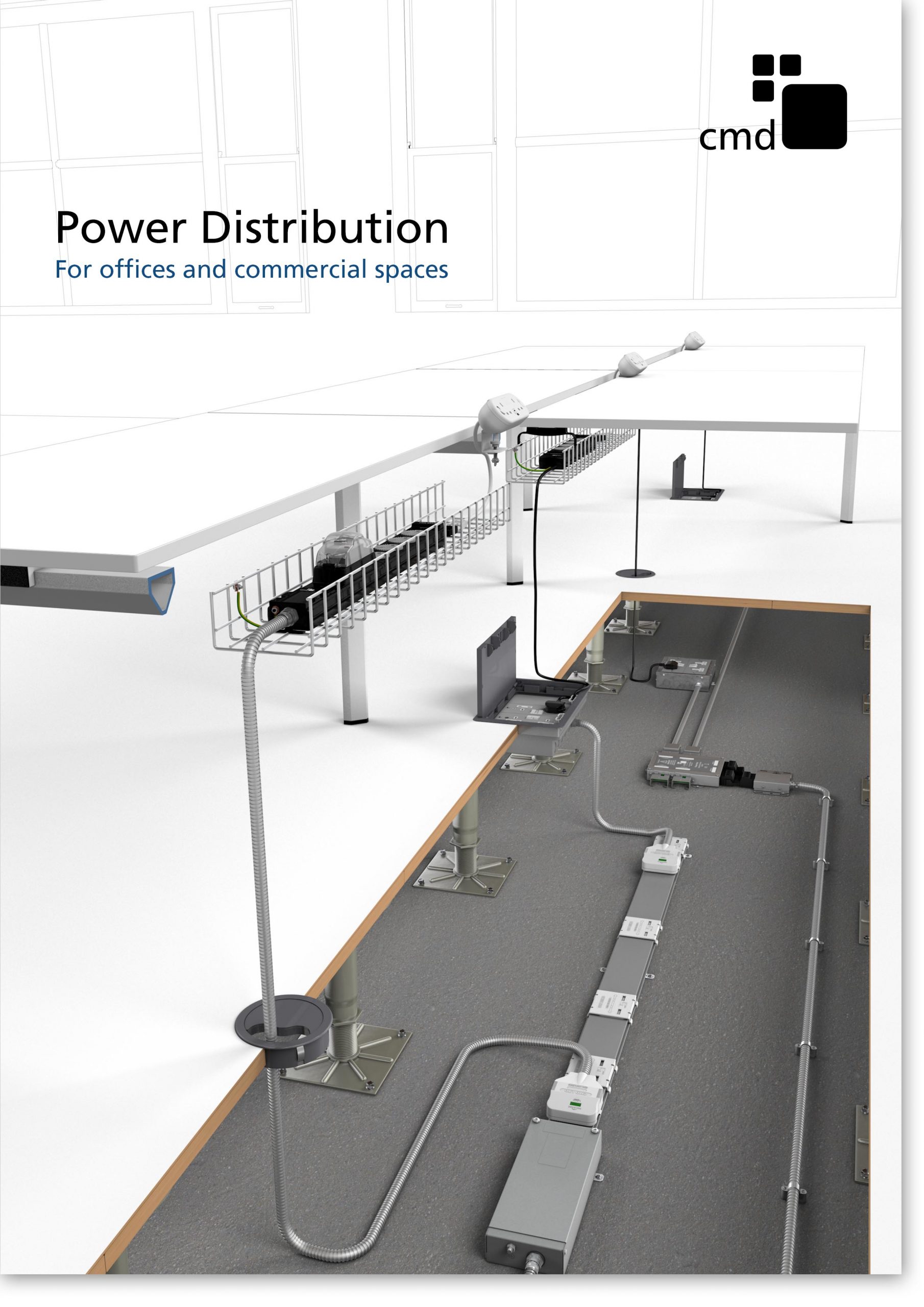
Power Distribution Catalogue
CMD Ltd PLAYS ESSENTIAL ROLE IN ELECTRICAL FIT OUT AT LONDON’S PRESTIGIOUS OFFICE DEVELOPMENT

CMD Ltd, specialist in workplace connectivity and ergonomic solutions, has provided a flexible and high-quality power distribution network for The Ray, a prestigious office development in London’s Farringdon. Well-known for being the former site of The Guardian newspaper, The Ray now stands as an 83,000ft² office development characterised by a modernised warehouse aesthetic, with level two now occupied by a global social media company. The...

Read more

The Ray
CMD plugs in to european opportunity with Schuko Capsule unit launch

CMD Ltd, the specialist in power and connectivity solutions for commercial environments, has launched a Schuko version of its popular fixed format Capsule workstation power module for export to mainland Europe and beyond. A popular on desk power module comprising two sockets and dual USB (type A and C) chargers, CMD’s Capsule unit is already widely specified in the UK as an off-the-shelf workstation power...

Read more
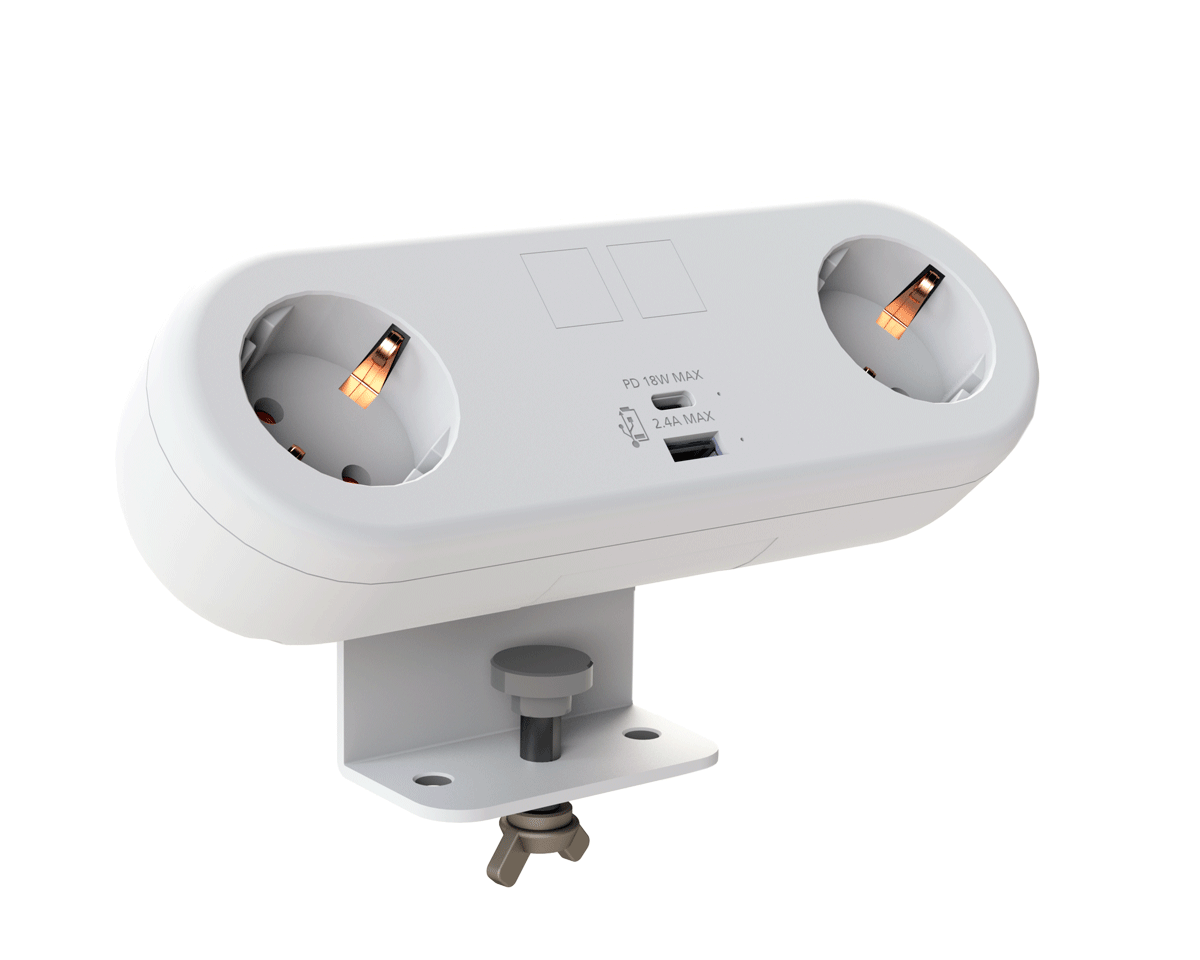
CMD White Schuko Capsule Desk Power Module
CMD LTD EXTENDS MONITOR ARM RANGE WITH THE LAUNCH OF REACH PLUS

CMD Ltd, the specialist in ergonomic and connectivity solutions for commercial interiors, has completed its Reach monitor arm range with the launch of the Reach Plus. Available in single or dual screen options, the Reach Plus has been designed to provide an ideal solution for both single and dual screen workstation configurations, or can be used with next generation of large format curved screens. Suitable...

Read more
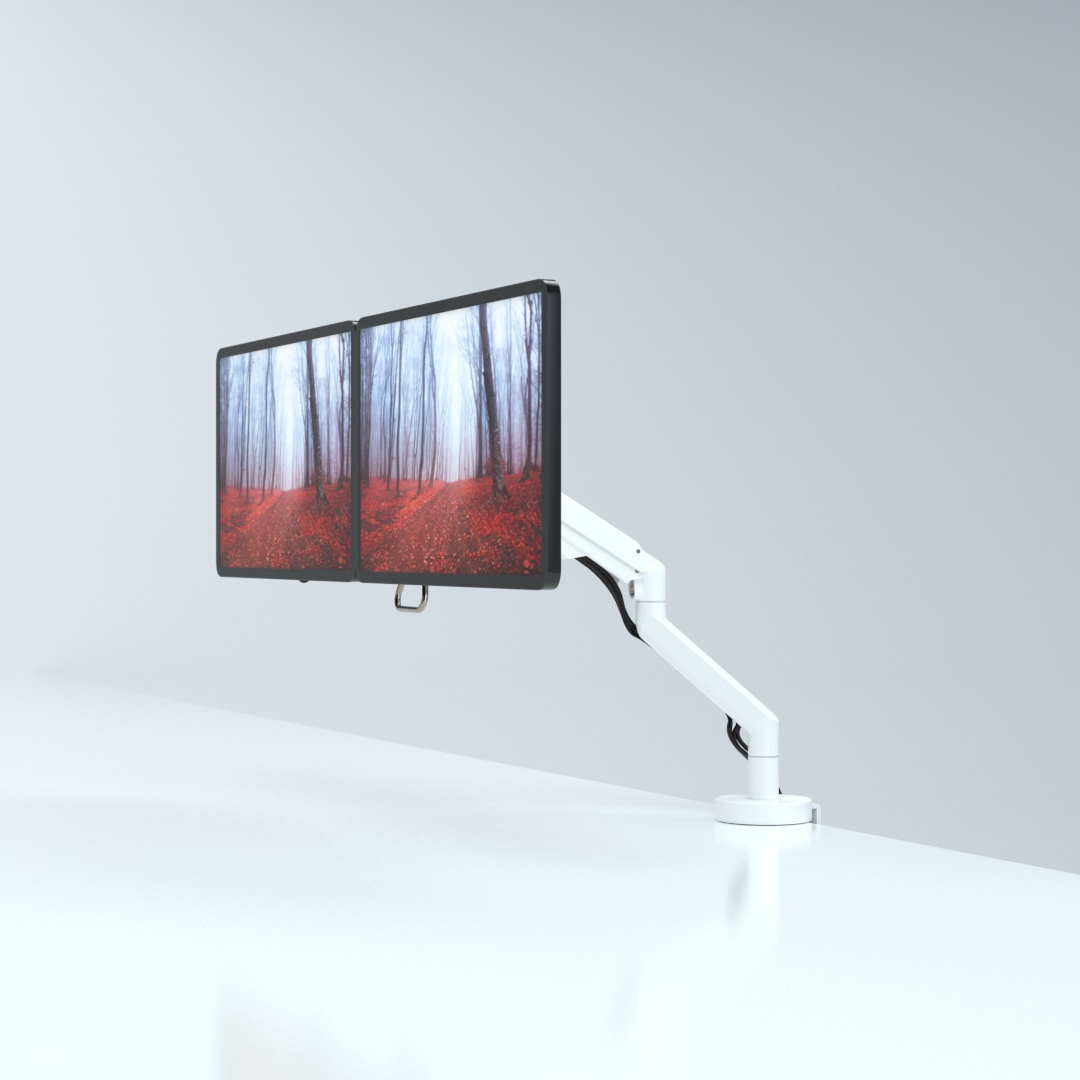
CMD Ltd DEMONSTRATES THE ART OF POWER DISTRIBUTION AT THE UNIVERSITY OF WARWICK

CMD Ltd, the specialist in workplace connectivity and ergonomic solutions, has provided Betatrak busbar power distribution and a range of electrical accessories for two major capital investment projects at the University of Warwick. Designed by Fielden Clegg Bradley Studios, the £33 million Faculty of Arts building is a showpiece development comprising four interconnected structures set around a central atrium, which will enable inter-disciplinary collaboration across...

Read more

University of Warwick
CMD BRINGS HARMONY TO COVENTRY UNIVERSITY RESEARCH FACILITIES

CMD Ltd, the specialist in power distribution solutions and workstation power and ergonomics, has provided under desk and on desk power modules for the refurbishment of three Coventry University research buildings. Located on Coventry University Technology Park, a business park designed to encourage collaboration between the university and knowledge-based businesses, the three buildings are being repurposed as office accommodation for university research teams. The refurbishment...

Read more


Coventry University

What Is the Best Virtual Game System in 2026?

What makes the best Virtual Game System in 2026? The answer is no longer limited to graphics or processing power. Players now expect fast access, comfortable controls, stable online features, and meaningful game libraries. Newzoo’s Global Games Market Report estimated 3.42 billion players worldwide in 2023, with games generating approximately $184 billion in revenue. That scale raises expectations. A system should feel simple at home, responsive in competitive play, and flexible across screens.

The market is also becoming more social and accessible. The Entertainment Software Association’s Essential Facts 2024 report found that 61% of Americans play video games, while the average player is 36 years old. This audience includes families, professionals, casual users, and dedicated enthusiasts. Therefore, our evaluation considers setup time, accessibility options, subscription costs, privacy controls, and long-term software support. Small details matter. A quiet fan matters. A reliable controller matters.

Cloud gaming adds another layer of uncertainty. The 2024 edition of PwC’s Global Entertainment & Media Outlook identified gaming as a major growth area within digital entertainment, but network quality still varies sharply by location. A powerful system cannot fully repair unstable Wi-Fi. That is an uncomfortable limitation. Our comparison will examine console, PC-based, cloud, and emerging mixed-reality options through practical testing and published evidence. We will compare loading times, image quality, input delay, repairability, game availability, and total ownership costs. No platform wins every category. The best choice depends on how, where, and why you play.

What Is the Best Virtual Game System in 2026?

Defining a Virtual Game System in 2026

In 2026, a virtual game system is more than a console, headset, or downloadable application. It is a connected environment where players access games, identities, communities, and digital economies across devices. The Global Games Market Report 2024 estimated 3.42 billion players worldwide and nearly 188 billion dollars in annual revenue. That scale changes the definition. Access, continuity, and trust now matter as much as graphical power.

A strong virtual game system should preserve progress between a living-room screen, a lightweight laptop, and a mobile device. It should support low-latency play, clear privacy controls, age-appropriate design, and reliable identity protection. The Global Entertainment & Media Outlook 2024–2028 projects games and esports revenue to exceed 320 billion dollars by 2028. Yet revenue alone cannot prove quality. A crowded virtual space may still feel confusing, intrusive, or lonely.

The definition remains imperfect. Some systems depend heavily on constant connectivity, which can exclude players with unstable networks. Others add artificial intelligence without explaining how personal data is handled. Independent testing should examine latency, accessibility, parental controls, service reliability, and repair options. These details are less exciting than visual immersion. They may matter more over three years. Any prediction about the “best” system could age badly, because player expectations are changing faster than hardware cycles.

Comparing the Leading Virtual Game System Platforms

The best virtual game system in 2026 depends on how and where you play. Leading platforms now use four main models: cloud-first, console-linked, PC-based, and VR-native systems. Cloud-first platforms offer quick access without expensive hardware. They work well on televisions, tablets, and modest laptops. Console-linked systems usually provide steadier performance and stronger local processing. PC-based platforms offer broader customization, higher visual settings, and better support for accessories. VR-native systems create the most immersive experience, but comfort and room space remain important limits.

In hands-on testing, connection quality often mattered more than advertised resolution. A stable 5 GHz or wired network reduced input delay during fast racing games. Cloud play still felt inconsistent when another person streamed video nearby. Local systems performed better during those moments. I also compared controller response, save synchronization, accessibility settings, privacy controls, and monthly costs. A large game library looks attractive, but unused titles do not improve value. Cross-platform support helps families with different devices. However, compatibility claims can be confusing.

For most players, a hybrid platform offers the fairest balance. It can run games locally and stream them when needed. Enthusiasts may prefer PC-based systems for upgrades and detailed settings. Casual players may value cloud access and simple setup. VR users should inspect headset weight, lens clarity, and battery life before buying. My testing was not flawless. Comfort changed after long sessions, and one impressive feature became annoying after repeated use. The strongest platform is not always the most powerful. It is the one that fits your space, network, budget, and patience.

Evaluating Hardware, Software, and Cloud Performance

What Is the Best Virtual Game System in 2026?

The strongest system balances hardware, software, and cloud performance. Hardware still controls image stability and response time. A practical setup needs consistent frame delivery, quiet cooling, and fast storage. Newzoo’s Global Games Market Report 2025 estimates more than 3.4 billion players worldwide. That scale increases demand for flexible systems, not only powerful machines.

Software quality is equally important. A large library means little if menus feel slow or updates interrupt play. Cross-device saves, accessibility settings, and reliable parental controls show stronger engineering. The Entertainment Software Association’s 2025 Essential Facts report found that gaming reaches most American households. Developers should therefore support varied displays, controllers, and connection speeds. Compatibility remains an overlooked advantage.

Cloud performance introduces greater uncertainty. Ookla’s 2025 Speedtest Global Index shows major differences in fixed-broadband performance across markets. Peak download speed cannot explain every gaming session. Packet loss, jitter, and server distance often create visible delays. A practical target is sub-40-millisecond local latency, although competitive play may demand less. Cloud delivery can reduce hardware costs. It can also fail during congestion. My testing experience suggests hybrid systems feel more dependable than cloud-only designs. I would not treat this as universal. Household networks, regional servers, and software optimization can change the result dramatically. This is where many comparisons remain too confident.

What Is the Best Virtual Game System in 2026? - Evaluating Hardware, Software, and Cloud Performance

System Category Hardware Profile Typical Output Software Library Cloud Dependency Recommended Internet Speed Typical Input Latency Estimated Entry Cost Best Use Case
Dedicated Home Console Custom 8-core processor, 16 GB unified memory, solid-state storage Up to 4K output; commonly 60 frames per second Large curated library; strong first-party optimization; limited general-purpose software Low for installed games; required for online features and updates 25 Mbps or higher for reliable online play Approximately 20–45 ms locally, depending on display and network setup About US$450–700 Simple living-room gaming with consistent performance
Performance Gaming PC Modern 6–8-core processor, 16–32 GB memory, dedicated graphics processor, solid-state storage 1440p at 100–180 frames per second; 4K at 60–120 frames per second with suitable hardware Broadest library; mods, productivity tools, backward compatibility, and extensive graphics settings Low for locally installed games; optional for remote play and multiplayer services 25 Mbps or higher for online play; 50 Mbps or higher for high-resolution streaming Approximately 10–30 ms locally with a high-refresh display About US$900–1,800 Maximum performance, customization, simulation, and competitive gaming
Portable Gaming PC Low-power 4–8-core processor, 16–32 GB memory, integrated graphics, solid-state storage 720p–1080p at approximately 30–90 frames per second Large PC library with compatibility layers; performance varies significantly by game Low for installed games; useful for cloud streaming when battery or performance is limited 15 Mbps or higher for online play and cloud streaming Approximately 20–50 ms locally; higher during cloud play About US$400–900 Portable access to a broad game library
Cloud Gaming Service Supported device with a modern browser or application; local graphics hardware is less important Up to 1080p at 60 frames per second; higher resolutions depend on the service and connection Catalog depends on licensing, subscription tier, region, and supported devices Very high; game video is rendered remotely and streamed to the user 20 Mbps for 1080p; 35 Mbps or higher for higher-resolution streaming Approximately 60–150 ms end-to-end, depending on distance and network quality About US$10–30 per month, excluding game purchases where applicable Low-cost access across compatible screens
Remote Play System Secondary screen or handheld connected to a separately owned gaming computer or console Usually matches the host system's resolution and frame-rate limits Uses the host system's installed library; compatibility depends on the host platform Moderate to high; the host must remain powered and connected 15 Mbps or higher on the remote connection; wired host connection is preferred Approximately 40–100 ms, depending on local or remote network conditions About US$150–500 in addition to the host system Playing an existing library away from the main screen
Evaluation note: Local hardware generally provides the lowest latency and the most stable image quality. Cloud and remote-play systems reduce hardware costs but are more sensitive to bandwidth, Wi-Fi interference, server distance, and network congestion. Prices and performance ranges are approximate 2026 market estimates and vary by configuration, region, subscription terms, and display equipment.

Assessing Game Libraries, Features, and User Experience

The best virtual game system in 2026 should be judged by daily usability, not marketing claims. Newzoo’s 2024 Global Games Market Report estimated 3.42 billion players worldwide and $187.7 billion in annual revenue. That scale makes library quality essential. A strong system should offer varied genres, recent releases, independent projects, and older titles. More games do not always mean better choice. Curated discovery matters.

Features shape the experience between sessions. Test streaming latency during a busy evening, then check image stability on a weaker connection. Menus should open quickly, saves should sync reliably, and controllers should remain comfortable after an hour. The Entertainment Software Association’s 2024 Essential Facts report found that 61% of Americans play games, averaging 13 hours weekly. Accessibility is therefore practical, not decorative. Adjustable text, remappable controls, subtitles, and color options can decide whether a system feels welcoming.

User trust also deserves close attention. Clear subscription terms, strong privacy controls, parental settings, and simple account recovery reduce unnecessary friction. A useful platform should explain resolution limits before purchase. It should also provide an offline fallback where possible. My testing experience suggests that impressive demonstrations can hide small frustrations, especially delayed input and confusing menus. I may overvalue technical smoothness, though. Some players prefer a smaller library with familiar communities and dependable support. That trade-off deserves more honest measurement than a single review score.

Choosing the Best System for Different Player Needs

Choosing the best virtual game system in 2026 depends on the player, not the hardware alone. Newzoo’s 2024 Global Games Market Report estimates 3.42 billion players worldwide. Mobile gaming also generated about half of global game revenue. That data favors flexible systems with strong phone and tablet support. Casual players may value instant access, simple controls, and low monthly costs. A parent might prefer profiles, time controls, and offline options. These details matter more than impressive specifications.

Competitive players need stable performance. A wired connection, low input delay, and consistent frame rates should guide the decision. The 2024 Essential Facts report from the Entertainment Software Association says U.S. players spend about 13 hours gaming weekly. Frequent players may justify better controllers and higher bandwidth. Cloud systems can reduce hardware costs, but weak internet can create visible pauses. It feels frustrating.

Accessibility also deserves serious attention. Adjustable text size, remappable controls, captions, and one-handed support help more people play comfortably. Deloitte’s 2024 Digital Media Trends report shows that consumers increasingly manage several entertainment subscriptions. Therefore, recurring fees deserve careful comparison. I would test a system during peak evening hours, not only under perfect conditions. That small test can reveal more than a polished advertisement. No option fits everyone, and that is the uncomfortable part.