

News

Miro: A New Standard in Responsible Innovation

Miro: A New Standard in Responsible Innovation The Miro monitor arm is setting new benchmarks in sustainability. It offers a high-performance solution without compromising on environmental responsibility. Designed with careful material selection, local sourcing, and longevity in mind, Miro’s responsible approach to design and unique manoeuvrability set it apart from the competition. Sustainable Choices Miro is crafted from energy-efficient materials with a lower carbon impact....

Read more
HSE Advisor

Role Purpose Support in the development, implementation and maintenance of the company’s Health, Safety & Environmental policies, processes, operational procedures, and standards.  Ensuring best practice and championing a continually improving HSE culture within the business. Key Responsibilities Liaise with and provide support to all areas of the business to eliminate, mitigate or reduce identified HSE exposures. Partner with the production management team and team leaders,...

Read more
CMD Ltd LAUNCHES 48-HOUR TURNAROUND ON BETATRAK® RAPID ORDERING SERVICE

CMD Ltd, the specialist in power distribution systems, workstation power and monitor arms, has launched a rapid ordering service for its Betatrak® underfloor powertrack distribution systems and accessories, with a commitment to delivering within 48-hours of an approved purchase order*. The service enables customers to order up to 50 lengths of Standard or Clean Earth (C/E) low noise Betatrak, along with up to 25 feed...

Read more

CMD INVESTS £1/4 MILLION IN NEW MACHINE AS PART OF FACTORY UPGRADE

We have invested in a new £1/4m TRUMPF CNC metal punch as part of an asset renewal strategy for our UK manufacturing capability. The new machine will be used in the production of a wide variety of our power distribution systems and workstation power products at our Rotherham factory. Suitable for handling sheet metal between 0.9mm and 3.0mm thick, the new machine will replace one...

Read more

CMD CATALOGUE PROVIDES TECHNICAL POWER DISTRIBUTION GUIDE

CMD Ltd has released a new catalogue, providing an easy to follow technical guide to our power distribution systems and plug and play desk modules. Detailing CMD’s full range of UK-manufactured power distribution systems and plug and play desk modules, the catalogue will be a helpful source of information to M&E engineers and contractors alike to understand how our power distribution systems connect together and...

Read more

Power Distribution Catalogue
CMD Ltd PLAYS ESSENTIAL ROLE IN ELECTRICAL FIT OUT AT LONDON’S PRESTIGIOUS OFFICE DEVELOPMENT

CMD Ltd, specialist in workplace connectivity and ergonomic solutions, has provided a flexible and high-quality power distribution network for The Ray, a prestigious office development in London’s Farringdon. Well-known for being the former site of The Guardian newspaper, The Ray now stands as an 83,000ft² office development characterised by a modernised warehouse aesthetic, with level two now occupied by a global social media company. The...

Read more

The Ray
CMD plugs in to european opportunity with Schuko Capsule unit launch

CMD Ltd, the specialist in power and connectivity solutions for commercial environments, has launched a Schuko version of its popular fixed format Capsule workstation power module for export to mainland Europe and beyond. A popular on desk power module comprising two sockets and dual USB (type A and C) chargers, CMD’s Capsule unit is already widely specified in the UK as an off-the-shelf workstation power...

Read more

CMD White Schuko Capsule Desk Power Module
CMD LTD EXTENDS MONITOR ARM RANGE WITH THE LAUNCH OF REACH PLUS

CMD Ltd, the specialist in ergonomic and connectivity solutions for commercial interiors, has completed its Reach monitor arm range with the launch of the Reach Plus. Available in single or dual screen options, the Reach Plus has been designed to provide an ideal solution for both single and dual screen workstation configurations, or can be used with next generation of large format curved screens. Suitable...

Read more

CMD Ltd DEMONSTRATES THE ART OF POWER DISTRIBUTION AT THE UNIVERSITY OF WARWICK

CMD Ltd, the specialist in workplace connectivity and ergonomic solutions, has provided Betatrak busbar power distribution and a range of electrical accessories for two major capital investment projects at the University of Warwick. Designed by Fielden Clegg Bradley Studios, the £33 million Faculty of Arts building is a showpiece development comprising four interconnected structures set around a central atrium, which will enable inter-disciplinary collaboration across...

Read more

University of Warwick
CMD BRINGS HARMONY TO COVENTRY UNIVERSITY RESEARCH FACILITIES

CMD Ltd, the specialist in power distribution solutions and workstation power and ergonomics, has provided under desk and on desk power modules for the refurbishment of three Coventry University research buildings. Located on Coventry University Technology Park, a business park designed to encourage collaboration between the university and knowledge-based businesses, the three buildings are being repurposed as office accommodation for university research teams. The refurbishment...

Read more

Coventry University

Who Are the Best Gravity Conveyor Manufacturers in 2026?

Choosing among Gravity Conveyor Manufacturers in 2026 takes more than comparing prices and catalog photos. A roller conveyor may look simple, yet small design choices affect how cartons move, where workers load them, and how smoothly a line handles daily demand. Think of a box crossing a short, slightly sloped lane. Roller spacing, load weight, frame width, and stopping points all matter. Small details count.

A useful buying principle is: “Let the load, route, and operating rhythm guide the design—not the catalog photo.” This is an original editorial line, not a verified quotation from a named expert. No source article or expert attribution was provided, so assigning it to a real person would risk misleading readers. The guide can still assess manufacturers through practical evidence: documented specifications, application experience, customization options, and responsive technical support. Ask for details about load capacity and roller dimensions. Check how the proposed layout handles transfers, curves, and operator access. Then compare delivery, installation, and after-sales support.

There is no universal winner. A supplier well suited to a small packing area may not fit a high-volume distribution line. Some buying decisions also depend on details that are easy to overlook, including floor conditions and future layout changes. This guide examines leading manufacturers and the questions buyers should ask before requesting a quote. The comparison is useful, but not a substitute for a site-specific review.

Who Are the Best Gravity Conveyor Manufacturers in 2026?

What Is a Gravity Conveyor? CEMA 401’s Roller-Conveyor Scope

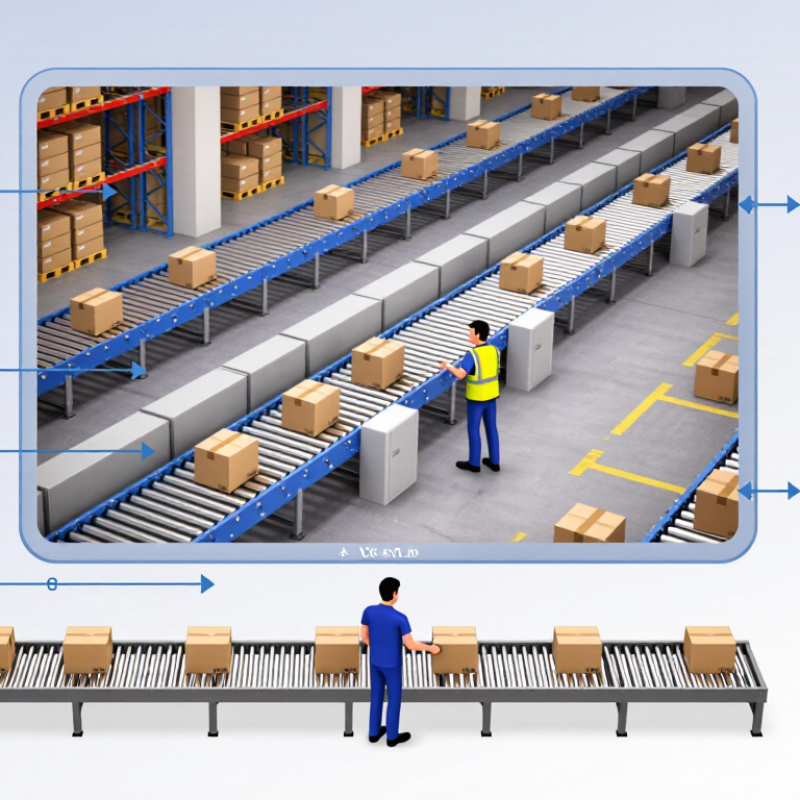
A gravity conveyor moves cartons, totes, or other unit loads on rollers without a powered drive. The rollers turn under the load, helped by a slight slope or a worker’s push. On a warehouse floor, even a small incline can affect speed, so test the actual load before setting the conveyor angle. Simple equipment, but not always simple to tune.

CEMA 401 addresses roller-conveyor design and application within unit-handling systems. Its scope helps buyers and engineers compare key details, such as roller arrangement, frame dimensions, and intended service. It is a useful reference when specifying non-powered roller sections. It does not, by itself, select the right conveyor for every product or layout.

That distinction matters. A short carton may sit between rollers, while a heavy tote can create concentrated loads at transfer points. Check load size, weight, bottom condition, and the gap between rollers. CEMA guidance can support a consistent specification, but the installation still needs practical checks. I would not treat a standard as a substitute for testing awkward loads, especially when packages vary in shape or arrive damaged.

Which Design Metrics Matter? Load Capacity, Roller Pitch, and Three-Roller Support

Load capacity should be checked for both individual rollers and the complete conveyor section. A 25-kilogram carton with a narrow base can place more stress on a few rollers than a wider carton of equal weight. Ask manufacturers to state whether their ratings apply to static or moving loads, and confirm frame and support limits. Include a sensible operating margin, but do not assume one figure suits every layout. Real cartons reveal more.

Roller pitch determines how many rollers support a package at once. A useful starting point is to keep at least three rollers beneath the shortest load, including at transfer points. Small gaps matter. Flexible cartons may sag between rollers even when rigid boxes travel smoothly. Test the actual package mix, especially soft-bottom cartons and uneven loads, before approving a layout. A neat spreadsheet can still mislead.

When comparing manufacturers, request load charts, pitch options, roller dimensions, and details about testing conditions. Check whether stated capacity changes with conveyor width or support spacing. Three-roller support is a practical design check, not a guarantee of smooth movement; package shape, surface friction, and slope also affect travel. I would revisit the pitch after observing real operation, since early assumptions about carton stiffness are often wrong.

How Do Leading Manufacturers Compare on Frames, Rollers, and Customization?

Gravity conveyor manufacturers are best compared by their specifications, not polished catalog photos. Ask for frame material, wall thickness, support spacing, and rated load. A wide frame can still flex when legs sit too far apart. Aluminum can ease repositioning; steel may suit fixed, heavier-duty lines. Neither choice wins without the actual carton weight and floor conditions.

Roller diameter, spacing, and bearing type affect how smoothly cartons travel. As a practical design check, the smallest carton should rest on at least three rollers. MHI’s 2024 Annual Industry Report found that 55% of respondents planned to increase supply-chain technology investment over the following five years. That signals interest in upgrades, not proof that a more expensive conveyor performs better. Ask for a layout drawing that shows roller pitch, side-guide clearance, transfer gaps, and attachment points. Curves, stops, adjustable legs, and brake rollers can be tailored to the route. Small details matter. A poorly matched transfer gap can catch a carton edge. Request a test with representative loads; quotes do not always include one.

Who Are the Best Gravity Conveyor Manufacturers in 2026?

How do leading manufacturers compare on frames, rollers, and customization?

These are examples of commonly offered nominal roller diameters, not a manufacturer ranking or a complete market survey. When comparing suppliers, check frame construction, roller material and bearing options, load requirements, conveyor width, and available custom configurations against your application.

Who Are the Best Gravity Conveyor Manufacturers in 2026? A Spec-Based Comparison

A useful 2026 comparison of gravity conveyor manufacturers starts with the job, not a sales claim. Record the product’s weight, base dimensions, and required flow rate. Then check each manufacturer’s published load capacity against those details. A conveyor rated for heavy cartons may still handle small packages poorly.

Roller diameter and spacing matter. For a carton with a narrow base, closer roller centers can reduce tipping and snagging. Ask for frame dimensions, roller material, and adjustment options, then compare them against your facility’s aisle width and floor slope. Small details matter. Request test conditions behind any stated capacity, since ratings can depend on support spacing and load distribution.

Compare delivery times, replacement-part access, and technical support alongside the hardware. Ask whether the supplier provides layout drawings and installation guidance for your specific load. These points are harder to score than roller diameter, but they affect downtime. No spec sheet tells the whole story; even careful comparisons can miss uneven floors or changing package sizes. A short trial with representative cartons may reveal issues that a neat table cannot.

Who Are the Best Gravity Conveyor Manufacturers in 2026? A Spec-Based Comparison
Conveyor Configuration Best-Suited Loads Typical Applications Key Specification Checks Advantages Limitations
Straight gravity roller conveyor Rigid-bottom cartons, totes, and containers that can bridge the roller gaps. Packaging lines, shipping areas, accumulation lanes, and short transfers. Roller diameter and spacing; conveyor width; frame rating; unit-load weight; and the number of rollers supporting the load at any time. Simple layout, no powered drive, and straightforward access for cleaning and maintenance. Small, soft, or uneven-bottom items may not travel reliably. Slope and speed need to suit the load and operator requirements.
Skate-wheel gravity conveyor Lightweight cartons and other rigid-bottom packages with a stable base. Temporary packing stations, order-picking areas, and lightweight transfer paths. Wheel spacing; wheel-bed width; load support; frame capacity; and whether the package base is wide enough to contact multiple wheels. Lightweight sections are easy to reposition, and the open surface provides access to the conveyed load. Less suitable for heavy loads, narrow bases, or packages with irregular bottoms. Wheels may need more frequent inspection in demanding environments.
Flexible gravity roller conveyor Cartons and totes with sufficiently rigid, flat bottoms. Loading docks, temporary work areas, and layouts that change with the task. Extended and compressed length; usable width; curve radius; roller spacing; load rating; and the support requirements specified for the operating position. Can be repositioned and extended or compressed to suit changing transfer distances. Capacity and stability depend on the actual configuration and support conditions. Flexible sections are not a substitute for a fixed, accurately aligned conveyor where precise positioning is required.
Gravity roller curve Rigid-bottom packages that remain stable while changing direction. Connecting conveyor runs where a layout needs a turn without a powered drive. Curve angle and radius; roller arrangement; inside and outside guide rails; package footprint; and load behavior through the turn. Changes direction without a powered transfer unit when the package and layout are suitable. Packages may drift toward the outside of a turn. Narrow, unstable, or irregular loads may require guides or a different transfer method.
Ball-transfer table Flat-bottomed items that can be manually pushed or rotated across the surface. Workstations, packing benches, and multidirectional manual transfers. Ball spacing; tabletop dimensions; load distribution; rated capacity; and compatibility between the load base and ball pattern. Allows manual movement in multiple directions across the table surface. Requires a suitable flat base and operator input. It is not a continuous, controlled downhill conveying solution.
Gravity chute Items specifically suited to sliding on the selected chute surface. Controlled drops between elevations, subject to item and facility requirements. Chute angle; surface material; side containment; item dimensions and weight; impact at discharge; and guarding. Can provide a simple, non-powered route between different elevations. Sliding friction and impact vary by item and surface. Testing and appropriate containment are important before use.
Selection note: These are conveyor configurations, not a ranking of named manufacturers. Gravity-conveyor ratings and suitable operating slopes are design-specific; verify them against the supplier’s current technical documentation and the actual load, layout, support spacing, and operating conditions.

How Do CEMA Guidance and OSHA 1910.212 Inform Safe Conveyor Selection?

CEMA guidance helps buyers match gravity conveyor design to the load, route, and operating conditions. It can inform roller spacing, conveyor width, slope, and transition planning. A carton should rest on enough rollers to stay stable, even when its base is soft or uneven. Too steep a decline may send it rushing toward the next workstation. Too shallow, and workers may push loads repeatedly. Test with the actual products, not just an empty frame. Small gaps matter.

OSHA 1910.212 addresses guarding hazards such as points of operation, nip points, and rotating parts. On gravity conveyors, inspect roller gaps, side transfers, and places where hands could become trapped between a moving load and a fixed surface. Guards, covers, or distance-based controls may reduce exposure, but they must suit the task and not create new hazards. Add practical controls such as stop gates, clear loading limits, and stable supports. Secure frames against shifting, and keep walkways clear of protruding loads. A risk assessment should reflect real use, including jams and awkward reaches. One detail is easy to miss: operators may bypass a control that slows routine work. Review the layout with the people who use it, then verify safeguards before operation.