2026 Top Chamfering Cutter Buying Guide for Global Buyers
Global buyers are entering 2026 with tighter machining budgets and higher quality expectations. The Chamfering Cutter is no longer judged by price alone. Tool life, edge consistency, coating performance, and machine compatibility now influence the total purchasing decision.
Grand View Research identifies steady growth in the global cutting tools market, driven by automotive, aerospace, medical, and precision engineering demand. Its market analysis also highlights automation and advanced materials as important growth factors. Reports from Mordor Intelligence similarly point to rising consumption of carbide tools and increased interest in high-performance machining. These trends matter because difficult materials can quickly expose a weak cutter. A chamfer that looks acceptable under shop lighting may fail under inspection.
This 2026 buying guide translates those market signals into practical selection criteria. It examines carbide grades, flute geometry, coating options, shank standards, cutting parameters, and supplier verification. ISO 13399 can support clearer technical communication through standardized tool data, while manufacturer catalogs remain essential for application limits and recommended speeds. Real workshop experience still matters. A catalog rarely shows vibration beside a thin aerospace wall or burr formation after hundreds of holes.
Small details decide results.
Buyers should compare measured tool life, dimensional repeatability, and technical support instead of relying on attractive claims. Country of origin alone proves little. Neither does a polished product page. Some recommendations in this guide may require adjustment, especially when machines, materials, and coolant systems differ. That limitation deserves honesty. Reliable purchasing comes from documented testing, traceable specifications, and suppliers willing to discuss failure—not only successful samples.
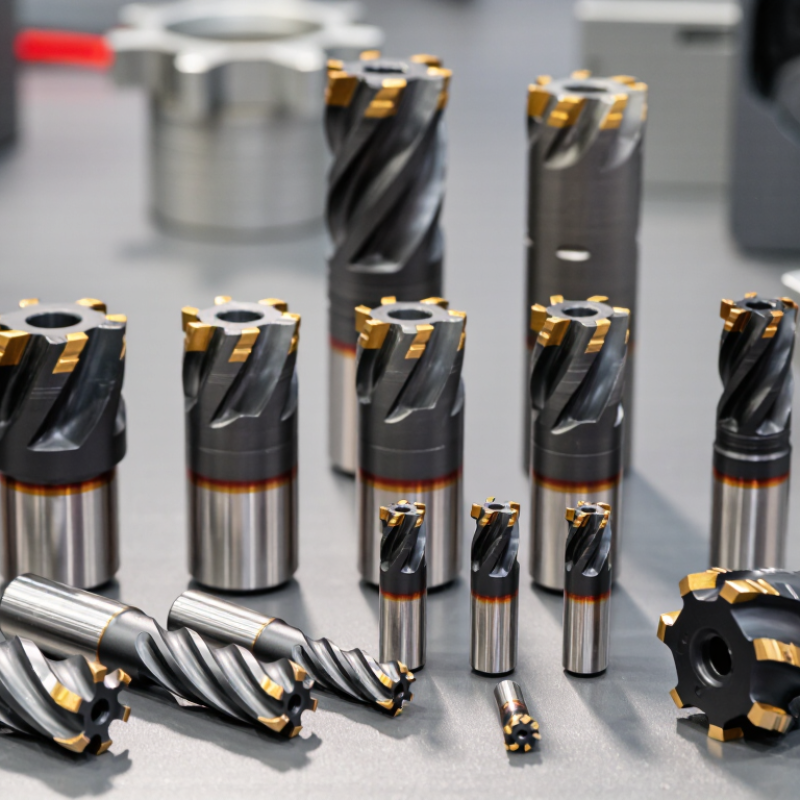
Chamfering Cutter Types: 45°, 60°, 90°, and Custom-Angle Applications
Selecting a chamfering cutter starts with the edge, not the catalog photograph. A 45° cutter creates a balanced bevel for general deburring and visible edge preparation. It suits mild steel, aluminum, and many machining fixtures when feed and speed are controlled. On a 6 mm edge, the chamfer is easy to inspect with a rule or optical comparator. Small details matter. A dull insert can leave torn material and misleading measurements. Experienced buyers check tool rigidity, insert availability, runout, and coating suitability before comparing prices.
A 60° cutter works well when the drawing requires a sharper transition or limited surface width. It can support countersink-like preparation, but the final diameter depends on depth and workpiece geometry. Trial cuts on scrap material reveal burr direction, heat marks, and machine vibration. A 90° cutter produces a broad, open chamfer for countersunk fasteners or generous edge breaks. However, it removes more material per pass. Thin parts may flex, especially when clamping pressure is uneven.
Custom angles deserve closer engineering review. The supplier should confirm the included angle, corner radius, diameter range, spindle interface, and inspection method. Send a drawing, not only a verbal request. Tolerance changes everything. Carbide may improve wear resistance, while high-speed steel can suit lower-volume work. Actual results vary with material, coolant, and machine condition. I would not choose an angle from habit alone; a 45° tool once performed poorly because the programmed depth ignored the part’s curved surface. That mistake was avoidable, but useful.
2026 Top Chamfering Cutter Buying Guide for Global Buyers
Chamfering Cutter Types: 45°, 60°, 90°, and Custom-Angle Applications
45° Cutters Commonly selected for general edge breaking and shallow chamfers.
60° Cutters Used when a steeper chamfer profile is required by the part design.
90° Cutters Often specified for countersinking and broad, drawing-defined chamfers.
Custom-Angle Cutters The angle is determined by the engineering drawing, workpiece geometry, and clearance requirements.
The chart compares nominal cutter angles in degrees. Custom-angle tools do not have one universal value; buyers should confirm the required angle, chamfer width, material, tool interface, and machine compatibility before ordering.
Cutting Data: Calculate RPM from Diameter and 3.14 × D Formula
2026 Top Chamfering Cutter Buying Guide for Global Buyers
Cutting speed must guide spindle selection, not guesswork. The basic formula is RPM = Vc × 1000 ÷ (3.14 × D). Vc means cutting speed in metres per minute. D is cutter diameter in millimetres. For a 10 mm chamfering cutter at 80 m/min, calculate 80,000 ÷ 31.4. The result is about 2,548 RPM. Measure twice.
The U.S. Cutting Tool Institute reported roughly 2.5 billion dollars in cutting-tool consumption during 2023. This figure shows the scale of machining demand, but it does not replace application testing. ISO 13399 supports standardized cutting-tool data, while ISO 3685 provides a framework for tool-life testing. Use these references with the cutter supplier’s recommended speed range. A harder workpiece may require a lower Vc. Coated tools can sometimes tolerate higher values, but coolant, rigidity, and edge geometry still matter.
Diameter changes RPM quickly. A 20 mm cutter at the same 80 m/min needs about 1,274 RPM. That simple relationship is often missed during tool changes. My practical mistake was trusting the previous cutter setting without checking diameter. It produced heat and a rough chamfer. Do not guess. Start conservatively, inspect the edge, then adjust speed and feed in small steps. U.S. manufacturing data also shows continuing demand for precision production, yet real workshop results remain dependent on setup quality, not formulas alone.
2026 Top Chamfering Cutter Buying Guide for Global Buyers — Cutting Data: Calculate RPM from Diameter and 3.14 × D Formula
Recommended starting parameters for carbide chamfering cutters under stable machining conditions
| Workpiece Material | Typical Hardness | Cutter Material | Cutter Diameter
(mm) | Included Angle
(°) | Cutting Speed Vc
(m/min) | Calculated RPM
(rev/min) | Flutes
(z) | Feed per Tooth fz
(mm/tooth) | Calculated Feed Rate
(mm/min) |
| Aluminum 6061-T6 | 95 HB | Solid carbide | 6 | 90 | 250 | 13,250 | 2 | 0.04 | 1,060 |
| Aluminum 6061-T6 | 95 HB | Solid carbide | 10 | 90 | 250 | 7,960 | 3 | 0.06 | 1,433 |
| Free-machining brass | 80 HB | Solid carbide | 8 | 90 | 180 | 7,166 | 2 | 0.04 | 573 |
| Gray cast iron | 180–240 HB | Solid carbide | 10 | 90 | 100 | 3,185 | 3 | 0.04 | 382 |
| Medium-carbon steel, AISI 1045 | 170–220 HB | Solid carbide | 8 | 90 | 120 | 4,777 | 3 | 0.03 | 430 |
| Medium-carbon steel, AISI 1045 | 170–220 HB | Solid carbide | 12 | 90 | 120 | 3,185 | 3 | 0.04 | 382 |
| Stainless steel, AISI 304 | 123–201 HB | Solid carbide | 8 | 90 | 70 | 2,786 | 3 | 0.02 | 167 |
| Stainless steel, AISI 304 | 123–201 HB | Solid carbide | 10 | 90 | 70 | 2,229 | 3 | 0.025 | 167 |
| Tool steel, AISI D2, annealed | 200–250 HB | Solid carbide | 10 | 90 | 80 | 2,548 | 3 | 0.02 | 153 |
| Titanium alloy, Ti-6Al-4V | 330–380 HB | Solid carbide | 8 | 90 | 45 | 1,791 | 3 | 0.015 | 81 |
RPM formula: RPM = (Vc × 1,000) ÷ (3.14 × D), where Vc is cutting speed in m/min and D is cutter diameter in mm.
Feed-rate formula: Feed rate = RPM × number of flutes × feed per tooth. Values are practical starting points; reduce speed or feed when machine rigidity, tool overhang, coolant delivery, workholding, or material condition is unfavorable.
Standards and Fit: Verify ISO 13399, ANSI B94.19, Shank, and Runout
2026 Top Chamfering Cutter Buying Guide for Global Buyers
Standards and fit should guide every chamfering cutter purchase. ISO 13399 helps organize cutting-tool data, including geometry, dimensions, and technical descriptions. However, a digital model does not guarantee physical compatibility. Request a complete drawing before ordering. Check the included angle, cutting diameter, overall length, and usable depth.
ANSI B94.19 can support dimensional verification for applicable cutting tools, but buyers should confirm the exact edition and scope. Standards may leave practical details to the manufacturer. Match the cutter shank with the machine holder, such as a straight shank, Weldon shank, or another specified interface. Measure the holder, too. A small mismatch can create vibration, poor edge quality, or unsafe movement.
Tips: Ask for measured runout at the cutting edge, not only a general tolerance statement. For precision work, compare the supplier’s result with your own gauge test. Keep the tool, holder, and spindle clean before inspection. Even a thin chip can change alignment. I have found that buyers often check diameter carefully but overlook shank length. That mistake can reduce clamping contact. It is also worth admitting that catalog data may be incomplete. Clarify uncertain points in writing, and retain the inspection record with the purchase order.
Global Buyer Checklist: Inspect Tolerance, Coating, MOQ, Warranty, and Lead Time
When purchasing a chamfering cutter in 2026, global buyers should treat the checklist as a receiving procedure, not a sales conversation.
Tolerance needs numbers. Ask for diameter, angle, runout, and measured deviation on an inspection report.
For example, a 10 mm cutter with ±0.01 mm diameter tolerance can behave differently from one marked only “precision.”
Check whether measurements were taken at 20°C, because temperature changes can affect small tools.
I learned this after a cutter passed visual inspection but produced uneven edges.
Appearance was not enough.
Coating claims also require evidence. Request the coating type, thickness range, substrate material, and recommended cutting conditions. A hard coating may improve wear resistance, yet it will not correct excessive runout or poor workholding. Ask for sample test data using similar steel or aluminum. Do not accept vague terms such as “long life.”
One controlled trial is more useful than a glossy specification sheet.
Still, test results can be incomplete.
MOQ, warranty, and lead time affect the real purchase cost. Confirm whether MOQ applies per size, coating, or total order.
A low unit price may become expensive when unused inventory fills a shelf.
Warranty terms should state coverage, evidence requirements, and response time. Ask who pays return freight for verified defects.
Lead time must include coating, inspection, packing, and export documents. Request a written production schedule with a shipment date, not merely “available soon.”
Leave room for delays.
Supply estimates are never perfectly stable, especially for custom dimensions.









