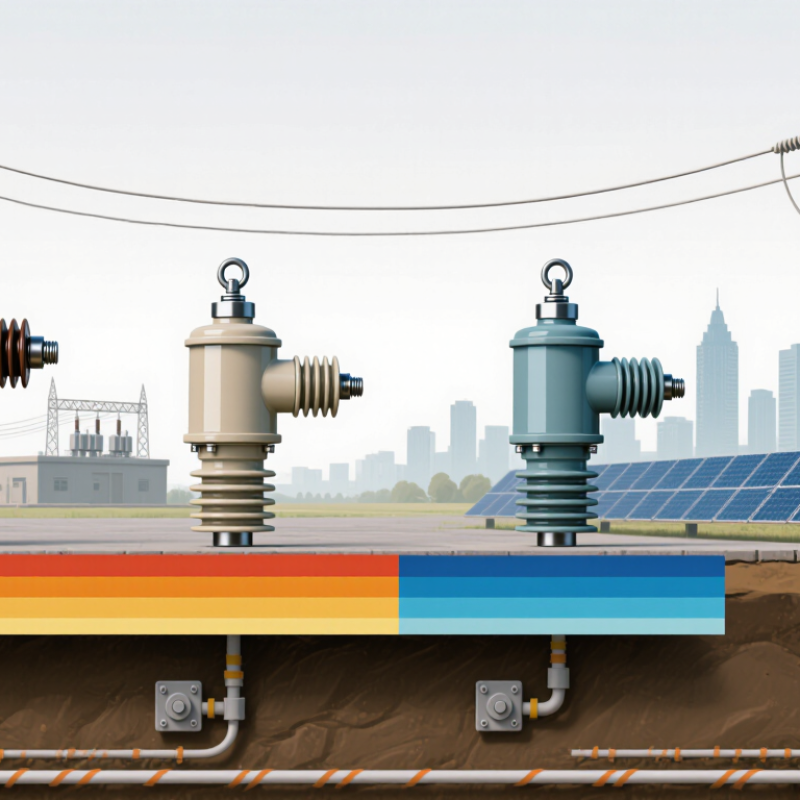
Gapless Metal-Oxide Surge Arrester
Modern standard | A stack of zinc-oxide varistor blocks enclosed in a polymeric or porcelain housing, normally without a series spark gap. | At normal system voltage, the zinc-oxide blocks have very high resistance and allow only a small leakage current. During a lightning or switching surge, their resistance drops sharply, diverting surge current to earth. After the surge, resistance rises again and the arrester returns to its normal state. | Distribution networks, substations, transformers, cable systems, renewable-energy collector systems, and industrial installations. | Fast response, no spark-gap insulation coordination problem, good repetitive-surge performance, and relatively simple monitoring. | Continuous leakage current and thermal stability must be controlled. Incorrect energy or voltage selection can cause overheating or failure. | Maximum continuous operating voltage, rated voltage, energy capability, protective level, housing material, and system grounding method. |
Station-Class Metal-Oxide Arrester
High-energy duty | High-capacity metal-oxide varistor columns with robust housings, pressure-relief features, and mechanical support suitable for substation service. | The varistor column conducts high lightning and switching surge currents to earth while limiting the voltage across transformers, busbars, circuit breakers, and other high-value equipment. | High-voltage and extra-high-voltage substations, generator terminals, transformer banks, bus sections, and transmission assets. | High discharge-current capability, strong energy absorption, low residual voltage, and suitability for critical high-voltage equipment. | Higher cost, greater physical size, and more demanding installation, grounding, and coordination requirements. | System voltage, insulation level, switching-surge energy, lightning-current duty, creepage distance, seismic requirements, and pressure-relief performance. |
Distribution-Class Metal-Oxide Arrester
Utility distribution | Compact metal-oxide varistor blocks in polymeric or porcelain housings, commonly installed on pole-top or distribution equipment. | The arrester remains nearly nonconductive during normal operation and provides a low-impedance path to ground when an overvoltage exceeds the varistor’s conduction threshold. | Medium-voltage overhead lines, pole-mounted transformers, switchgear, feeder equipment, and distribution substations. | Compact construction, quick surge response, low maintenance, and effective protection for common distribution equipment. | Lower energy capability than station-class units. Performance depends strongly on grounding, lead length, and correct voltage rating. | MCOV, rated voltage, discharge-current class, line-to-ground configuration, housing creepage, disconnector option, and mounting arrangement. |
Line Surge Arrester
Overhead-line protection | A metal-oxide arrester designed for direct attachment to overhead conductors or line structures; it may be installed with or without a series gap depending on the design. | It limits conductor-to-ground overvoltage caused by direct or nearby lightning strikes and switching events. Some designs disconnect after severe failure to reduce the risk of sustained power-frequency faults. | Overhead transmission and distribution lines, especially sections with high lightning exposure or frequent back-flashover. | Reduces line outages, improves lightning performance, and can be installed selectively at vulnerable towers or spans. | Exposure to weather, contamination, vibration, and mechanical loads is high. Installation geometry and grounding impedance are critical. | Line voltage, lightning exposure, tower-footing resistance, mechanical strength, housing pollution performance, and disconnector behavior. |
Expulsion-Type Arrester
Legacy technology | A series spark gap and a gas-generating fiber or polymer tube that expels the internal arc and interrupts follow current after a surge. | A surge initiates an arc across the gap. Heat from the arc produces gas inside the tube, which increases pressure and helps elongate, cool, and expel the arc. The device then attempts to interrupt the power-frequency follow current. | Older medium-voltage distribution systems and locations where low initial cost or legacy-system compatibility is important. | Simple construction, relatively low purchase cost, and limited leakage current during normal operation. | Slower and less predictable voltage protection, audible discharge, possible exhaust products, and limited suitability for sensitive modern equipment. | Existing-system compatibility, interruption capability, clearance for exhaust, maintenance practice, and local utility requirements. |
Station-Gap or Silicon-Carbide Arrester
Legacy gap type | Nonlinear silicon-carbide resistor blocks connected in series with external or internal spark gaps. | The spark gap isolates the nonlinear resistor from normal system voltage. A surge breaks down the gap, allowing the resistor blocks to conduct and divert current. The gap must then recover insulation strength and interrupt follow current. | Older substations and distribution installations where replacement units must match existing protection coordination. | Very low normal leakage current and historical compatibility with many legacy networks. | Gap breakdown is less consistent than gapless metal-oxide operation. The design can require more maintenance and may provide a higher protective level. | Existing insulation coordination, gap performance, follow-current interruption, environmental condition, and replacement availability. |
Secondary-Surge Arrester
Low-voltage service | A low-voltage surge protective device using metal-oxide varistors, gas discharge tubes, or a coordinated combination of components. | The protective elements change state during transient overvoltage and divert surge current away from connected circuits. Some hybrid designs use a gas discharge tube for high-current conduction and a varistor for faster voltage limitation. | Low-voltage service entrances, control panels, building distribution boards, instrumentation, and industrial automation systems. | Protects electrical and electronic equipment from residual lightning and switching transients; available in multiple connection modes. | It is not a substitute for medium- or high-voltage network arresters. Backup overcurrent protection and coordinated upstream protection may be necessary. | Nominal system voltage, maximum continuous operating voltage, temporary overvoltage withstand, surge-current rating, protection modes, and status indication. |
Signal and Data-Line Surge Protector
Communication circuits | A coordinated combination of gas discharge tubes, transient-voltage suppressors, semiconductor clamps, or resettable protection elements. | The protector diverts common-mode or differential-mode transient current while limiting the voltage applied to communication, measurement, and control electronics. | Ethernet and communication lines, industrial fieldbus networks, instrumentation loops, alarm circuits, and outdoor sensor wiring. | Helps preserve signal integrity while protecting sensitive interfaces from induced or conducted transients. | Incorrect capacitance, impedance, bandwidth, or grounding can affect signal quality. Protection must match the interface and transmission speed. | Operating voltage, signal bandwidth, line impedance, insertion loss, clamping voltage, discharge current, grounding topology, and connector format. |
Neutral-to-Ground Arrester
Transformer protection | A metal-oxide arrester connected between a transformer neutral and earth, selected for the neutral’s voltage stress and grounding arrangement. | It limits transient voltage between the transformer neutral and ground, reducing stress on neutral insulation and helping control transferred lightning and switching surges. | Power transformers, generator neutrals, resistance-grounded systems, reactors, and installations with reduced neutral insulation levels. | Provides targeted protection where neutral insulation is more vulnerable than phase insulation. | Incorrect selection can cause continuous overloading or inadequate protection. The neutral grounding method must be analyzed before application. | Neutral voltage stress, grounding impedance, temporary overvoltage, transformer insulation design, discharge energy, and coordination with phase arresters. |
Polymeric-Housed Arrester
Housing option | Metal-oxide arrester elements encapsulated or supported within a weather-resistant polymeric housing, commonly using silicone rubber. | The internal varistor elements perform the surge-limiting function. The polymeric housing provides external insulation, weather resistance, and controlled creepage distance. | Overhead lines, coastal or polluted environments, compact substations, rail systems, renewable-energy plants, and space-restricted installations. | Lightweight, good contamination performance, reduced shattering risk, and easier handling compared with many porcelain designs. | Long-term aging, interface sealing, ultraviolet exposure, and mechanical design must be evaluated for the installation environment. | Pollution severity, creepage distance, hydrophobicity retention, UV resistance, mechanical cantilever strength, sealing, and pressure relief. |
Porcelain-Housed Arrester
Traditional housing | Metal-oxide or legacy arrester elements enclosed in glazed porcelain with designed external creepage and internal pressure-relief provisions. | The internal arrester elements limit surge voltage, while the porcelain housing provides electrical insulation and mechanical protection under specified environmental conditions. | Substations, outdoor switchyards, transformer terminals, and retrofit projects with established porcelain-insulator practices. | Long history of utility use, rigid mechanical structure, and familiar inspection and installation procedures. | Heavier than polymeric designs and potentially hazardous if a failed unit ruptures. Handling and transport require additional care. | Mechanical load, pollution and moisture performance, pressure relief, transport requirements, creepage distance, and site safety procedures. |